Occasionally, phrases just leap out of songs, resonate with my heart, and find a permanent place in my consciousness.

One that has been rattling around in my brain for a few years now is the line, “I’m way too old to hate you,” from Brandi Carlile’s tune, “My Song,” which appeared on her 2007 album, The Story.  As I have commented on this blog before, I have a great affinity for Carlile’s music.  Her lyrics are honest and poetically powerful, and she delivers them with amazing energy and palpable emotion.  She doesn’t shy away from lyrically expressing feelings of failure, regret, and loneliness.

“I’m way too old to hate you.”

Shouldn’t there be an age cap or some sort of statute of limitations on hatred?  Shouldn’t our journey of spiritual growth, maturity, and conformity to the image of Christ eventually lead us to a threshold where we are required to leave our excess emotional baggage behind?

I can think of few things sadder than someone approaching death, yet still harboring bitterness and animosity in their hearts over some incident that took place years or decades earlier.

It is so emotionally and spiritually self-destructive to live under the tyranny of a painful event from the past.  In shutting the gates of compassion and mercy toward others and refusing to release them from their offenses, we may fool ourselves into thinking that we are holding them as emotional hostages, when in reality it is ourselves who have been consigned to captivity.  Very often, the other person has moved on, having found forgiveness and redemption from an infinitely higher Source.  They live in grace and freedom, blissfully unaware of our self-imposed confinement in the mire of our own misery.

How old do I have to be before I can learn to let things go?  I think 51 is old enough!

While the following passages may be somewhat familiar, perhaps fresh phrasing from The Living Bible will provide some additional insight.

“If you are angry, don’t sin by nursing your grudge. Don’t let the sun go down with you still angry— get over it quickly; for when you are angry, you give a mighty foothold to the devil,” (Ephesians 4:26-27).

“Stop being mean, bad-tempered, and angry.  Quarreling, harsh words, and dislike of others should have no place in your lives,” (Ephesians 4:31).

“So get rid of your feelings of hatred. Don’t just pretend to be good! Be done with dishonesty and jealousy and talking about others behind their backs,” (I Peter 2:1).

“Try to stay out of all quarrels, and seek to live a clean and holy life, for one who is not holy will not see the Lord.  Look after each other so that not one of you will fail to find God’s best blessings. Watch out that no bitterness takes root among you, for as it springs up it causes deep trouble, hurting many in their spiritual lives,” (Hebrews 12:14-15).

Whatever the offense, let it go.

Whatever the disappointment, the pain, or the sense of betrayal, release it.

And pray that others will be just as gracious and merciful to you.

How far would you go to rescue and recover something of great value to you?  Would you be willing to get your hands dirty?  Would it be worth coming into contact with things that are generally considered to be unpleasant, if not downright nasty, in order to reclaim a prized possession?

Yesterday, I sat for an unexpected exam in which those were the three short-answer questions, and I didn’t have a lot of time to ponder my responses.

I had driven to a local hospital to check in on a couple of friends and fellow church members who were dealing with serious illnesses.  Before I left the house, I had generously lathered my hands with some of Kim’s medicated hand lotion.  Don’t judge me!  For some reason, this winter’s arctic air and nearly constant wind have been particularly rough on my hands, causing some serious dryness and chapping.  The hand lotion sadly plays into the rest of the story.

When I arrived at the hospital, I decided to make a stop in the restroom by the elevators.  Having washed my hands with soap and hot water, I held on to the paper towels so that I could open the restroom door without physically touching it.  I’m generally not overly conscientious about this, and am not what I would consider a germaphobe, but this was a hospital during cold and flu season and it just seemed like the prudent thing to do.

I opened the door, propped it open with my foot, and flung the paper towels downward into the tall, lid-less, nearly full trash can by the door.  Instantly, I realized that the ring on my right hand had accompanied the paper towels into the dismal abyss of waste.  It was a cruel conspiracy between the hand lotion and some remaining soapy moisture on my hand.

The ring which had plummeted into the trash can was a gift from Kim, a silver James Avery “Song of Solomon” ring, inscribed with “My beloved is mine, and I am hers” in Hebrew script.

There was no debate or hesitancy.  I didn’t stop to consider the range of germs or level of nastiness that might inhabit the contents of the garbage can.  I just instinctively went after the ring because of its value to me.  Obviously, I hoped that it might have come to rest on something near the top.  Such was not the case.

I will spare you the gory details of everything that I encountered while emptying the trash can, but my search took me all the way to the bottom.  The weight of the ring, combined with the movement of the contents as I emptied them, had caused it to keep descending until it could go no further.  Great!

However, the joy of recovering the ring was worth all of the effort, unpleasantness, and discomfort!  And yes, I was a good boy and completely reloaded the trash can.  Then I spent several minutes washing and rewashing my hands and just about emptied a dispenser of hand sanitizer out in the hall.

Jesus loved us so much that He came after us.  He pursued us all the way to the bottom of the barrel and found us right at the gates of hell.  He left heavenly glory to dumpster dive through the spiritual cesspool of this world in order to rescue and ransom our souls.  That’s how much He loved and valued us.

Are we willing to do the same for others whom Jesus loves just as much?

In my last post, I wrote about my recent sabbatical/silent retreat at the Abbey of Gethsemani near Bardstown, Kentucky.  It was my second retreat there in as many years.  Among other blessings, the week provided me with an opportunity to work through some inner conflict, turmoil, and anxiety that I didn’t even realize were affecting me so significantly until I was in a context where I could be still and focused long enough to reflect on it and face it.  I spent a lot of time in reading, prayer, reflection, and introspection.

Among the issues that I wrestled with that week was the concern that I feel for Kim and Coleman while I am away from home.  While Kim has been nothing but encouraging and accommodating over the last nearly 21 years of Coleman’s life in regard to my traveling great distances for mission trips, revivals, seminars, and now sabbaticals, I always experience a sense that I have left her with a significant weight of responsibility to bear alone.  We are so blessed with dear friends and church family members who would be there (and have been) at the drop of a hat to assist in whatever ways may be needed, but that does not alleviate the sense of responsibility and angst that I feel.

My resolution of the conflict was to determine that, for the foreseeable and indefinite future, I will not make foreign mission trips.  Foreign trips, of necessity, require a greater amount of time away from home  than do domestic destinations.  Also, the time and logistics of returning home in the event of an emergency are just too great.

I have been greatly blessed over the last 30 years to share in the work of Christ and His church in Australia, New Zealand, Papua New Guinea, England, Scotland, Mexico, Honduras, Nigeria, South Africa, Estonia, and Ukraine.  Seven years ago, I had the joyful and enriching experience of traveling to Israel with my daughter Hannah.  Even if I never travel abroad again, I will be extremely grateful for the opportunities that I have had up to this point in my life.  Our son’s special needs and unique circumstances just necessitate a change of itinerary.

There are so many other people who can go (and will gladly go) to minister to others in the name of Jesus and share His love and message of salvation.  Not only can they accomplish exactly what I would hope to accomplish, they can likely do so far more effectively, creatively, and fruitfully than I would be able to do.  I will focus more in the months and years ahead on supporting others to go and encouraging those who have been sent.

Kim has already tried to get me to reconsider this decision.  That is noble of her, but her efforts will be unfruitful.  There is so much that I can do here and from here.  I currently teach via Skype each week with a small group of Christians in Guyana, with plans to add a second congregation later this week; no airfare, no ground expenses, and no travel time required!  Domestic mission destinations, seminars, sabbaticals, etc., will remain on the books, but only to places from which I could be home in a matter of hours versus days.

Is there any disappointment in this decision?  Only that I may not have another opportunity in this life to personally see the smiling faces and enjoy the sweet fellowship of people that I have come to know and love in other places, most recently in Estonia and Ukraine.  I had also hoped to return to Nigeria this year or next and to include a stop in Liberia where I lived for a while when I was a boy.

So, yes, a bit of disappointment, but no sense of defeat.  This is just another lesson in learning to live joyfully and gratefully within my limitations.  It’s simply a situational adjustment, just like the multitude of adjustments and accommodations that all of us have to make in response to circumstances in our lives.

Just keeping it real (for me) and close to home (for now)!

I met her last year.  Well, I didn’t actually meet her.  We just saw one another briefly two or three times a day over the course of a week.  We made eye contact a few times, but never actually spoke to one another.  The primary reason that we never spoke was that our paths crossed in the Retreat House at the Abbey of Gethsemani near Bardstown, Kentucky, where silence is strictly observed.  I was there for a week-long sabbatical and spiritual retreat.  She worked in the kitchen where the meals for retreatants were prepared and served three times a day.

Just as silence is observed throughout the monastery’s retreat house, grounds, gardens, and walking trails, so it is also in the small commercial kitchen where retreatants fill their plates and soup bowls from a serving line before walking into the adjacent dining room to eat their meals.  On each of the tables is a small placard that offers the gentle reminder, “Silence Is Spoken Here.”

Between meals, she could often be found in the dining room, seated near the kitchen door, facing the large window that overlooked a peaceful garden, sipping coffee, and working diligently through the pages of a paperback crossword puzzle book.  I’m not sure why I even noticed her fondness for crossword puzzles, but she seemed devotedly passionate about them.

As I stood in the serving line each day or returned to the kitchen to refill my coffee cup, I would smile at her, hoping to communicate gratitude for the delicious food she had prepared.  However, I felt like I spoiled any positive impressions by arriving late for a couple of meals after the serving line had already closed and she was mopping the floor.  Though no words were ever exchanged, I found myself on the receiving end of “the look.”  While I’m totally incapable of knowing her heart or her intent, I interpreted “the look” as meaning, “Are you serious?  Can’t you read?  Can’t you tell time?  You’ve got gray hair, for crying out loud!  Get here at meal time if you want to eat!”  I just sheepishly grabbed a banana from the ever-present fruit bowl, and toughed it out until the next meal.

I returned to the Abbey of Gethsemani two weeks ago for another much-needed week of spiritual renewal, refreshment, and undistracted focus on matters of the Spirit.  Not until I arrived there did I realize just how badly I needed a week away from my normal routine.  Disconnected from the noise and endless beckoning of my office phone, cell phone, computer, email, Facebook, television news, and the daily demands of ministry, I soon became acutely aware of how conflicted my heart had become.  I was immensely blessed through the course of the week to be able to wrestle through some inner turmoil, anxieties, and fears and be graciously restored once again to a sense of peace, emotional calm, and renewed spiritual strength.  I was reminded of my daily dependence upon the Word of God and disciplined times of extended prayer.

Among the things that were familiar to me on my second visit to the Abbey was the lady in the kitchen.  With as many people as she encounters throughout the year, I felt like there was little chance of her recognizing me or having any lingering negative impressions from last year’s episodes of tardiness.  Perhaps we could enjoy a fresh start!

About midway through the week, I realized that I had failed to pack a couple of needful things and decided to briefly leave the Retreat House and drive into Bardstown to purchase the items at (where else?) Walmart.  I don’t know why it hit me as I neared the store, but I decided that I would buy a crossword puzzle book to give the lady in the kitchen.  I didn’t know her name or anything about her or her family.  I just thought she might enjoy it.

That night, I scribbled a brief note, slid it between the pages of the crossword book, walked downstairs to the darkened dining room, and placed it at her “spot” on the table near the kitchen door.  I can’t remember exactly what I wrote, but it was something to the effect of, “Merry Christmas!  Thanks so much for what you do for God, and for the delicious meals that you prepare and serve every day.”  I signed it, A Grateful Retreatant.

The next morning, I noticed that the new book had been neatly placed beside the other puzzle books she had been working through.  I saw her as I walked out of the kitchen with my bowl of oatmeal and cup of coffee.  Maybe it was just me, but her face seemed a little brighter and her smile a bit kinder and sweeter.  Not knowing which of the 30 or so retreatants had left the book for her, she could afford to look at each of us as if we might have been the responsible party.  A multiplied dividend!

Later that day (or the next, I can’t remember for sure), as I carried my meal tray past her “spot,” I noticed the new puzzle book on the table by itself, with my little note visibly sticking out of the pages.  Beside the book was a napkin upon which she had written, “Thank You!”  She didn’t know exactly to whom she was directing her appreciation, but the message was received.

A small, simple gift of affirmation and gratitude!  The book cost practically nothing, but it assured someone created in the image of God that her efforts were noticed and appreciated.

I hope that I will have the opportunity to return to the Abbey of Gethsemani again for another retreat.  If I do, I know of one item that I will be certain to pack.

Gratitude

I am thankful for an awesome, powerful, loving, and just Creator who made me in His own image with the intention of sharing a relationship with me as His child for all eternity.

I am thankful that when I squandered and severed that relationship by my own foolishness, willfulness, selfishness, and sinfulness, He acted yet again to seek me and save me through His gift of grace and mercy in His Son, Jesus Christ.

I am thankful for the eternal Son of God, the Logos, the Word who became flesh, who laid down His life as an unblemished and spotless sacrifice for my own mountain of sins and for those of the world.  I am thankful that through His precious blood I have been forgiven, redeemed, restored, renewed, and revived.

I am thankful for the divine, indwelling Holy Spirit whose unfailing presence within me serves as a mark of identification that I belong to God, as a down payment and pledge of my eternal inheritance, and as an empowering incentive to live in holiness.

I am thankful for a wife of 25 years who has loved, supported, and encouraged me through times of both smooth sailing and troubled seas, not because of my goodness, but in spite of my weaknesses, and who has been an incomparable nurturer, guide, and mother to our children.

I am thankful for the joy and blessing of two precious children, each of whom, in their uniqueness, giftedness, and expressiveness, have enriched my life beyond measure.

I am thankful for friends who have embraced me and accepted me, warts and all, and who have extended their faithful friendship to me, not on the basis of my role of ministry in the body of Christ, but based on who I am as a person and as a Christian brother.

I am thankful for the local body of believers of which I am a part and among whom I serve, for our shepherds, for my co-workers in ministry, and for every servant-hearted member of this family.  I am thankful for every precious, beloved brother and sister with whom I have been blessed to serve in years past in other states and other countries.  I am thankful for the innumerable lights in this world and salt upon this earth that I will not be blessed to meet until this passing world is done.

I am thankful for daily bread, the warmth and protection of my home, clothing, transportation, the tranquility of life and the freedoms afforded by living in this country and for the untold sacrifices of those who have served and are serving to ensure them.

Thank you, Father! And please forgive me in those moments when I forget just how immeasurably blessed I am.

This week, the Oxford English Dictionary announced its Word of the Year for 2013.  The honor goes to selfie, “a photograph that one has taken of oneself, typically one taken with a smartphone or webcam and uploaded to a social media website.”  According to the language experts at Oxford Dictionaries, usage of the word increased by 17,000% over the last year.  The origin of the term selfie was traced to a chat room comment from someone in Australia “way back” in 2002.  However, the proliferation of smartphones with built-in digital cameras, along with the advent of social networks like Facebook, Twitter, and Instagram, have combined to trigger an explosion in the practice of snapping self-portraits and sharing the do-it-yourself mug shots with a potentially global audience.

For those who may be tempted to think that obsession with the image of one’s own face is a somewhat recent, postmodern, narcissistic phenomenon, it is good to be reminded that “selfies” go back at least 600 years.  Portrait of a Man in a Turban by Jan van Eyck in 1433 is widely thought to have been the artist’s own likeness.  Rembrandt seriously ramped up the painting of self-portraits in the 17th century.  Van Gogh produced numerous self-portraits in the late 1800s, including the one featuring his bandaged ear.  Perhaps you are familiar with Norman Rockwell’s clever and intriguing Triple Self-Portrait.  It is not without significance that you can observe images of Rembrandt and van Gogh among the self-portraits that are pinned at the upper right corner of the canvas in Rockwell’s painting.

Mankind has been intensely focused on self and fulfilling one’s own desires ever since Eve saw that the forbidden fruit was good for food, a delight to the eyes, and desirable to make one wise (Gen. 3:6).  “It’s all about me” has a long, sad history on our planet.

While natural self-love is to provide a template and standard for our love for others (Lev. 19:18; Matt. 22:39) and while our own personal salvation, spiritual growth, and relationship with Jesus are of primary concern, the demanding and convicting call of Christ is for us to move beyond ourselves in love, service, sacrifice, and ministry to others.

“Do nothing from selfishness or empty conceit, but with humility of mind regard one another as more important than yourselves; do not merely look out for your own personal interests, but also for the interests of others,” (Philippians 2:3-4).

Love your neighbor as your selfie!

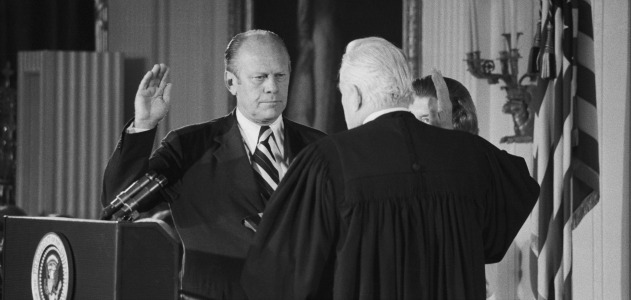
The words that form the title of this blog post came from the lips of Gerald R. Ford, 38th President of the United States.  You are forgiven for thinking that I was headed toward a discussion of Isaiah 1:17, Micah 6:8, or Matthew 23:23.  However, I would like to think that these and other texts of Scripture informed and inspired Ford’s speech following his inauguration as President on August 9, 1974.

Gerald R. Ford came to the Presidency of the United States following a series of events that were as unlikely as they were unfortunate.  Vice President Spiro Agnew resigned on October 10, 1973, in response to criminal charges of tax evasion and money laundering, charges to which Agnew pleaded no contest.  Agnew’s resignation led to the invoking of the vice-presidential vacancy provision of the 25th Amendment to the United States Constitution.  To fill the vacancy, President Richard M. Nixon nominated Ford, a 25-year Congressman from Michigan, who for the last 8 years had also served as House Minority Leader.  The U.S. Senate confirmed Ford with a 92 to 3 vote.  The U.S. House of Representatives followed with a confirmation vote of 387 to 35.

Gerald Ford was sworn in as Vice President on December 6, 1973.  When President Nixon resigned eight months later over his involvement in the Watergate scandal, Ford was sworn in as President of the United States on August 9, 1974, making him the first and only person in U.S. history to have served as both Vice President and President without having been elected by the Electoral College.

What do you say as the new political leader of the world’s most powerful country, knowing that no one had elected you to that office nor to the one you had just vacated to assume the Presidency?  Immediately after being sworn in by U.S. Supreme Court Chief Justice Warren Burger, President Ford addressed the nation in a live, televised speech.  His words were infused with humility and hope.  Several poignant excerpts appear below.

The oath that I have taken is the same oath that was taken by George Washington and by every President under the Constitution.  But I assume the Presidency under extraordinary circumstances never before experienced by Americans.  This is an hour of history that troubles our minds and hurts our hearts.

I am acutely aware that you have not elected me as your President by your ballots, and so I ask you to confirm me as your President with your prayers.  And I hope that such prayers will also be the first of many.

If you have not chosen me by secret ballot, neither have I gained office by any secret promises.  I have not campaigned either for the Presidency or the Vice Presidency.  I have not subscribed to any partisan platform.  I am indebted to no man, and only to one woman—my dear wife—as I begin this very difficult job.

I have not sought this enormous responsibility, but I will not shirk it.  Those who nominated and confirmed me as Vice President were my friends and are my friends.  They were of both parties, elected by all the people and acting under the Constitution in their name.  It is only fitting then that I should pledge to them and to you that I will be the President of all the people.

Even though this is late in an election year, there is no way we can go forward except together and no way anybody can win except by serving the people’s urgent needs.  We cannot stand still or slip backwards.  We must go forward now together.

In all my public and private acts as your President, I expect to follow my instincts of openness and candor with full confidence that honesty is always the best policy in the end.

Our Constitution works; our great Republic is a government of laws and not of men.  Here the people rule.  But there is a higher Power, by whatever name we honor Him, who ordains not only righteousness but love, not only justice but mercy.

As we bind up the internal wounds of Watergate, more painful and more poisonous than those of foreign wars, let us restore the golden rule to our political process, and let brotherly love purge our hearts of suspicion and of hate.

With all the strength and all the good sense I have gained from life, with all the confidence my family, my friends, and my dedicated staff impart to me, and with the good will of countless Americans I have encountered in recent visits to 40 States, I now solemnly reaffirm my promise I made to you last December 6: to uphold the Constitution, to do what is right as God gives me to see the right, and to do the very best I can for America.

God helping me, I will not let you down.

(Ford’s speech in its entirety, in both text and video, can be accessed here.)

It’s a shame that President Ford’s speech is frequently remembered only for his statement, “My fellow Americans, our long national nightmare is over.”  The speech was so much more substantive than that; and its themes remain relevant and extremely needful for our nation nearly 40 years later.

A call for prayer; an appeal to a Power higher than either the people or the government (don’t quibble over his terminology; he wasn’t being sworn in as a preacher, pastor, or pope); the divine ordinance of not only righteousness and justice, but also mercy and love; an appeal for the restoration of the golden rule and brotherly love in politics and the purging of suspicion and hate; patriotism above party.

May it be so!

In numerous worship assemblies this Sunday morning there will be a sincere, well-meaning soul who says something to the effect of:

“Let’s completely focus our minds on the sacrifice of Jesus Christ for our sins and remove all other worldly concerns from our hearts as we share in the bread and the wine.”

“Whatever else might be going on in our lives right now with our families, our work, our finances, or our health, let’s put these things out of our minds for the next few moments as we completely center our thoughts on the cross in remembrance of Jesus.”

For most of my life, I have heard statements similar to these shared in communion thoughts before the Lord’s Supper or expressed more indirectly in the prayers that are offered prior to sharing in the unleavened bread and the fruit of the vine.

Despite the sincerity and noble intentions of such admonitions for us to empty our minds of “worldly concerns” during this memorial feast, I would like to suggest that: 1) it isn’t possible, and 2) it isn’t necessary or advisable.

As to the possibility of self-induced, temporary amnesia, try this… don’t think about a banana… or your favorite sports team… or the name of your first pet.  How well did you do?  By merely mentioning “whatever else is going on in our lives right now,” our thoughts instantly lock on to our most pressing concern, the heaviest burden on our heart, our deepest pain, or the most recent source of our anxiety or guilt.  “So, now that you’ve identified it, stop thinking about it!”  Can we just instantly change channels like that?  I don’t think so.  But, here’s the cool thing: I don’t think we have to.

Let me clarify something, lest some readers misunderstand.

I completely agree that, in the solemnity and celebration of remembering the Christ who died for us, we dare not profane the feast and dishonor the Lamb by mere mechanical participation in the Lord’s Supper.  How tragic for us and how insulting to the Lord if our thoughts and sentiments are focused on self-absorbed trivialities like making grocery lists, checking Facebook, or adjusting the roster of our fantasy football team.  Regardless of your understanding of “unworthy manner” (“irreverently,” The Message) and “discerning the body of Christ,” surely this kind of trivialization of the bread and the cup (and the Savior’s body and blood which they represent) risks the guilt and judgment referenced in I Corinthians 11:26-29.

However, to suggest that our relationships, vocations, finances, and physical health are merely “secular” concerns which have “no place at the table” reinforces the erroneous notion of a compartmentalized faith in which our worship to God and our communion with Christ have nothing to do with “real life.”  On the contrary, there is no facet or aspect of my life that is to be exempt from His lordship.  “All He wants is all of me!”

So, bring your troubled marriage to the table as you remember the One who convicts and challenges us to sacrificially offer agape love to one another as husbands and wives, just as He did in laying down His life for His bride, the church.  Since God has declared the crucified and resurrected Jesus to be both Lord and Christ, let’s submit to His teaching and recommit ourselves to the hard work of “becoming one” and resolve to let nothing or no one separate what God has joined together.

How would the Christ who died for me want me to resolve a conflict at work?  How would He have me respond to a co-worker who has acted and spoken unreasonably and hurtfully against me.  Instead of engaging in a “mental block” about my relationships, wouldn’t the Teacher prefer, even during the Supper, that I “leave my offering before the altar,” walk across the assembly area, and be reconciled with an estranged brother or sister before I proceed any further with my worship?

In times of financial hardship and uncertain employment, I can be greatly encouraged by remembering that the Savior who bore my sins on the cross also taught me to trust in a heavenly Father who knows my needs and will provide for me just as He does the birds of the air and the lilies of the field.  He will never leave me or forsake me.

The Great Redeemer is also the Great Physician who not only cares for our souls, but acted so compassionately and mercifully toward those in physical need and pain.  Because of what He suffered, we have in Him a sympathetic, understanding High Priest through whom we can confidently approach the Father’s throne to receive mercy and find grace to help in time of need.

What better time is there for me to confess my sins through my Advocate, my atoning Sacrifice, my Passover, Jesus Christ the righteous, so that His blood, symbolized by the cup that I drink, will continue to cleanse me from all unrighteousness?  His sacrificial body and blood are the reason, the only reason, that I can live free and forgiven.

In all of this, primacy is still given to “proclaiming His death” through eating the bread and drinking the cup in remembrance of Him.  However, it is not merely a cognitive acknowledgment of a relationally remote death that is locked up in the annals of ancient history.  Rather, it is a memorial feast in which we praise, proclaim, and adore the Lamb of God, the Living Christ, the Conqueror of death, and the Hope of our own resurrection until the glorious day of His promised return.

Rather than seeking to temporarily ignore our burdens, doubts, struggles, and failings, let’s bring them with us to the foot of the cross.   As we remember the sacrificial body and blood of the Lord who saves us from sin, let us also lay claim to His power to redeem and restore whatever is burdening our hearts.

Let’s lay it all on the table!

A few days ago, I arrived for an appointment about 30 minutes early (I seriously overestimated the drive time on my inaugural visit), and I decided to use the lag time to browse around a nearby Books-a-Million.

As I typically do in large book retailers, I headed to the Religion Section so that I could be subjected to yet another self-inflicted dose of guilt and despair over how many books I haven’t read.  I live with a constant sense of “being behind” in my reading, and periodic visits to bookstores serve to insert a new exponent into the mathematical equation that expresses my utter hopelessness of ever catching up.  Christian publishers continue to churn out new volumes at a relentless pace, ensuring that I fade farther into the distance in their rear-view mirror.

This particular “walk of shame” through the imposing and intimidating aisles, however, struck me with an even more overwhelming sense of “what’s out there” in Christian publishing.  One entire side of an aisle was dedicated to the subject of Christian Living.  Mind you, this wasn’t Mardel or a Family Christian retail outlet, where I assume the titles are even more numerous.  This was a “secular” bookstore.  Across the aisle was the expansive General Religion section, which included such intriguing titles as The Dictionary of Demons: Names of the Damned, Hinduism for Dummies, and Paul Was Not a Christian: The Original Message of a Misunderstood Apostle.

But, the Christian Living collection?  Wow!  There were 5 shelves on each of the 7 mini-sections, for a total of 35 shelves.  A quick count on a couple of them led me to estimate that each shelf contained an average of 40 different titles.  Grand total (yes, I had to use the calculator on my phone): 1,400 books, each of which was authored with the intent of explaining some vital aspect of this thing called “the Christian life.”  Taking into account the embarrassingly low words-per-minute that I read, I would have to devote most of the rest of my life to “Christian reading” just to make it through those books.  There would be precious little time remaining for actual “Christian living.”  And this just represents current best-sellers, other recent publications, and those that have achieved the status of classic Christian literature.  Inventory and shelf space will have to be cleared for next year’s inevitably abundant crop of new books.

I’m extremely grateful for Christian authors, both ancient and contemporary, who write from a position of sincere faith in Jesus Christ and respect for the authority of the Word of God.  It’s a blessing that they share their study, research, knowledge, experience, humor, and gift of communication in order to broaden and deepen our understanding of Scripture and provide insights into how we can be transformed into more devoted disciples, ministers, leaders, husbands, wives, fathers, mothers, servants, citizens, and spiritual brothers and sisters.  We are much the better for it!

However, it’s good to be periodically reminded that Christian literature, while certainly able to enrich and enhance our life in Christ, is not essential to having a real, relevant, challenging, and meaningful relationship with Jesus.

So, you haven’t digested the Ante-Nicene, Nicene, and Post-Nicene Fathers?  You’ve never read Thomas Aquinas’ Summa Theologiæ or John Calvin’s Institutes of the Christian Religion?  Have you somehow managed to avoid Thomas à Kempis’ The Imitation of Christ, Dietrich Bonhoeffer’s The Cost of Discipleship, and The Seven Storey Mountain by Thomas Merton?  You’ve never read a single book authored by C.S. Lewis?  You’ve only read a handful of the hundreds of books authored by contemporary masters of devotion?  Do the latest issues of Christianity Today and Leadership Journal lie unopened on a side table in your study?  Do you rarely, if ever, read periodicals and teaching magazines from within your own brotherhood and fellowship of believers?

It’s okay!  Don’t be too hard on yourself.  The fact that you haven’t (or you don’t) shouldn’t cause you to feel like a second-class Christian.  And if you have or you do, please drop your air of spiritual superiority right here and right now.

Scripture is fully capable of leading us to faith in Jesus Christ and into a maturing, saving relationship with Him.  A more-than-sufficient challenge for Christian living is provided by the simple, yet daunting, commands to love the Lord our God with all of our heart, soul, mind, and strength, and our neighbors as ourselves.  The call to love my wife as Christ loves His church and to guide my children in the Lord’s discipline and instruction is enough to keep me from ever becoming complacent or haughty.  Ditto, the instruction to do justice, love kindness, and walk humbly with my God.  I recently shared a message on Colossians 3:12-17, and I stated that if the New Testament canon only consisted of the Gospels and these six verses of admonition, I would have plenty to keep me convicted and diligently occupied for the rest of my time on earth.

I was momentarily overwhelmed by the 1,400 reasons why I wasn’t sufficiently “making the grade” in my efforts to follow in the steps of Jesus.  However, I took comfort once again that, though tempted to be distracted, worried, and bothered about so many things, “only one thing is necessary” (Luke 10:38-42) and the essentials are so relatively few.

A couple of months ago I was asked to address the question, “What do you say to someone whose child died from cancer and they want to blame God?  Their sadness and their anger with God just seem to rule their life!” While I attempted to provide some counsel and direction regarding the immeasurable pain of this particular loss, the same principles would similarly apply to the entire sad spectrum of tragedies, hardships, and griefs that afflict human hearts.

Long before we concern ourselves with “what to say” to grief-stricken souls who are wrestling with anger toward God, we first need to focus on “what to do” for such a person, i.e., how we should respond to them, treat them, and minister to them.  Our “presence” and our actions of kindness and compassion should always precede our words, and completely substitute for them if necessary.  Show compassion, extend kindness, demonstrate humility, deal with them gently, and be patient with them (Colossians 3:12).

The emotions of those who have suffered soul-jarring and faith-shaking losses are very real and extremely raw.  What they feel is what they feel.  Their pain is deep.  Their grief is intense.  To attempt to get them to deny their emotions, to suppress their feelings, or to feel guilty about their anger will be completely unhelpful and counterproductive and will almost certainly ensure that you will not be welcomed to walk beside them throughout their long journey of grief.

While I will conclude with a few suggestions as to what words might be offered to accompany our deeds of compassion, let me first identify a few specific things not to say.

“Everything happens for a reason.”

No it doesn’t.  Not even close.  This is one of those statements that is almost in the Bible.  Though it may sound like an affirmation of unqualified faith in a sovereign God, in actuality it slanderously accuses God of cruelty and injustice and impugns His divine will.  Romans 8:28 is frequently used as a proof text for this unbiblical notion, but that passage doesn’t teach that all earthly outcomes are somehow the result of a micro-managing, manipulative Deity.  Read the passage carefully.  “Everything happens for a reason” is a quotation from Marilyn Monroe, not the Messiah.  Since I have written about this statement previously, I won’t further belabor the point here.  See “Everything Happens for a Reason, Right?” for a lengthier discussion and explanation.

“God won’t give you more than you can handle.”

Again, close, but no canon!  Almost in the Bible, but not!  What about I Corinthians 10:13?  What about it?  The specific subject of that verse is temptation (enticement to do evil), and it affirms that God will always provide a way of escape for us; that is, no spiritual lose-lose scenarios where our only recourse is to sin; there will be a way out of temptation, if we choose to take it.  But, that is theological light years away from saying, “God will never give you more than you can handle,” in regard to anything and everything in this life.  Such a statement suggests that God’s divine hand is on a celestial spigot of suffering, determining and divvying out tragedies and heartaches based on His assessment of our ability to “handle it.”  It is not only wrong and hurtful, but insulting, to suggest to someone that their immense suffering is somehow a divine “compliment.”

“God is in control.”

Ultimately, yes; God reigns supreme and unrivaled over the whole of His creation.  But a cosmic control freak who expressly and explicitly manipulates and maneuvers the actions and outcomes in the lives of 7.1 billion people?  No, no, a thousand times, no!!!  Offered as a response to a tragic loss, “God is in control,” comes across as yet another hollow platitude, and, worse, one that wrongfully lays the blame for our suffering squarely at the foot of God’s throne of grace.

“God has a plan.”          

Yes, He indeed does, but the death of their child was not a part of it.

“One day you’ll understand why; one day you’ll know the reason.”

No, they won’t.

If this is a person who you know and love, tell them how much they mean to you and how much your heart aches with them and for them.  Tell them how much you loved their child, and how much you miss them.  Tell them, “I can’t imagine the pain, the hurt, the sense of loss, and the anger that you are feeling.”  Unless, of course, you can!  But, even if you haven’t walked that particular road of pain yourself, you can connect them with others who have, who can help minister to them and who know precisely what they are experiencing.

Grief is a journey and a process, not an event.  Patiently love them and consistently demonstrate the Spirit of Jesus Christ.  When the time is right, assure them that God loves them, too.  Remind them that they can speak openly and honestly to God about what they are feeling.

Hopefully, in time, they will come to see how God can bring light even out of the darkest of nights, and out of our brokenness He can bring blessing.  He is not the Cause, but rather the Redeemer of our suffering.

Ultimately, however, it is not our job to convince them of these things; that will be their choice.  Our responsibility is to simply love them and minister to them.

Enter your email address to subscribe to this blog and receive notifications of new posts by email.

Join 175 other subscribers

Archives

February 2026
S M T W T F S
1234567
891011121314
15161718192021
22232425262728