A couple of months ago, I saw an online article with the headline, “Trio wrongfully convicted of murder released after 18 years in prison.”  I didn’t have time to read it at that moment, so I bookmarked the article for later reference.  I finally got around to reading it on Tuesday.  It seems that three New York men, Michael Cosme, Devon Ayers, and Carlos Perez, were released from prison on January 23.  They had been convicted in 1995 for the murder of a cab driver and a FedEx executive.  Recently, however, two gang members confessed to murdering the cab driver, and the remainder of the case against the three imprisoned men began to disintegrate.

Upon their release, the three men talked about the difficulty of being incarcerated for nearly two decades, during which they maintained their innocence and worked tirelessly to have their names cleared and the record set straight.  I can’t imagine the level of relief and elation that these men felt to finally be free men again and to look forward to rebuilding their lives and reuniting with family members and friends.

The headline in Scripture, however, reads, “Millions who were rightfully and justly convicted of sin against God are released from guilt, freed from condemnation, and set free from eternal punishment through Jesus Christ.”

Jesus releases the guilty, because there are no innocent ones (Psalm 14:1-3; Romans 3:23).  Jesus didn’t come to call the righteous (Luke 5:31-32), simply because there weren’t any to call; none of us were spiritually healthy; all of us were sick with sin and in need of healing from the Divine Doctor.

“For while we were still helpless, at the right time Christ died for the ungodly… But God demonstrates His own love toward us, in that while we were yet sinners, Christ died for us,” (Romans 5:6,8).

And, because of His victory over death that will be celebrated around the world this Easter Sunday, “He is able also to save forever those who draw near to God through Him, since He always lives to make intercession for them,” (Hebrews 7:25).

“Thanks be to God for His indescribable gift,” (II Corinthians 9:15).

The release of the guilty!  How incredible is that!

Have a blessed and happy Easter!

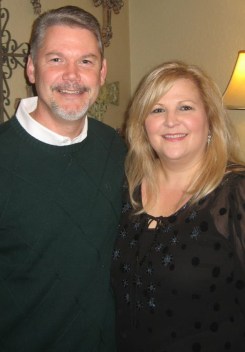
As of today, I’ve been married to Kim for half of my life!  25 years ago, on March 12, 1988, we became husband and wife.

The first 25 years of my life were spent living in various places around the country and around the world.  Ravenna, Ohio; Warrior, Alabama; Greenville, South Carolina; Louisville, Kentucky; Monrovia, Liberia; Richmond, Kentucky; Columbia, Tennessee; Lewisburg, Tennessee; Montgomery, Alabama; Nashville, Tennessee; and Gympie, Queensland, Australia.  After two years in Australia, I returned to the U.S. in August of 1987 with the intention of going to graduate school, getting a master’s degree, returning Down Under,  planting a church, and probably spending the rest of my life there.

That was Plan A.

I didn’t plan on meeting Kim.  In fact, our meeting was so preposterously unlikely, that neither of us could have seen it coming.  A week and a half after getting back on American soil, I met Kim at a Wednesday night church service in Florence, Alabama.  That’s another good reason to be there on Wednesday nights, boys and girls!  We met in late August, had our first date in September, and were married six months later on March 12.  While that’s not the precise road map to matrimony that I would recommend to everyone, my life hadn’t been very “textbook” up that point anyway, and it certainly hasn’t been since then!

The last 25 years with Kim have been such a blessing and an adventure.  In some ways, the time has flown by, especially when I consider that our children are now 22 and 20 years old.  But, in other respects, 25 years doesn’t seem sufficient to contain all of the people, places, events, circumstances, victories, defeats, joys, and disappointments that we have experienced in our life together.  Certain segments of the journey seem like unique lifetimes of their own.

Successful marriages are not built around fairy tale scenarios or flawlessness, just faithfulness.  They do not depend on perfection, but perseverance: enjoying the many good times, slogging your way through the periodic tough ones, catching your collective breath after a crisis to brace yourself for the next, and learning to both request and extend forgiveness.  That probably doesn’t sound very romantic or “seminar worthy,”  but it’s been our experience; it’s been our life.

Our journey has included several unexpected turns.  We are currently on Plan K or Plan L.  If God gives us another 25 years, we may well run out of letters.  Thankfully, the Greek and Hebrew alphabets are standing by in reserve should they be needed to designate subsequent chapters of the story.

There’s no way to adequately express what Kim means to me in such a brief blog post, but suffice it to say that, not only have I spent half of my life being married to her, she is half of my life.  That’s what it means when two people become one.  She is the other half of me.

Happy 25th Anniversary, Kim!

One of these days the ground will drop out from beneath your feet
One of these days your heart will stop and play its final beat
One of these days the clocks will stop and time won’t mean a thing
One of these days their bombs will drop and silence everything

One of these days your eyes will close and pain will disappear
One of these days you will forget to hope and learn to fear

Some of you younger readers will immediately recognize the lines above as lyrics from the song, “These Days,” released last year by Foo Fighters.  Some of you older readers just thought, “It was released last year by who?”  Actually, those in the G.I. and Silent Generations, who may have no knowledge at all of the U.S. rock band, may recall that the term “foo fighter” was used by Allied pilots during World War II to describe fiery, unidentified flying objects encountered during combat and reconnaissance missions.  Who knew, right?

Anyway, as I was listening to this song on the radio the other day, it caused me to think about the brevity of life and the certainty of Christ’s return.  I have no idea what Foo Fighters front man Dave Grohl had in mind when he wrote the song.  The verses segue into a chorus that focuses on the concepts of hearts being broken and pride being stolen, so my guess is that he was far more concerned about human relationships and emotions than spiritual relationships and eschatology.  Still, there is a lot of truth in these lyrics.  Unless the Lord comes back first, “one of these days my heart will stop and play its final beat.”  When Christ does return, “the clocks will stop and time won’t mean a thing.”

I do think I know, however, what another Dave (King David) had in mind when he wrote the following:

Lord, remind me how brief my time on earth will be.
Remind me that my days are numbered –
how fleeting my life is.
You have made my life no longer than the width of my hand.
My entire lifetime is just a moment to you;
at best, each of us is but a breath.

(Psalm 39:4-5)

“I don’t wanna die; there’s no future in it!”  So said Curly Howard in a rerun of “The Three Stooges” that I saw a couple of weeks ago.  Call me juvenile, but those guys can still make me laugh; out loud; really loud!

I hate to take issue with someone as scholarly and insightful as Curly, but life’s uncertainties and death’s imminence are not causes for alarm or anxiety among believers in Christ, for the precise reason that we believe there is indeed a future in death: resurrection and eternity glory.

We need to live each day as if it could be our last, because it very well could be.  We need to realize that Jesus will return on a day just like today.

“So teach us to number our days, that we may present to You a heart of wisdom,” (Psalm 90:12).

Come, Lord Jesus!

Today is our son Coleman’s 20th birthday, which is a miracle and a blessing on so many different levels.  I have periodically blogged about the countless ways in which Coleman has taught us, challenged us, inspired us, amazed us, sent us to our knees in prayer (both in petitions and thanksgivings), filled our eyes with tears, our hearts with joy, and our voices with laughter.   Despite Coleman’s autism, Dubowitz Syndrome, and developmental disabilities, God has faithfully demonstrated over and over again how His power and providence can bring blessings and beauty out of brokenness.  Coleman remains an incomparable and irreplaceable blessing in our lives.

As I reflect today on the course of Coleman’s 20-year journey, I want to express love, admiration, praise, and appreciation to someone who has been integrally involved in his life from the day of his birth.

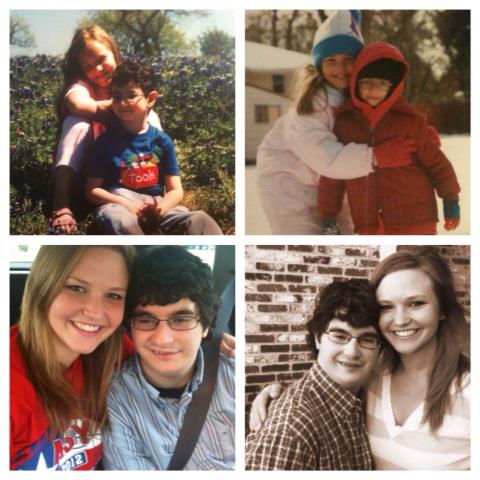
Our daughter Hannah was almost 2 and 1/2 years old when Coleman was born.  She was plenty old enough to know that Mommy was going to be having a baby, and she was thrilled to know that she would have a little brother.  Since Coleman was born fairly early in the morning, I was able to bring Hannah up to the hospital late that evening to officially welcome her brother into the family.  Since that day, “Baby Coleman” has had an unparalleled guardian and guide in his big sister.

By the time Hannah was four or five, she was aware of the fact that Coleman was somewhat different from her friends’ younger siblings.  Throughout Coleman’s multiple hospitalizations with pneumonia, ongoing treatment for neutropenia, and periodic trips to the National Institutes of Health, Hannah was as resilient and unflappable as a young child could be.  She was a regular recipient of our “Go with the Flow” award.  While we sought to keep life as “normal” for her as possible, Hannah would often pass on invitations and offers for special trips or activities if Coleman was not going to be able to participate.  She preferred to have him with her, whatever that might or might not entail.  The fact that Coleman could never verbally communicate with her never stopped her from talking to him… constantly!  We have joked (only slightly) that one of the reasons Coleman remained non-verbal was that he never really got a chance to talk!

For 20 years, Hannah has been a vital part of every aspect of Coleman’s care and comfort.  More than just a big sister, she has been like a third parent to him, although he periodically reminds her that he knows the difference!  Coleman’s unique circumstances caused Hannah to grow up, mature, and take on responsibilities far beyond her years.  She has fed him, bathed him, dressed him, put on his AFO braces and shoes, washed his clothes, picked up his room, kept up with his glasses and now his hearing aids, driven him to therapy sessions, gotten him off the school bus and off to sleep.  She knows all of the nuances of his own special dialect of sign language.  She has always been so gentle and patient with him.

Coleman could not have a more ardent defender than he does in Hannah!  I have seen her face redden, her back straighten, and her arm around his shoulder tighten when she encountered someone who “just didn’t get it.”  I recall being in a mall in Texas several years ago and seeing Hannah’s wrath unleashed on a woman who, unfortunately for her, couldn’t manage to break free from her slack-jawed staring at Coleman as they passed in the concourse.  I took the opportunity to do the dutiful, Christian, “parently” thing in telling Hannah that, while I appreciated her protectiveness of her brother, it really wasn’t cool to call someone out in public like that.  Still, I couldn’t help from feeling extremely proud of her, and also somewhat sorry for the lady who had no idea what she was walking into and quickly skulked away!

Coleman has noticeably missed Hannah since she was has been away at college.  He brightens up, even more than normal, when she is at home.  He stashes her suitcase in her closet in an effort to prolong her visits.  He evoked tears from all of us when he retrieved her suitcase from her car as she was loading up to head back to school a few months ago.  They share a special bond that will never be broken.  This must be exactly what God had in mind when He urged “brotherly love” among the members of His spiritual family.

Hannah’s preparation for a career in nursing seems so fitting and natural.  She has had a lifetime of experience already.

I love you, Hannah, for so many reasons.  Your relationship with Coleman is right at the top of that very long list.  Thanks for blessing his life in so many wonderful ways!

“In India, we have a saying: ‘Everything will be all right in the end.’  So, if it’s not all right, it’s not yet the end.”

So goes the response of the irrepressibly optimistic Sonny, the aspiring hotelier, to his dissatisfied guests in last year’s surprise hit movie, The Best Exotic Marigold Hotel.  Though I assume it was entirely unintended, Sonny’s expression of confidence in the future reflects a sentiment that is very much at the heart of Christian hope and faith.

I don’t have to convince you that “it’s not all right” in this world.  Beyond the global concerns of numerous wars and regions of famine throughout the world, and national worries about violence, crime, and a struggling economy, our personal lives can sometimes be a total mess.  God does not provide Christians with exemption cards or pass chips that shield us from chronic illnesses, unemployment, broken relationships, betrayal, or mistreatment by others.  “In the world you will have tribulation,” (John 16:33).  You nailed that one, Lord!  This isn’t a “chance of rain – 40%” kind of prediction; it’s a given; Jesus practically promised that things are going to be tough.

We hurt.  We have disappointments, both in ourselves and in others.  We get discouraged.  We get tired.  Just when we start catching some wind in our sails, something or someone comes along and knocks the legs out from under us, resulting in a solid, mixed metaphoric kick in the gut.

But, we’re not there yet!

Scripture reminds us that “everything will be all right in the end.”  Granted, there are some days when those words come across like a toothless, impotent platitude that utterly fails to sooth the soul or dull the pain.  But, deep down I believe and know that one day, God is going to call a halt to all of this temporal nonsense, and suffering is going to be victoriously swallowed up by glory.

After His heads-up about life’s hardships, Jesus went on to supply the antidote for our anxieties.

“I have said these things to you, that in me you may have peace.  In the world you will have tribulation.  But take heart; I have overcome the world,” (John 16:33).

“For I consider that the sufferings of this present time are not worth comparing with the glory that is to be revealed to us,” (Romans 8:18).

“So we do not lose heart.  Though our outer self is wasting away, our inner self is being renewed day by day.  For this light momentary affliction is preparing for us an eternal weight of glory beyond all comparison,” (II Corinthians 4:16-17).

I’ve got a room booked at the Best Eternal Celestial Hotel (John 14:1-3).  I can endure a few more bumps in the road along the journey, and I will patiently persevere while I’m waiting for check-in time to arrive!

I caught a glimpse of myself in the mirror yesterday and was struck by my ashen complexion.  It may have been the brightly lit room, the color of my sweater, the graying of my hair,  my recent lack of sleep, or a conspiracy involving all of these factors.  Most likely, however, my paleness was due to the fact that we are only a few weeks removed from the winter solstice and several months away from the onset of summer.  This typical, seasonal washing out of my skin has removed all traces of last summer’s tan.  It is not unusual each winter for at least a few people to inquire about my health.  “Are you okay?  You don’t look like you feel very well.”  “Oh, it’s nothing serious,” I reply, “just January!”

My reflection in the mirror evoked the title of Procol Harum’s classic hit, “A Whiter Shade of Pale.”  I could hear the haunting Hammond organ melody of the song, along with Gary Brooker’s soulful vocals, playing in my head.  As I hummed along, I thought, “I really need some sun.”  It will still be quite some time though before I’m doing weekly lawn work, jogging in the afternoon heat, and enjoying a periodic round of golf.  This is just going to be my color for a while.

It is extremely evident when someone has been in the sun.  Even in these days of heightened awareness about the dangers of overexposure to the “greater light’s” rays and the increased use of protective sunscreen, it is still quite common to hear someone say, “Wow!  You’ve really gotten some sun.”

Regular exposure to “the Son” should have a similar effect on our spirit and produce observable evidence of our proximity to the Savior.  He is indeed the true Light of the world who gives light to everyone (John 1:1-9).

“I am the Light of the world; he who follows Me will not walk in darkness, but will have the Light of life,” (John 8:12).

“…but now you are light in the Lord; walk as children of Light, for the fruit of the Light consists in all goodness and righteousness and truth,” (Ephesians 5:8-9).

The effect of exposure to His Divine Light should cause people to “recognize that we have been with Jesus,” (Acts 4:13).

I indicated in my last post that I want to focus on gaining spiritual weight.  In the same way, I need to work on my “spiritual tan” by “walking in the Light,” (I John 1:7).

Yesterday’s trip down a musical memory lane led me to several online performances of “A Whiter Shade of Pale,” including this impressive instrumental version below by an incredibly talented young guitarist from South Korea, Sungha Jung.  If you enjoy Jung’s artistry, you can visit his official website.

How much should I weigh as a Christian?

In recent months, I have become a bit obsessive about stepping onto the bathroom scales every morning before I shower.  It is a daily, self-imposed accountability routine that confirms either the success or failure of my efforts to control my weight.

In my late 30s and throughout most of my 40s, I carried more weight than I should have.  The frequency and intensity of my exercise regimen waned significantly during those years due to nagging knee problems, and far too often I found myself eating because of nervousness or stress.  However, in the last couple of years I have managed to reverse this trend and begin dropping some pounds.  While I still have quite a way to go to reach my target weight, I feel that it is at least within sight, and I am much more thoughtful (intentional!) about menu selections and portion sizes.

A couple of months ago, I took a personal challenge to try to weigh the same or less on January 1 as I did in mid-November, seeking to safely navigate the culinary minefield that surrounds Thanksgiving, Christmas, and the multitude of festive, calorie-laden gatherings in between those holidays.  I was very fastidious at first, but succumbed to “the nibbles” during a few days off at home at the end of December, resulting in a New Year’s weigh-in that was a pound and a half heavier.  In the two weeks that have followed, I have let my guard down even further, reverting to a “grazing pattern” during the evening hours in which I make counter-productive raids on the pantry and refrigerator.  “Be sure your sin will find you out”; in my case, to the tune of another two or three pounds.

On mornings that follow a snacking binge, I struggle with whether or not to get on the scale.  If I do, I know that undeniable evidence of my lack of discipline will be glaring upward toward my face in angry, red digital numbers.  It is really strange that, despite my knowledge that this is just an inanimate electronic device, I feel the urge to “hide” my actions from it, dreading its judgment, condescension, and mockery.  I don’t want to be reminded that indulgence has triumphed over self-control.  In reality, the scale is an extremely consistent, reliable, and objective means of assessing how well I am progressing toward my goal.

But, enough about my physical weight.  How much should I weigh as a Christian?

“We need to stop counting Christians and start weighing them!”

I jotted down that quote a few months ago, and for the life of me I cannot remember where I came across it.  I am very conscientious about crediting sources, and it seriously bugs me that I can’t properly acknowledge the wisdom and insight of the author who issued this timely call to focus less on numerical church growth and more on spiritual maturity and substantive discipleship.  When I confirm the source of the quotation, I will edit this post accordingly.

Faith, goodness, knowledge, self-control, perseverance, godliness, brotherly kindness, and love.  “If you possess these qualities in increasing measure…” (I Peter 2:5-9).  Increasing measure!  What if these Christian graces had some sort of quantifiable mass?  Ideally, I would be gaining spiritual weight and expanding my girth of grace and godliness!

Diet and exercise?  These are essential as well, but they work inversely to their physical counterparts, ensuring that one can pack on those needed spiritual pounds.  “For everyone who partakes only of milk is not accustomed to the word of righteousness, for he is an infant.  But solid food is for the mature, who because of practice have their senses trained (exercised) to discern good and evil,” (Hebrews 5:13-14).

How do I assess how I’m doing?  The mirror test can be helpful, looking intently and regularly into Christ’s law of liberty (James 1:23-25).  Honestly gazing into the mirror of the Word, just like looking at the verdict of the bathroom scale, can be a humbling and convicting indicator of whether spiritual disciplines or worldly indulgences have had the upper hand in my life.  When weighing on the scales of maturity and discernment, I don’t want to discover a Belshazzar-esque deficiency (Daniel 5:27) that keeps me classified as a spiritual flyweight or featherweight.

Am I as serious and obsessive about gaining spiritual weight as I am with losing physical weight?

“Blessed are those who hunger and thirst for righteousness…,” (Matthew 5:6).

“As the deer pants for the water brooks, so my soul pants for You, O God.  My soul thirsts for God…,” (Psalm 42:1-2).

Stay thirsty, my friends!

I have a natural aversion to buzzwords.  While they are employed with great frequency throughout our society, it is Christian culture in particular that seems to be the most fertile buzzword breeding ground on the planet.  If you want to be taken seriously as a cutting-edge disciple or hailed as a spiritual sage, it is imperative that you pepper your parlance with a proficient mastery of the latest, hippest, coded vocabulary.

Are you being missional?  Relational?  Attractional?  Incarnational?  Authentic?  Relevant?  Transparent?  Do you have the confidence and comfort level to abandon the use of definite and indefinite articles when speaking about categorical concepts such as “story” and “community?”

“Buzz-Saw Louie” was the name of the highly prized and advertised toy in the cleverly written (weren’t they all?) VeggieTales episode, “The Toy That Saved Christmas.”  “Buzzword Louie” (or “Louise”) is the epithet that invariably pops into my head when I encounter a speaker or writer who seems intent on setting a new world record for the highest buzzword to word count ratio.  I have to consciously work against the gravitational pull of judgmentally attributing their choice of words to either shallowness or pretentiousness.  I know that sounds really harsh and surly, but I’m just trying to be “transparent” here!  In truth, I have to be extremely “intentional” about it.  Segue…!!!

Despite being up-to-date on all of my buzzword vaccinations, “intentional” is a term that has somehow managed to breach my defenses, infiltrate my system, and take root in my thinking.  Initially, the word and its cognates were met with my typical “first responder” attitude of smart-alecky cynicism.  “Are you living intentionally, Tim?”  Yeah, pretty much!  I “meant to do” just about everything I did today!

Maybe it’s maturity (I hope so) or the Holy Spirit (I hope so), but I have begun to give “intentionality” a chance.  I have moved beyond my first blush, dismissive (arrogant, perhaps?) reactionism, and have come to the realization that I could genuinely benefit spiritually, emotionally, and physically by living more intentionally.

I have come to realize that much of my life has been spent merely reacting to things that were going on around me.  Don’t get me wrong.  I think I have done a fairly decent job of it, but shouldn’t there be more to life than just “responding well” to what is being dictated by others or thrown at me by forces and circumstances beyond my control?  Is that really life or just existence?

I don’t want to live my life incidentally or accidentally.  I don’t want to just “take it as it comes” and follow the path of least resistance.  I want to live my life “on purpose”  and “with purpose” when it comes to deepening my relationship with Jesus and strengthening relationships with my wife, my children, my friends, brothers and sisters in Christ, etc.  I want to be “deliberate” in my prayer life, study, evangelism, and service to others.  I realize more than ever that none of these things are ever going to “just happen.”

So, sign me up for being more intentional in 2013.  I may even go “all in” and start playing buzzword bingo, but only in a way that is truly authentic and relevant.

the passage 2

As I stepped out into the still, cold December air the other evening, I looked up into the cloudless night sky and was treated to a sight that I haven’t seen in a long time: a ring around a brilliant full moon.  Yes, I understand that, astronomically speaking, there really wasn’t a ring around the moon.  What I saw was just an optical, atmospheric phenomenon caused by high altitude ice crystals refracting the moonlight.  Yes, yes, I know that “moonlight” is technically sunlight being reflected toward Earth by the lunar surface.  Thank you, Sheldon Cooper!  Just let me call it a ring around the moon, okay!

Upon seeing this halo of light in the sky, I instantly began to recall (and soon thereafter began to sing) the opening lyrics of an old Dan Fogelberg song, “In the Passage,” which begins, “There’s a ring around the moon tonight, and a chill in the air.”  I muddled and mumbled my way through the lines that followed until I got to the chorus: “And in the passage from the cradle to the grave, we are born, madly dancing.  Rushing headlong through the crashing of the days, we run on and on without a backwards glance.”  It has been years since I have heard that song, which appeared on Fogelberg’s epic 1981 album, The Innocent Age.  I’ll comment at a later time on music’s incredible ability to permanently etch itself into our hearts, minds, and memories.

“The passage from the cradle to the grave…”

Maybe it was because the end of another year was fast approaching, or perhaps because I reached the half-century mark a couple of months ago, but for whatever reasons I found myself ruminating for quite a while on this “cradle to the grave” imagery.  I’m farther along in that passage than I have ever been before.  Given the “seventy years, or if due to strength, eighty years” of Psalm 90:10, I’m most likely well beyond the 50-yard line in my march toward the end zone.

The run-up to the New Year always brings a host of retrospectives that recount the deaths of notable individuals during the year.  This year, in particular, it struck me that an entire generation or two of people with whom I have been familiar since childhood were passing away:  Neil Armstrong, Dick Clark, Earl Scruggs, Davy Jones, Larry Hagman, Robin Gibb, Andy Griffith, Ernest Borgnine, George Lindsey, Doc Watson, Levon Helm, Jack Klugman, and many others.  Each of these was memorable to me for different reasons.  I began to ponder how my grandmother, Louetta Pyles, must have felt at the age of 101 when all of her contemporaries and those with whom she grew up were gone.

The takeaway for me from all of these considerations was a reminder of just how precious our time on this planet is.  Each day is a gift from God (James 4:14-15).  Moments are far too valuable to be wasted on regrets, bitterness, jealousy, grudges, pettiness, and trivialities.  It was a wake-up call to “number my days” (Psalm 90:12) and “make the most of every opportunity” (Ephesians 5:16).

Live, love, learn, serve, give, teach, pray, support, encourage, grow, correct, confess, forgive, embrace, laugh, weep, wait, etc.  These are the things that I want to dominate my days until I cross the goal line or until the Lord returns.  I just want to be ready whenever He decides to blow the whistle (or trumpet) and signal the end of the game.

When Coleman was five months old, a neurologist at Vanderbilt University Medical Center in Nashville told us that he thought our son might be deaf, given his unresponsiveness to voices and the fact that he would not “startle” at the sound of loud noises.  Having already received diagnoses of neutropenia and Dubowitz Syndrome that week, we weren’t sure how much more bad news we could take.

The neurologist ordered an ABR (auditory brainstem response) in which electrodes are placed on the scalp to measure brain wave activity in response to the introduction of sound.  Results: Coleman’s hearing was near perfect!  He was just locked in his own little world and would respond (or not) if and when he chose to do so.  While many questions about Coleman’s future remained, hearing loss was removed as a variable in the equation, that is, until just a few months ago.

A word of counsel for you fellow husbands and fathers out there: never underestimate the power and the accuracy of a mother’s intuition.

Kim mentioned to me a few months back that she was afraid that Coleman was experiencing a decreasing ability to hear.  I had absolutely no idea what she was talking about.  How can you tell when a non-verbal child is losing his hearing?  Coleman’s behavior and responses seemed exactly the same as far as my perception was concerned.  He still chuckled when I whistled, and he laughed all over when I did my “insider routine” of rapidly saying, “One, two, three, four… Johnny Bravo… whut, whut, whut… bumpity, bumpity, bump… uhhh, uhhh, uhhh,” followed by a sustained whistle.  (That’s the best description I can offer right now.)  He also responded with appropriate signs or actions when I made requests or asked him questions.

Yet, Kim noticed that Coleman was confusing like-sounding words.  When she would say “bird,”  he would often sign “verb.”  You might be wondering why Coleman would have a sign for that particular part of speech.  It’s actually his sign for the song “Verb: That’s What’s Happenin'” in the Schoolhouse Rock! animated educational series which he watches over and over and over.

Kim went with her hunch and scheduled an appointment at the Scholl Center in Tulsa.  An initial evaluation led to an ABR, the preliminary results of which indicated hearing loss, but of an indeterminate level due to Coleman’s activity during the procedure.  The most accurate assessment could only be made if he were under anesthesia and completely still.  As providence would have it, Coleman’s sedation dentistry procedure was coming up soon since it had been delayed due to the guardianship issue (see “Guardians“).  This allowed time for Meredith (our incredible, favorite audiologist!) to coordinate things with the dentist (Dr. Evan Clothier, another blessing from God) and the surgical center so that she could perform the ABR prior to the dental procedure, thus avoiding additional anesthesia.

The ABR under sedation confirmed an assessment of moderate hearing loss, right in middle of the scale between mild and severe, and a recommendation of hearing aids was made.  Kim and I took Coleman soon afterward to have impressions made for the earmold portion of the behind-the-ear (BTE) devices.  We were very apprehensive about how well Coleman would handle wearing hearing aids.  For many years, he has demonstrated a behavioral habit of pressing his index fingers into his ears, which has nothing to do with the volume of ambient noises.  Rather, it seems to be a comfort measure in which the pressure is soothing to him.

The big test came on Tuesday, December 18, when Kim, Hannah, and I accompanied Coleman to pick up the hearing aids and receive instruction on their use.  Meredith gave us a tutorial on the devices and explained that the volume had been preset and locked based on Coleman’s ABR results.  Then, she and I simultaneously placed the hearing aids in and behind Coleman’s ears, turned them on, and waited on the 10-second delay for them to power up.

The look on Coleman’s face changed immediately when the hearing aids came on.  His expression was one of contemplation and discovery.  After a minute or so, Meredith prompted Kim to ask Coleman who loved him.  This is a question that never fails to draw a response of the only sequential syllabic sounds that Coleman has ever been able to make, “Ma-ma.”  “Coleman, who loves you,” Kim asked.  For the first time in his life, Coleman whispered.  It was almost like a faint breath with his lips moving.  “Ma-ma.”  He instantly processed the fact that he was hearing things much more distinctly than he had been, and he was wading in ever so tentatively, not knowing exactly how his voice would sound.  Laughter and tears were shared around the room.

With only three school days left before the Christmas break, we decided not to send Coleman back to school with the hearing aids; better to let him adjust to them at home over the holidays, rather than risk him ditching them in a trash can, toilet, or some other place that he has been known to deposit his non-favorite things.  I will hold off for now on sharing the initial instances when Coleman stealthily and fluidly popped the hearing aids out as soon as our backs were turned, one time squirreling them away under our bed.  It took us 20 minutes to discover that particular hiding place.

However, since those first few trials and errors, Coleman has adjusted wonderfully to the hearing aids, far beyond our most optimistic expectations.  We’re still not out of the woods yet, but the battle that we feared has not materialized.  He seems to have embraced the ability to hear with greater clarity.  The snugness of the earmolds is apparently satisfying his sensory need for pressure, and he is consistently keeping his fingers away from his ears, reversing a behavior that I had just assumed would always be a part of his “Coleman-ness.”

Yet again, Coleman’s resilience and perseverance have amazed and inspired us.  God keeps blessing him in new and profound ways, and Coleman, in turn, keeps blessing us.

Enter your email address to subscribe to this blog and receive notifications of new posts by email.

Join 175 other subscribers

Archives

February 2026
S M T W T F S
1234567
891011121314
15161718192021
22232425262728