As I was mowing my backyard in the late afternoon one day last week, I was startled by movement that I detected out of my peripheral vision to the right.  I kept pushing the mower and turned my head fully in that direction, but no longer saw anything.  On the return trip across the yard, I noticed the same thing at exactly the same spot, but this time to my left.   I stopped, backed up a few steps, and discovered that a faint shadow of my body appeared if I stood within the confines of a very small space.

You may be thinking, “Tim, are you saying that you were unaware of the phenomenon of shadows?  They’ve been around for quite a while, you know!”  No, smarty pants, I’m quite familiar with shadows; just not those that are cast toward the west in the late afternoon.  That’s right!  My shadow was being cast toward the setting sun!

A brief investigation of my surroundings revealed that, although a dark, distinct shadow of my body was being cast toward the east by the afternoon sun, a lighter, lesser shadow was being cast toward the west by the sun’s reflection in an upstairs window on the back of the house.  Mystery solved!

The dueling shadows (one greater, one lesser) were created by two lights (one greater, one lesser).  In actuality, the sun was the only true source of light; the cause of my westward-leaning shadow was a mere reflection of the sun.

In the same way, Jesus is the only true light of the world (John 1:4-9; 8:12; 9:5).  He is the only One who has the power to deliver us from spiritual darkness.  Yet, as His disciples, we are called to reflect His divine light.  In that sense, Jesus could say that we are the light of the world and are to let our light shine in such a way that people are drawn to glorify our heavenly Father (Matthew 5:14-16).

Even though John the Baptist was not “the Light” (John 1:6-8), he was still “a light” through his testimony about Jesus.   Jesus said of John, “He was the lamp that was burning and was shining and you were willing to rejoice for a while in his light,” (John 5:35).

Are we reflecting enough of the Light of the World to make a difference?  Are we walking as children of light (Ephesians 4:8-15) in a way that will catch someone’s attention and direct their curiosity toward the Son?

Are we casting any shadows?

Michael Whitworth.  The Derision of Heaven: A Guide to Daniel. Bowie, Texas: Start2Finish Books, 2013. 194 pages.

In the early 1990s, I had the pleasure of getting acquainted with Michael Whitworth’s father, Daniel, when he was working with a nationwide evangelistic outreach ministry.  So, years later when I met Michael in the summer of 2008, I felt an immediate connection with him.  Michael impressed me greatly at that first meeting five years ago as a multi-talented, intelligent, and passionate disciple of Jesus Christ.  Little did I know then that he was also a very diligent researcher and an extremely gifted writer.

Michael sent me an advance copy of his latest book a few weeks ago and asked if would provide a brief review on my blog, a request to which I readily and happily agreed.  The Old Testament book of Daniel has long been a favorite of mine in preaching and teaching.  I’m always eager to explore new approaches and fresh insights into this challenging and faith-affirming prophetic text.

The Derision of Heaven is written in an engaging style that I would describe as “well-researched casual,” which makes for a very compelling read.  It is quite evident that Michael did his homework in preparing this guidebook to the study of Daniel.  His bibliography of sources includes a very generous supply of widely known and highly respected conservative, evangelical Biblical scholars.  A few of his sources will be familiar primarily to readers among Churches of Christ.

The body of the text is heavily footnoted, which is further evidence of the author’s thorough research.  Many of the footnotes do not merely provide source citations, but also include more detailed discussion and explanation, making them well worth the time to read and digest.  The text is also amply filled with parenthetical cross-references which invite deeper comparative study with other sections of Scripture.

Michael’s recommendations for dealing with the apocalyptic portions of Daniel (i.e., don’t force literalness, don’t be dogmatic, and don’t miss the forest for the trees) are admirably respected even in the historical narrative sections of the book.  He openly acknowledges points at which the interpretation of the text is seriously debated and where even conservative scholars find themselves in significant disagreement.  Michael humbly offers his most honest and studied insight into the passage without dogmatically demanding agreement on every detail as a test of one’s faith in God or confidence in the inspiration of Scripture.

Michael champions the message of the book of Daniel as one that, even after the passage of 2,500 years, is enduringly relevant to a church that is as much in exile in this world as the Jewish nation was in Babylon.  American Christians, in particular, are cautioned by the author against the idol of nationalism.  He references “Christians who seem prouder to be an American than a member of the church, God’s eternal kingdom, one that cannot be shaken (Heb. 12:28).  It’s not a sin to be a patriot unless patriotism becomes your idol.  I wonder if some Christians aren’t bigger fans of the Constitution than the gospel.”  Statements like this, along with his contention that “even the Constitution is imperfect,” will certainly challenge and unsettle many conservative Christians who have become too much a part of the political world in which we live.

Michael’s regular insertion of humor into his treatment of the text generally works in positive fashion to keep the discussion personal and contemporary.  However, it occasionally seems misplaced, which is an admittedly subjective evaluation.  Also, his understanding of God’s active work among the geo-political affairs of men (including a “chessboard” analogy) is much more explicit and “hands on” than my own thinking on the subject.  However, since the workings of the Almighty’s will and providence in this world transcend human scrutiny, he may well be right and I may be wrong about the matter.

Each chapter ends with a few “Talking Points” that are ideal for discussion-oriented Bible classes and small group studies, as well as for personal reflection and application.

Whether you are needing a fresh and insightful reminder of the power and contemporary relevance of the familiar stories contained in Daniel 1-6 or an introduction to the less frequently studied apocalyptic visions of Daniel 7-12, I highly recommend The Derision of Heaven for your reading and study.

This time last week the Internet was abuzz with widespread denunciations, head-shaking, and finger-wagging over Miley Cyrus’ performance at the MTV Video Music Awards on Sunday, August 25.  By all accounts, both secular and religious, it was an over-the-top, beyond the pale, unabashedly lewd performance.  No, I haven’t seen the video, and won’t be seeing it.   Thanks for asking, though!

I read several responses (and responses to responses) on blogs and Facebook; some were thoughtfully written, others were less helpful.  “Twerking” was introduced into the vocabulary of those of us who live somewhat culturally sheltered lives.  On a lighter note in this serious discussion, Cyrus’ VMA incident elicited a mention on NPR’s Wait Wait… Don’t Tell Me! on Saturday.  Host Peter Sagal explained, “Twerking, for all you Public Radio listeners, is a kind of suggestive dance that’s big in the clubs right now.  But, it’s the same sort of thing we’ve had for years.  It’s what our parents would have called a grand mal seizure.”

I both can and can’t understand the level of response that Cyrus’ performance precipitated.  First of all, anyone who willfully chooses to watch the MTV Video Music Awards has implicitly forfeited any right to be morally shocked, offended, or outraged.  Don’t plead ignorance here.  MTV?  The VMAs?  You were expecting a Scottish Highlands sword dance, maybe?  Secondly, I’m confident that multitudes of conscientious, moral people intentionally viewed the performance after the fact, fully aware of the nature of the content, just so they would know exactly how upset and incensed they should be.  “I can’t comment on it unless I’ve seen it!”  Really?  You should probably unscrew the cap on your home’s sewer clean out line just to make sure it stinks.  Check it out and let me know!

Don’t misunderstand!  I’m not at all questioning whether or not the performance was morally offensive.  I am, however, concerned about our near constant state of moral outrage, how it is affecting our spiritual well-being, and what is being communicating to others who are “listening” to us on social media.

As if anticipating the Miley Cyrus flap, the September issue of Christianity Today features a wonderful editorial by Katelyn Beaty entitled, “Hungry for Outrage.”  It is subtitled, “Indignation is the discourse du jour on the Internet.  We can do better.”  Below are a few excerpts.

“Call it the tart deliciousness of moral outrage.  From mayors’ sex scandals to pastors’ oddball comments to judges’ incoherent rulings, we are reminded 24/7 of the extent of human folly.  If anything, a nonstop news cycle gives us nonstop proof that sin pervades every person and institution.”

“When justice is dashed and human dignity is maimed, anger is our right response.  But what we do with that anger is the line between wisdom and our own folly.  Increasingly, it seems, many of us are using it to show our social media and blog followers that we are on the right side of contentious issues.  Who knew that being offended tasted so good.”

“I wonder if at the root of our Internet outrage is the need to show that we are righteous – specifically, more righteous than others.”

God created us with the capacity for moral outrage.  Such indignation serves the global village, as well as our local communities, by crying out against reigns of terror by despotic dictators, human trafficking, the insatiable greed of white-collar criminals, political corruption, senseless violent crime, and general, societal moral decay.

However, the technology of our age has created relentless exposure to an endless array of potential targets for our anger.  News of evil, injustice, and immorality is instantaneously available to us from sources that literally span the globe.  We can barely process one before we are informed of the next.  Many websites and Internet news feeds seem to exist for the sole purpose of fueling an already raging fire, keeping us perpetually “fed up,” agitated, and primed to sound off on the matter.  We are suffering from “indignation overload,” and I don’t believe that we were wired to perpetually bear that kind of emotional burden.

Because the news of events is communicated instantly, we feel compelled to respond in the same way.  We have to weigh in with extreme urgency and immediacy; precious seconds are ticking away.  People need to know where we stand.  Our silence will be interpreted as apathy, at best, or as agreement and endorsement, at worst.  The result is often a “ready, fire, aim” response which lacks the benefit of all of the facts and the helpfulness of insights that come from slowly distilled, thoughtful reflection.  I know!  “Ain’t nobody got time for that, Tim!”

I fear that outrage has become an addiction for many people of faith.  I’m caused to wonder if certain endorphins are released when we feel anger over a just cause; an emotional, pseudo-spiritual “rush” that just keeps us coming back for more.  In order for us to feel “righteous,” has it become essential that “indignation” be an inseparable companion?  “God, I thank you that I am not like other people: swindlers, unjust, adulterers… twerkers.”  Reread the context of Luke 18:9-14 to be reminded of why Jesus told this parable.

The more I am consumed by moral outrage, the less time I have to dwell on those things that are “true, honorable, right, pure, lovely, and of good repute; things that are excellent and worthy of praise,” (Philippians 4:8).

Last week’s outrage?  That particular bubble seems to have already burst.  A scan of my Facebook news feed resulted in nary a mention, and a Google search indicated that the tsunami of articles had subsided by the weekend.  Oh, of course!  College football was in full swing by then!  Who knows what fresh outrage the coming week will bring?

I hope that there were as many prayers offered for Miley Cyrus as there were laments over the fall of Hannah Montana.  In light of the accompanying bashing that was directed toward her parents, I offered a prayer of thanksgiving on behalf of the rest of us that the moral failings of our own children are not broadcast globally for public derision and condemnation.  For that, we can truly be thankful.

Many of you who read this blog will be gathering together with other Christians this morning to offer worship and praise to God.  However, no two people in your assembly will be in the exact same frame of mind, condition of heart, or state of emotion.  Unity as a spiritual body and being “of one accord” as Christ’s church does not mean that we are an undifferentiated, monolithic mass of Christians who think and feel just like everyone else or who will experience the worship assembly in exactly the same way.

Some of us are filled with joy and expectation this morning.  Things are going very well in our lives right now.  We are employed, and happily so.  There is “peace in the valley” in our marital and parental relationships and among our friends.  We are feeling healthy, wealthy (relatively speaking anyway), and wise.  If that’s the case for you, then praise God!  I mean it.  Praise Him!   Thank Him!  “Men shall speak of the power of Your awesome acts, and I will tell of Your greatness.  They shall eagerly utter the memory of Your abundant goodness, and shall shout joyfully of Your righteousness,” (Psalm 145:6-7).

Some of our hearts are filled with fear and doubt.  I completely understand.  Faith and doubt co-exist in constant tension during our journey in the steps of Jesus.  Some days, faith has the upper hand; at other times, doubt appears to be winning the day.  If that is the case for you this morning, freely and openly acknowledge those feelings to the Lord .  He knows that we’re feeling that way anyway, so why try to hide it?  Join with the frantic father who, wrestling with faith, said to Jesus, “I do believe; help my unbelief,” (Mark 9:24).

Some of us are feeling anxious, worried, and stressed.  We are still seeking a job after an extended period of unemployment, or we’re concerned about the stability of our workplace.  We are experiencing difficulties in our marriage or strained relationships with other people in our family.   Responsibilities just seem to keep piling up on top of us, and we feel increasingly more overwhelmed, further behind, and unable to cope.  Lay these burdens before the throne of God this morning.  “Be anxious for nothing, but in everything by prayer and supplication with thanksgiving let your requests be made known to God,” (Philippians 4:6); “casting all your anxiety on Him, because He cares for you,” (I Peter 5:7).  Hang on!  Keep trusting!

Some of us are hurting today from the physical pain and discomfort of a chronic illness or degenerative disease.  Others are extremely weak and feeling totally wiped out because of ongoing cancer treatment.  Others are feeling numb and lost this morning because of the recent death of the person who sat beside them and held their hand every Sunday morning for over fifty years.  If you’re just not up to being around other people today, I get it!  May the Father of mercies and the God of all comfort grant you peace and strength to endure.  May He hasten the day when sorrow and pain will be no more, death will be swallowed up in victory, and His gentle, loving hand will wipe away every tear from our eyes.

Some of us are angry this morning, either at someone or about something that happened in our life this week.  It’s natural to experience this intense emotion, but we need to process it, work through it, talk about it, get over it, and forgive whoever we need to forgive.  Otherwise, bitterness will consume us from the inside out.  “In your anger do not sin.  Do not let the sun go down while you are still angry,” (Ephesians 4:26); “the anger of man does not achieve the righteousness of God,” (James 1:20).

Some of us are feeling guilty this morning because of sin in our life.  Been there, done that, too!  Allow the God of salvation and the blood of Jesus Christ to take care of that for you!  “I acknowledged my sin to You, and my iniquity I did not hide; I said, ‘I will confess my transgressions to the Lord’; and You forgave the guilt of my sin.  How blessed is he whose transgression is forgiven, whose sin is covered!” (Psalm 32:5, 1).

As we bless His holy name today from places that are scattered all across the emotional map, may His blessings fall upon each of us according to our need!

Today is the 50th anniversary of Martin Luther King Jr.’s “I Have A Dream” speech which was delivered on the National Mall before a crowd of 200,000 people.  What follows below is a slighted edited version of a blog post that I wrote three and half years ago.

I was less than a year old when Martin Luther King Jr. stood in front of the Lincoln Memorial and delivered his powerful and inspiring “I Have a Dream” speech during the March on Washington on August 28, 1963.  It would be a decade later before I first read the speech and began to understand why it is considered to be among the most notable and influential in American history.  King dreamed of a day when America would “rise up and live out the true meaning of its creed: We hold these truths to be self-evident, that all men are created equal.”  He dreamed of a day when his four children would live in a nation “where they will not be judged by the color of their skin, but by the content of their character.”  Over the last 50 years, much of King’s dream has been realized, but much still remains to be fulfilled.

I consider it a blessing that, even though I grew up mainly in the Deep South, I was shielded in my early years from the pervasive poison of racism by parents whose behavior and language treated all people with dignity and respect, regardless of the color of their skin.  As a young boy, I accompanied my father to black churches where he had appointments to preach.  When my parents served as missionaries in Liberia, West Africa, in the early 1970s, I attended the American Cooperative School (ACS) which had an international student body.  There were a dozen or more nationalities represented in my class.  In the fourth and fifth grade, I had a huge crush on a young lady named Zinnah Holmes, the prettiest girl in the class and also the best athlete, male or female.  Upon returning to central Kentucky in 1974, I showed a friend my yearbook and acknowledged my affection for Zinnah.  His response was, “Tim, she’s black.”  Either I had never noticed, or it never mattered.

As I grew older, my naiveté gave way to the sad realities of racism and the tragic role that slavery had played in American history.  Even the brilliant Thomas Jefferson, the chief architect of the Declaration of Independence which celebrated the equality and unalienable rights of all men, found a way to morally justify the holding of a multitude of slaves.  I heard racial epithets and the propagation of senseless stereotypes.  In the basement of a building at the Christian university I attended, there was a door which still bore the imprint of a sign which had read “Colored Men.”  It was the door to a separate restroom.  The sign was gone, but the evidence of past inequities remained.  Early in our marriage, Kim worked for a family, providing childcare and doing some light house cleaning.  In straightening the master bedroom one day, she found Klan pamphlets and propaganda under the edge of the bed.  She quit that day, out of both fear and disgust.

I am very grateful that I have lived to see African Americans serve at the highest levels of our national government, including the Supreme Court and the Presidency.  I believe that Martin Luther King  Jr. would be proud of such progress.  But, there is still much to be accomplished in erasing the vestiges of prejudice and racism.  King once lamented that 11 o’clock on Sunday morning was the nation’s most racially segregated hour, the worship hour in America’s churches.  The truth of that observation hasn’t changed much over the last five decades.

I pray that the dream is still alive.  And I pray that my heart, language, and actions will help it become more fully realized.

Did you see the story about the man who was found living in a grocery store?  Store managers had no idea how long he may have been using the business as a residence.  He very likely would have continued to escape discovery if he had not been found passed out from dehydration and malnourishment.  That’s right!  His body was emaciated from an extended period of having no solid food or liquids.  His deteriorated physical condition remains an inexplicable mystery, especially since he was surrounded by a vast array of fresh produce, hundreds of ready-to-eat food products, and an entire aisle of juices and soft drinks.  The man was transported to a local hospital and put on an aggressive regimen of IV fluids.  Doctors are cautiously optimistic that he will make a full recovery.

Isn’t that incredible?  Do you find it hard to fathom how something like this could occur?  Well, there’s a reason for that.  I made the whole thing up; it never happened.  Who knows?  Maybe this story will soon appear on Snopes.com!  I completely fabricated the previous paragraph, not for the purpose of deceiving anyone, but in an effort to make a point.  While I’ve never heard of anything like this happening in a physical way, it regularly happens in epidemic proportions in a spiritual sense.

If you are friends with me on Facebook, you know that I inadvertently baptized my old cell phone in the Gulf of Mexico last week.  Alas, it didn’t survive the experience, so I upgraded to my very first iPhone.  Being a complete smartphone novice, I asked my FB friends to suggest mobile apps that they found to be especially useful and helpful.  Among the many wonderful recommendations that I received were those for numerous Bible apps.

This reminded me just how ubiquitously available the Word of God is to those of us who are blessed to live in the Western world.  Go to any Christian bookstore and you will find a massive wall of Bibles in every conceivable format and the full gamut of contemporary English translations.  The digital age has far surpassed Gutenberg’s dream by making the Spirit’s sword electronically accessible with the click of a mouse on our laptops or the touch of a finger on our tablets and phones.  We are literally (and cyberly) surrounded by a veritable and virtual mega-mart of food for our souls.

In such a marvelous age as this, what a tragedy if we suffer from “a famine throughout the land – not a famine of food or a thirst for water, but a famine of hearing the words of the Lord,” (Amos 8:11).

Fabricated story or not, don’t be that guy!

24 - 7

Early last Thursday morning, I drove Coleman out to Sand Springs to the American Therapeutic Riding Center for his weekly appointment with Buster, the Quarter Horse who faithfully and sure-footedly serves as a steady mount for his 30-minute therapy session.  Even though plenty of staff members and volunteers are always on hand, I’m grateful that the folks at ATRC indulge me and allow me to side-walk with Coleman.  It’s a father-son activity that we have enjoyed together for many years now, going all the way back to the early days at SpiritHorse Therapy near Denton, Texas.

One of the persistent challenges for Coleman while riding is keeping both hands on the reins.  It’s not that he is careless, disinterested, or unbalanced in the saddle; far from it!  The problem is that he likes to “talk,” which, for Coleman, involves the use of his hands.  He might sign “bird” (when he hears one chirping outside the arena), “rain” (if he hears it thunder or if I say “rein”), or “tickle” (for no apparent reason other than wanting to be tickled).  However, the signs that he can be counted on to make multiple times throughout the therapy session are “hamburger” and “soda.”  He wants to make sure that on our way home I don’t forget his obligatory reward meal of a burger (doesn’t matter where from, just plain with mustard) and a Dr. Pepper (has to be Dr. Pepper, although we opt for Diet whenever possible; our choice, not his!).

Where can you get a hamburger at 9:00 in the morning?  Jack in the Box!  As we pulled up to the drive-thru window on Thursday to pay for and pick up Coleman’s food, I noticed their Hours of Operation sign.  It was a standard sign that had a vertical list of the days of the week on the left, with parallel Open and Closed columns to the right.  In each of the available time slots, the sign simply read “24 Hours.”  I had forgotten that Jack in the Box was open 24 hours a day, 7 days a week.  They never close.  If you want a Sourdough Jack at 2:30 a.m., they’ll make one for you.  If you have a craving for Seasoned Curly Fries or Stuffed Jalapenos in the middle of the afternoon, they’ve got you covered.  You can go weeks or months without ever thinking about them or visiting their restaurant, and they are still there, non-stop, all day, no breaks.

We serve a 24/7 God!

I lift up my eyes to the mountains –
where does my help come from?
 My help comes from the Lord,
the Maker of heaven and earth. 

He will not let your foot slip –
he who watches over you will not slumber;
 indeed, he who watches over Israel
will neither slumber nor sleep.

Psalm 121:1-4

It is so comforting to know that, as the I AM, our God and Father does not waver, wane, diminish, or weaken, not in the least and not even for a moment, in His sovereignty, love, care, and provision for His children.  He is never distracted.  He never becomes disinterested.  As a Creator with infinite knowledge, presence, and power, He attends to my needs as if I were His only child.  He knows me just as intimately as He does the other 7.1 billion souls on this planet who have been created in His image.

When I busily focus my attention on my work, my family, and my comfort, and forget to acknowledge Him, consider Him, or speak to Him, He is there nonetheless.  I can completely ignore Him or even mock the notion of His very existence, and He still knows me and loves me.

When I sleep, He is awake.

In peace I will lie down and sleep,
for you alone, Lord,
make me dwell in safety.

Psalm 4:8

When I awake,
 I am still with You.

Psalm 139:18

I’m grateful for a 24/7 God!

On Tuesday of last week, April 16, a significant anniversary was marked in our nation’s history.  The observance was largely (and understandably) overshadowed by tragic events that occurred the day before and the day after.  On Monday, April 15, two bombs exploded near the finish line of the Boston Marathon, killing three and injuring nearly three hundred.  This cowardly act of hatred and domestic terrorism dominated the week’s news with a massive manhunt in the city of Boston, culminating in the death of one suspect and the dramatic capture of the other on Friday.  On Wednesday, April 17, a massive explosion at a fertilizer plant in West, Texas, inflicted unbelievable destruction and shattered the tranquility of this tight-knit community.  At present, the death toll stands at fifteen, with others still unaccounted for and over two hundred injured.

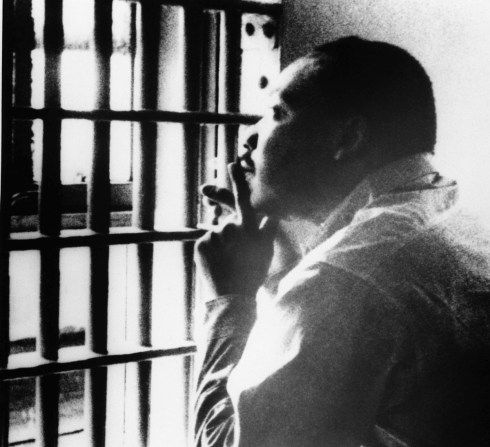
Sandwiched in between these two devastating events last week was the 50th anniversary of the penning of a letter by Martin Luther King, Jr. on April 16, 1963, from inside the Birmingham City Jail.  King and others had been arrested four days earlier for defying an injunction against “parading, demonstrating, boycotting, trespassing and picketing.”  King and his fellow demonstrators had continued their non-violent acts of civil disobedience in protesting racial inequality, Jim Crow laws, violence against black Americans, and institutionalized segregation in the South.  While in jail, King was given a copy of a local newspaper that contained a statement written by eight white Alabama clergymen, entitled “A Call for Unity,” which criticized King and other civil rights activists for their “unwise and untimely” activities in Birmingham.  King was moved to right an open letter in response their criticisms and mischaracterizations of his efforts.

I was five and a half months old when Martin Luther King, Jr. wrote what came to be known as the “Letter from Birmingham Jail.”  My family would soon move to Warrior, Alabama, just twenty-five miles north of Birmingham.  It is still hard for me to fathom that such racial injustice existed in my lifetime and that, just a few miles down the road from where I was sleeping safely and soundly in my bed, other Americans were being beaten, mauled by attack dogs, and pummeled by water cannons.  Just three months before King’s arrest in Birmingham, George Wallace, the newly elected governor of Alabama, defiantly stated in his inaugural address on January 14, “In the name of the greatest people that have ever trod this earth, I draw the line in the dust and toss the gauntlet before the feet of tyranny, and I say segregation now, segregation tomorrow, segregation forever.”

And where were the leaders of many white churches?  Either shamefully and fearfully silent, or, like the authors of “A Call for Unity,” inexplicably seeking to make a “Christian case” against the civil rights movement.

King’s “Letter from Birmingham Jail” is truthful, touching, convicting, poignant, wise, and masterfully crafted.  You can read it in its entirety by clicking here, but I have included some especially powerful excerpts below.

But more basically, I am in Birmingham because injustice is here.  Just as the prophets of the eighth century B.C. left their villages and carried their “thus saith the Lord” far beyond the boundaries of their home towns, and just as the Apostle Paul left his village of Tarsus and carried the gospel of Jesus Christ to the far corners of the Greco-Roman world, so am I compelled to carry the gospel of freedom beyond my own home town.  Like Paul, I must constantly respond to the Macedonian call for aid!

Injustice anywhere is a threat to justice everywhere.  We are caught in an inescapable network of mutuality, tied in a single garment of destiny.  Whatever affects one directly, affects all indirectly.

You may well ask:  “Why direct action?  Why sit-ins, marches, and so forth?  Isn’t negotiation a better path?”  You are quite right in calling for negotiation.  Indeed, this is the very purpose of direct action.  Nonviolent direct action seeks to create such a crisis and foster such a tension that a community which has constantly refused to negotiate is forced to confront the issue.  It seeks to so dramatize the issue that it can no longer be ignored.

Frankly, I have yet to engage in a direct-action campaign that was “well timed” in the view of those who have not suffered unduly from the disease of segregation.  For years now I have heard the word “Wait!”  It rings in the ear of every Negro with piercing familiarity.  This “Wait” has almost always meant “Never.”  We must come to see, with one of our distinguished jurists, that “justice too long delayed is justice denied.”

One may ask:  “How can you advocate breaking some laws and obeying others?”  The answer lies in the fact that there are two types of laws: just and unjust.  I would be the first to advocate obeying just laws.  One has not only a legal but a moral responsibility to obey just laws.  Conversely, one has a moral responsibility to disobey unjust laws.  I would agree with St. Augustine that “an unjust law is no law at all.”

I hope you are able to see the distinction I am trying to point out.  In no sense do I advocate evading or defying the law, as would the rabid segregationist.  That would lead to anarchy.  One who breaks an unjust law must do so openly, lovingly, and with a willingness to accept the penalty.  I submit that an individual who breaks a law that conscience tells him is unjust, and who willingly accepts the penalty of imprisonment in order to arouse the conscience of the community over its injustice, is in reality expressing the highest respect for law.

Shallow understanding from people of good will is more frustrating that absolute misunderstanding from people of ill will.  Lukewarm acceptance is much more bewildering that outright rejection.

But though I was initially disappointed at being categorized as an extremist, as I continued to think about the matter I gradually gained a measure of satisfaction from the label.  Was not Jesus an extremist for love:  “Love your enemies, bless them that curse you, do good to them that hate you, and pray for them which despitefully use you, and persecute you.”  Was not Amos an extremist for justice:  “Let justice roll down like waters and righteousness like an ever-flowing stream.”  Was not Paul an extremist for the Christian gospel:  “I bear in my body the marks of the Lord Jesus.”  Was not Martin Luther an extremist:  “Here I stand; I cannot do otherwise, so help me God.”  And John Bunyan:  “I will stay in jail to the end of my days before I make a butchery of my conscience.”  And Abraham Lincoln:  “This nation cannot survive half slave and half free.”  And Thomas Jefferson:  “We hold these truths to be self-evident, that all men are created equal…”

So the question is not whether we will be extremists, but what kind of extremists we will be.  Will we be extremists for hate or for love?  Will we be extremists for the preservation of injustice or for the extension of justice?

Never before have I written so long a letter.  I’m afraid it is much too long to take your precious time.  I can assure you that it would have been much shorter if I had been writing from a comfortable desk, but what else can one do when he is alone in a narrow jail cell, other than write long letters, think long thoughts, and pray long prayers?

I hope this letter finds you strong in the faith.  I also hope that circumstances will soon make it possible for me to meet each of you, not as an integrationist or a civil-rights leader but as a fellow clergyman and a Christian brother.  Let us all hope that the dark clouds of racial prejudice will soon pass away and the deep fog of misunderstanding will be lifted from our fear drenched communities, and in some not too distant tomorrow the radiant stars of love and brotherhood will shine over our great nation with all their scintillating beauty.


Yours for the cause of Peace and Brotherhood,

Martin Luther King, Jr.

Three years ago on Martin Luther King, Jr. Day, I posted “He Had A Dream” as a tribute to King’s influence and legacy.  It is noteworthy that 50 years after King wrote his letter from a Birmingham jail, an African-American is serving his second term as the President of the United States.  There are certainly those within our nation who oppose President Obama, but I sincerely pray that they choose to do so on the basis of his politics and policies and not the pigmentation of his skin.

Let us all hope that the dark clouds of racial prejudice will soon pass away and the deep fog of misunderstanding will be lifted from our fear drenched communities, and in some not too distant tomorrow the radiant stars of love and brotherhood will shine over our great nation with all their scintillating beauty.

It was about this time last year that I saw my first bald eagle in the wild while driving Coleman out to his horseback riding session at American Therapeutic Riding Center between Sand Springs and Keystone Lake.  I was ecstatic!  Since then, just in the past year, I have seen seven.  About six weeks ago, Kim, Coleman, and I took a scenic drive one Saturday afternoon.  We drove nearly to the Arkansas line and then wound our way down Highway 10 to Tahlequah.  Between Tahlequah and Fort Gibson, we pulled off on the roadside for about 30 minutes and watched three bald eagles as they fed on something in a pasture.  A three-fer!!!

However, my most incredible eagle sighting came just last week as, once again, Coleman and I were traveling along Highway 412, this time on the return trip from his riding session.  In the distance, I saw something that at first I thought must have been a kite (the man-made recreational kind, not the bird of prey) with a long tail extending below it.  As we drove closer, it became apparent that it was an eagle, but I still could not identify what was dangling from its clutched talons.  A huge, writhing snake, maybe?  As the eagle soared over the highway just ahead of us, I could clearly see that it was carrying a tree branch, probably four to five feet in length, with several smaller branches and twigs protruding from it.  It was truly an amazing sight, almost a “run-off-the-road-watching-it” kind of amazing!  The eagle was taking the branch to its nest, perhaps the one that is easily visible on Wekiwa Road that runs close to the Arkansas River.

Eagles’ nests are huge, ranging from five to nine feet in diameter.  Eagles were created with the divinely programmed instincts and abilities necessary to build these homes, but it still takes a massive amount time and effort on their part to construct such sturdy and durable aeries.

We humans, also, have been known to expend substantial amounts of time, effort, and resources on our “nests,” the homes in which we are blessed to live while on this earth.  That is all well, fine, and good (as long we keep it in perspective and within our means), but it would be wise for us to periodically assess how much we are investing, comparatively speaking, in preparation for our eternal home.

Like Abraham, we are “looking for the city which has foundations, whose architect and builder is God,” (Hebrews 11:10).  We are booking eternal accommodations in rooms prepared by Christ Himself in the Father’s house (John 14:2-3).  Our earthly houses can be destroyed by fire, flood, or wind; thieves can break in and steal our worldly possessions.  That is why we store up our treasures and invest our hearts in heaven, beyond the reach of thugs and thieves (Matthew 6:19-21), in a “building from God, a house not made with hands, eternal in the heavens,” (II Corinthians 5:1).

“Instruct those who are rich in this present world not to be conceited or to fix their hope on the uncertainty of riches, but on God, who richly supplies us with all things to enjoy.  Instruct them to do good, to be rich in good works, to be generous and ready to share, storing up for themselves the treasure of a good foundation for the future, so that they may take hold of that which is life indeed,” (I Timothy 6:17-19).

Some glad morning I’ll fly away, just like that eagle, to be at home with the Lord.

“The farmer waits for the precious produce of the soil, being patient about it, until it gets the early and late rains,” (James 5:7).

I am only a “raised garden bed” kind of farmer, but patience was in short supply over the last few weeks as I have fretfully looked for signs of life in our potato bed.  I had dutifully planted the potatoes in mid-February, well within the parameters of the planting guidelines recommended for Zone 7, which is the USDA Plant Hardiness Zone in which I live.  Mock me if you will for knowing that, but I’m serious about wanting to eat some homegrown Yukon Gold potatoes again this summer.

Six weeks had passed since planting them on February 16, with no emergence of the potato plants.  Had I planted them too early?  Was it still just too cold?  Was it lack of moisture?  Did I inadvertently plant them at an improper depth?  Had the neighborhood cats dug them up as they have repeatedly scratched around in what they have apparently mistaken for an 8 ft. x 4 ft. litter box?

Relief from my anxiety came last weekend.  Rain arrived in the Tulsa area on Friday evening.  After an exceptionally dry winter and with an ongoing drought in the region, it was wonderful to experience the sights and sounds of a good thunderstorm again: bright flashes of lightning, house-rattling claps of thunder, the clinking of tiny hailstones ricocheting off the windows, and the roar of heavy rain on the roof.

After another steady shower on Saturday morning, the clouds dispersed, a blue sky appeared, and the brilliant afternoon sun warmed the air well into the 70s.  That’s when I noticed that several of the potato plants had breached the earth above them, just barely exposing the tops of their little noggins.  God’s foolproof equation of seed, soil, water, light, and warmth had triumphed again.  Other plants around the lawn symbiotically joined in this Divinely choreographed renewal of life.  The iris blades, evidencing a deeper green, stood more erect and appeared to be several inches taller.  The dwarf Japanese maple sported tiny, but uniform, new growth that wasn’t there the day before; the weeping mulberry followed suit on Sunday morning.

Doubts were removed; faith was restored; hope was renewed.

What a perfect weekend for Easter Sunday!

Just as God’s unfailing promise of “seedtime and harvest, and cold and heat, and summer and winter” (Genesis 8:22) brings “life from death” each Spring, so the resurrection of Jesus Christ guarantees for us that “death isn’t terminal.”  “I am the resurrection and the life,” Jesus said.  “He who believes in Me will live even if he dies,” (John 11:25).

I Corinthians 15 declares the centrality and essentiality of the resurrection of Jesus Christ to the Christian faith; everything stands or falls with the empty tomb.  The apostle Paul even used a “seed” analogy in his systematic case for our resurrection.

But someone will ask, “How are the dead raised?  With what kind of body will they come?”  How foolish!  What you sow does not come to life unless it dies.  When you sow, you do not plant the body that will be, but just a seed, perhaps of wheat or of something else.  But God gives it a body as he has determined, and to each kind of seed he gives its own body…  So will it be with the resurrection of the dead. The body that is sown is perishable, it is raised imperishable;  it is sown in dishonor, it is raised in glory; it is sown in weakness, it is raised in power; it is sown a natural body, it is raised a spiritual body. (I Cor. 15:35-38, 42-44)

As surely as Jesus Christ was raised from the dead, so we will be!

“Be patient, then, brothers and sisters, until the Lord’s coming. See how the farmer waits for the land to yield its valuable crop, patiently waiting for the autumn and spring rains. You too, be patient and stand firm, because the Lord’s coming is near.” (James 5:7-8)

Doubts are removed; faith is restored; hope is renewed.

Enter your email address to subscribe to this blog and receive notifications of new posts by email.

Join 175 other subscribers

Archives

February 2026
S M T W T F S
1234567
891011121314
15161718192021
22232425262728