I received some questions about the photo that accompanied my post, “True Confessions,” that appeared last Thursday.  I actually cropped that image out of the larger photograph above.  Even this one has been cropped; there is much more water visible in the foreground of the original. 

I was given a copy of this photograph by Nelda Swenson, a member of the McDermott Road church in Plano, Texas, where I served as the preaching minister for nine years.  Nelda found the picture in a family Bible that had belonged to her grandmother or great-grandmother (sorry, Nelda, I can’t remember which one it was).  There was no indication on the photo as to when and where it was taken, but Nelda’s assumption was that it was somewhere in East Texas.  The timeframe looks to be in the late 1800s.  

There is almost complete uniformity in the clothing that was worn by the 200 or so people who had gathered for this baptismal service.  Women and girls are in white dresses; the men sport dark pants and coats with white shirts; the boys are dressed like the men, minus the coats.  The crowd is segregated by gender, with women and girls on one end and men and boys on the other.

In the close-up view below, you can clearly see the minister with his right hand raised and his left hand likely resting on the shoulder or arm of the man about to be immersed.  I am not sure when this tradition arose, but I distinctly remember my father doing the exact same thing every time I witnessed him baptize someone into Christ.  Just before baptizing them, Dad would raise his hand, bow his head slightly, and proclaim in a very powerful, prayer-like tone, “Upon your confession of Jesus Christ as the Son of God, I now baptize you in the name of the Father, the Son, and the Holy Spirit!”  To my knowledge, “lifting up his hand” in this manner was very traditionally and culturally accepted in the church and was never considered to be an issue or a controversial practice.

I really love old photographs like this.  What thoughts or emotions does it evoke for you?  What “story” do you see in the picture?

I was baptized into Christ on a cold, January night in 1973.  I remember so very well the feeling of conviction that I experienced during the sermon that Sunday morning, the deep yearning that I had for the blood of Jesus to wash away my sins, the conversation with my father that afternoon, and, after services that evening, the drive to a nearby town where there was a church building with a heated baptistery.  I remember in great detail nearly everything about that joyful night, except my confession of faith in Jesus Christ as God’s Son and the expression of my desire to receive Him in obedient faith as my Lord and Savior.  Why doesn’t my profession of faith in Christ stand out more clearly in my mind?  I imagine it is because my confession most likely consisted of a one-word, affirmative response to a question from the minister.  The question was probably asked much like the following:  “Do you believe with all of your heart that Jesus Christ is the Son of God?”

According to Jesus and His apostles, our confession of Christ is a vitally significant part of our faith response to the grace of God and our acceptance of His salvation.  In keeping with Peter’s confession that He was “the Christ, the Son of the living God” (Matt. 16:16), Jesus said that our unashamed, public confession of Him would result in Him owning and confessing us before His Father in heaven (Matt. 10:32-33) and before the angels of God (Luke 12:8).  Early Christian converts not only confessed their belief in Jesus as God’s Divine Son, but also professed their acceptance of Him as “Lord” (Master, Ruler, Sovereign) of their hearts and lives (Rom. 10:9-10; I Cor. 12:3 ).  Their confession was intrinsically connected with the concept of “calling on the name of the Lord” for salvation (Rom. 10:9-13), and so it is only natural that this profession would be made at the time of their baptism (Acts 22:16).  Paul recalls how Timothy had “made the good confession in the presence of many witnesses,” (I Tim. 6:12).  How did something so significant, powerful, courageous, and convicted get reduced, formalized, and ritualized into saying, “Yes,” in response to a question?

The words of the question that I was asked before my baptism can be found in Acts 8:37 in the King James Version.  If you are reading an NIV or one of several other newer English translations, you will be hard pressed to find verse 37.  In fact, you will notice that the sequence of the verse numbers in this section of the chapter is … 35, 36, 38, 39…!  You may have verse 37 in a footnote or perhaps bracketed within the text, as in the NASB.  Bottom line: some well-meaning copyist in the second century felt like a confession from the Ethiopian treasurer would certainly have been appropriate before his baptism, so he either wrote verse 37 in the margin of the manuscript or maybe just boldly inserted it directly into the text as he wrote.  The overwhelming evidence from early manuscripts of Acts indicates that verse 37 was not original in Luke’s record.  Still, the confession, “I believe that Jesus Christ is the Son of God,” undoubtedly reflects a common, accepted, historical baptismal confession.  But, even then, notice that the words are not framed in the form of a question that was asked; it was a confession that was made! 

In many of our churches, we commonly refer to “taking” someone’s confession before they are baptized.  When did we start “taking” confessions instead of “making” them?  It is not unusual for the one facilitating a baptism to talk (sometimes at great length) about the significance of the believer’s decision, the joy of the occasion, and what it means to them as a father, minister, elder, or friend to be able to baptize the person, while the one who is putting their faith into action, trusting in Jesus, being buried and raised with Christ, forgiven of sin, redeemed, added to God’s church, and indwelled by the Holy Spirit gets to say, “Yes.” 

For many years now, I have asked those who desire to be immersed into Christ to “make” their confession of faith in Him.  The power of tradition being what it is, I will still honor their desire to merely answer a question if that is what they expressly request, but I always explain what I believe to be the Biblical example of early Christians.   “Yes” just seems to be a far inferior substitute for the opportunity to proudly and enthusiastically “confess with your mouth Jesus as Lord,” (Rom. 10:9).

What is the most common practice where you worship?  Why do you think we started “taking” confessions instead of “making” them?     


I believe

In 2008, the state legislature of South Carolina approved a bill that provided for the production of specialty license plates that included the phrase “I Believe” and the image of a cross in front of a stained glass window.  Lieutenant Governor Andre Bauer had championed the legislation and sought to ensure the creation of the new plate design through state law rather than the normal process of application with the Department of Motor Vehicles.  Objections and legal challenges to the license plates were almost immediate.  Last week, U.S. District Judge Cameron Currie ruled that the plates were unconstitutional on the basis that they violated the prohibition of the government’s establishment of religion.  The Associated Press reported that Judge Currie wrote in her decision, “Such a law amounts to a state endorsement of not only religion in general, but of a specific sect in particular…The statute is clearly unconstitutional and defense of its implementation has embroiled the state in unnecessary (and expensive) litigation.”

Many believers in Jesus Christ will no doubt see this decision as a defeat, a slap in the face to Christian faith, more evidence of the advancing secularization of our culture, and an effort to create “freedom from religion” in America rather than “freedom of religion.”  To a degree, I can sympathize with those feelings.  After all, these are just license plates.  A quick review of the South Carolina DMV website revealed that, as is the case in most states, you can get specialty license plates related to a vast multitude of organizations and causes.  There are specialty plates for in-state and out-of-state universities, decorated military service, fraternal organizations, NASCAR (even specific drivers), and Parrotheads (fans of Jimmy Buffett, for the uninitiated).  Through your license plate, you can proclaim your support of education, the environment, endangered species, and homeownership.  You can clarify whether you are affiliated with the Ancient Free Masons or the Ancient Free and Accepted Masons (I don’t have a clue what the difference is).  If you object to the “In God We Trust” plate or the “Choose Life” plate, you can opt for the one sponsored by the Secular Humanists of the Low Country which reads, “In Reason We Trust.”  With that much water already under the specialty plate bridge in South Carolina, it doesn’t seem that the addition of “I Believe” and a cross to the mix would cause such an uproar.

On the other hand, I have no real need (or interest, for that matter) to proclaim through a state-issued metal rectangle on the back of my car that I believe that Jesus Christ is the Divine, Resurrected Son of God and that He is my Redeemer, Savior, Lord, and Friend.  If my life, language, behavior, attitude, and love of others aren’t already proclaiming that, then I’m afraid a specialty tag is not going to enhance my witness all that much.  In fact, Judge Currie may have done Christians a huge favor by her ruling.  I can’t imagine any real evangelistic impact that would have resulted from the plates, or that hearts and minds would suddenly turn toward Jesus among those traveling the roadways behind cars equipped with the “I Believe” tags.  However, a lot of  “counterproductive testimony” has been prevented from Christians who drive recklessly, seriously exceed the speed limit, tailgate, text while driving, cut people off in traffic, and park illegally.  Now, they can at least remain anonymous, without implicating Christ with their behavior.  For that, we can be grateful! 

Thankfully, there are still plenty of options for Christians who want to be involved in “automobile evangelism.”  There are window decals, adhesive ichthus symbols, and a wide variety of bumper stickers.  Admittedly, all of these tend to mar the appearance and finish on our luxury cars and SUVs far more than a license plate would have, but, I guess that is just part of the cost of discipleship!           


No Talking

“Be quiet and come out of him!”  Jesus spoke these words in response to a demon who had just screamed out at Him in the synagogue of Capernaum (Luke 4:31-37; Mark 1:21-28).  The demon had taken as hostage the body and mind of a local man, and it had no doubt reduced his life to constant torment and misery, not to mention the anguish of the man’s family who had to witness the suffering of their loved one.  While the Gospels make frequent references to demons or unclean spirits, Luke uniquely describes this man as being possessed by “the spirit of an unclean demon.”  Luke might well have said “spirits” or “demons,” for this instance is similar to the narrative in Luke 8 regarding Legion where the nouns and pronouns toggle back and forth between the singular and the plural.

By the demon’s own confession, this minister of Satan knew full well that Jesus of Nazareth was the Holy One of God.  “The demons also believe, and shudder,” (James 2:19).  I haven’t taken the time to count them up, but I imagine that among explicit confessions of Jesus as God’s Son recorded in the Gospels, there are more made by demons than those that spring from human hearts and lips.  Demons had no need to tune in to “Who Was the Historical Jesus?” on the History Channel or A&E in order to make up their minds.  They were similarly completely convinced of Jesus’ supreme power and authority and His ability to destroy them.  Jesus did not stoop to answer the demon’s questions; He just ordered him to “shut up and get out.”  And that is precisely what happened.  The demonic voice was muted, and this tormenting, unclean spirit was cast out.   

Notice that there was no debate; no discussion; no consultation or negotiation; no “our people will get with Your people, and we’ll hammer this thing out!”  When Jesus spoke in command to the demons, just as when He spoke to the created order in nature, it was an irresistible word.  When the Triune God said, “Let there be light,” light had to be.  When Jesus said, “Hush, be quiet!” to the raging storm, the surface of the Lake of Gennesaret could do no other than become as smooth as glass.

So, it is clearly demonstrated that the Christ can speak in irresistable fashion, where choice and decision are removed from the equation.  And, yet, to those who are created in the image of the Divine, Jesus speaks in terms of an appeal.  “Come to Me,” “take up your cross and follow Me,” and “enter through the narrow gate” are not issued as mandates, but invitations.  He loves us enough to let us choose to be chosen; He allows us to elect to be elect. 

“Behold, I stand at the door and knock.”  No battering ram.  No picking the lock on the door of our heart.

“The Spirit and the bride say, ‘Come.’ And let the one who hears say, ‘Come.’ And let the one who is thirsty come; let the one who wishes take the water of life without cost.”  No handcuffs or chains.  No taking us kicking and screaming where we do not want to go.

He entreats us.  He draws us.  We decide.

Remembrance Day 1

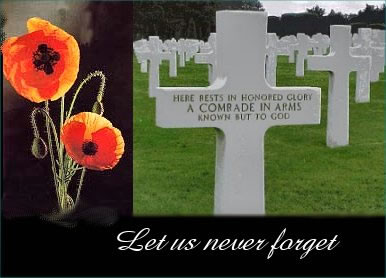
Today is Veterans Day, a day of recognition, appreciation, and honor for those who have served in our nation’s military.  Originally known as Armistice Day, the annual commemoration had its first observance on November 11, 1919, by order of President Woodrow Wilson to honor veterans of World War I and to mark the first anniversary of the signing of the Armistice which brought an end to the Great War.  The Armistice was signed by Germany at the 11th hour of the 11th day of the 11th month of 1918.  In the 1950s, the holiday’s name was officially changed to Veterans Day and was expanded to honor all U.S. military veterans.  Today, there will be numerous ceremonies and parades, and millions of flags will fly across the country.  Last week’s tragic shooting and loss of life at Fort Hood will no doubt heighten the emotions of the day. 

Other nations that were involved in World War I will be commemorating this day as well.  In the United Kingdom and among other nations of the British Commonwealth, November 11 is celebrated as Remembrance Day, also known as Poppy Day and Armistice Day.  Your desk calendar or daily planner may note that today is Remembrance Day in Canada. 

Mark Knopfler’s latest cd, Get Lucky, includes a track entitled, “Remembrance Day.”  While the song references many traditions that are far more British than American (i.e., morris dances, cricket, poppies, etc.) and the video images below are related to commemorations in the U.K., the sentiments are identical to those of U.S. citizens who wish to honor the service of our veterans.  Names like Alfie, Bill, Ken, Sam, Andy, Jack, John, Charlie, Martin, Jamie, Ron, Harry, Stephen, Will, Don, Matthew, and Michael were shared by both American and British troops. 

The final verse of the song reads:

“When November brings the poppies on Remembrance Day; when the vicar comes to say, ‘May God bless them, every one; lest we forget our sons.’  We will remember them.”

The last song on Get Lucky is “Piper to the End.”  The liner notes include the following explanation from Knopfler:  “Piper to the End is for my Uncle Freddie, Lance Corporal Frederick John Laidler, a piper of the 1st Battalion, Tyneside Scottish, The Black Watch, RHR, who carried his pipes into action and was killed with them at Ficheux, near Arras, on the 20th of May, 1940, aged 20.”  The notes also indicate that all proceeds from “Remembrance Day” and “Piper to the End” will go to the Royal British Legion Poppy Appeal.  It is refreshing to see recording artists using their influence to assist veterans’ organizations.

As appropriate as it is for us to observe Veterans Day, we are even more privileged as Christians to celebrate Remembrance Day every Sunday in the eating of the bread and the drinking of the wine.  This, too, is an acknowledgement of great suffering and a sacrifice that was made for our eternal good and blessing.  And, being celebrated each Resurrection Day, it affirms our faith that victory has been assured; victory over sin, victory over death, and victory over hell.  The Victor is coming!      

Lost

 A few years ago, I was in the habit of spending some time each day working on the Daily Commuter Puzzle in the Dallas Morning News.  This daily exercise did not consume an inordinate amount of time, and I could generally complete the puzzle without too much difficulty.  In the interest of full disclosure, I must tell you that this is the very reason why I did not do the New York Times crossword which also appeared in the paper each day.  “Failure to complete” was just far too frustrating and damaging to my ego.  Why put myself through that kind of emotional torture and intellectual humiliation? 

During “puzzle time” one evening, I found myself looking for a four-letter word in answer to the clue “among the missing.”  The answer turned out to be “lost.”  As I continued to do the crossword, I just couldn’t get the spiritual implications of that definition of “lost” out of my head.  When something is missing, it is not in its proper place; it is not where it belongs; it is not where it is supposed to be.  Is that what I thought about when I considered the spiritually lost?  Or did I fall into the trap and mindset of the scribes and Pharisees.  The reason those religious leaders objected so vehemently to Jesus’ time in the company of “sinners” was that they believed unequivocably that tax collectors, prostitutes, and others did not belong in the kingdom of God.  They were unclean, unholy, unfit, and immoral.  In the Pharisaic mindset, the lost weren’t “missing.”  They had no right to be there in the first place, and Jesus had no business spending time with them and teaching them.

Jesus challenged and rebuked this ungodly way of thinking in his three-fold parable recorded in Luke 15.  The lost sheep wasn’t where it was supposed to be.  It wasn’t where the shepherd wanted it to be.  It “belonged” with the other ninety-nine.  So the shepherd searched diligently until it was found, and he brought it back to the fold rejoicing.  Ditto, the woman who had lost one of her ten silver coins.  Her attitude was not that of, “Good riddance!  I never really liked that coin anyway!”  It was treasured; it was valued; it represented ten percent of her wealth.  It “belonged” to her and it was missing.  There was celebration when she found it.  That is precisely the way the father felt about his wayward son.  Though the prodigal had acted arrogantly and wastefully and was suffering the consequences of his own foolish choices, the father never stopped “missing” him.  When his son’s heart and feet turned toward home, the father ran to meet him, embraced and kissed him, gave him a robe for his back, a ring for his hand, and sandals for his feet, and called for a feast.  He would not hear any of this “hired man” nonsense!  “You are my son!  You are back where you belong!”  The older brother just didn’t get it.  Do I?

“We had to celebrate and rejoice, for this brother of yours was dead and has begun to live, and was lost and has been found,” (Luke 15:32).  He was no longer among the missing! 

the story 1

I wrote the following paragraph in my October 13 post, “Back from the Brink”:   

“A year ago today, I was at the lowest point of my entire life.  The days were dark, and I felt like there was a weight on my heart that would crush me.  I had questions about my physical and emotional health, my future in ministry, and my future, period!   From a human perspective, there was no way forward.  I cried out to the Lord like I never had before; and, often, I just cried.  I was spent, with no strength of my own to offer.  My tank was empty and my well was dry.”

I remained in that depth of despair until one year ago tomorrow.  That was the day when God began to reveal His answers to my prayers and when light began to appear at the end of the tunnel.  It was the day that hopelessness lost its suffixes!  I still had a long way to go emotionally, and I still had absolutely no idea what I was going to be doing in the coming months and years, but I knew that I was going to have my family along for the journey.  November 6, 2008 was the third-happiest day of my life, after the day of my baptism into Christ and the day that Kim and I were married!  Through tears and prayer, Kim and I knew that we were going to be okay!

For nearly 22 years, Kim and I have shared our lives together as husband and wife.  I can’t fully describe the blessing that she has been to my life.  She is a natural protector, nurturer, and encourager.  She is a champion for the underdog, the marginalized, and the disenfranchised.  From the day that Hannah was born, I knew that Kim was intended for motherhood.  When our lives were additionally blessed by the birth of Coleman, she met his diagnoses of Dubowitz Syndrome and autism with unyielding resolve and determination that have resulted in countless open doors and opportunities that he never would have enjoyed without her tireless, tenacious advocacy.  She has done all of this while suffering long bouts of fatigue and frequent pain associated with lupus.  She has challenged and encouraged me in my ministry, and has sometimes had to offer loving rebuke and correction.  I could not and would not have continued in full-time ministry without her blessing and support.

During those “dark days,” Brandi Carlile’s song, The Story, really connected with my heart.  I think it was a combination of the emotion of the lyrics and the passion of Carlile’s voice.  The refrain states, “But these stories don’t mean anything, when you’ve got no one to tell them to.  It’s true; I was made for you.”

I love you, Kim!

Fish 1

You’ve seen them everywhere: on bumper stickers, decals, t-shirts, key chains, caps, ties, etc.  Most people are aware that the “ichthus” symbol (alternately transliterated from Greek as “ichthys”) is a symbol of Christianity related to the person of Jesus Christ, but many are not aware its precise meaning.  The following is for the benefit of those who may be asking, “What’s up with the fish?”

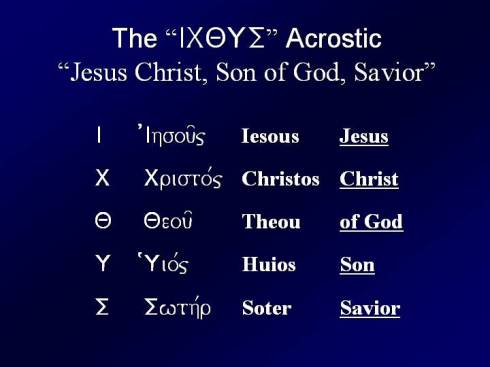
“Ichthus” is the Greek word for “fish.”  The “ichthus” symbol is considered to be among the earliest symbols used by Christians as a means of identification and a profession of their faith in Jesus.  It was simple to draw, and relatively safe to use, especially during the years when the early church was suffering persecution.  “Ichthus” was employed as an acrostic, with each letter of the word representing the first letter of another word related to Jesus, resulting in “Jesus Christ, Son of God, Savior.”  It worked like this…

Fish 2


 A really cool variation of the symbol is pictured below, with each of the letters contained in an eight-spoked wheel.  Rather ingenious, huh?

Ichthus

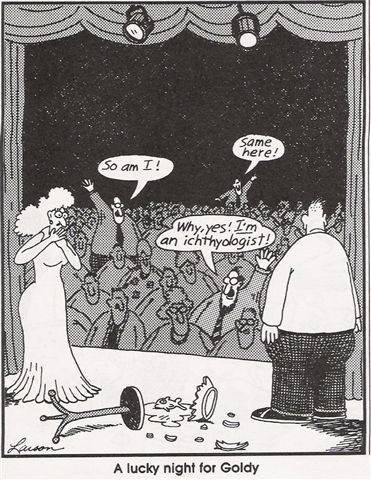
For those who consider “ichthus” to be an obscure word, it survives in English usage.  Ichthyology is the branch of zoology that deals with fish.  An ichthyologist is one who specializes in the study of fish.

If you enjoy The Far Side, you’ll get a kick out of the following cartoon by Gary Larson.  If you never really “got” The Far Side, then never mind. “Is there an ichthyologist in the house?!?”

A Lucky Night for Goldy

hell house 2

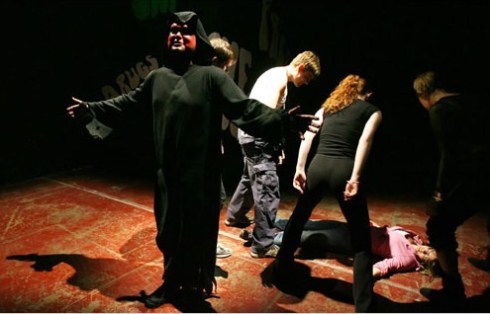
Tomorrow is Halloween.  All across the country, costumed children will be trick-or-treating their way through neighborhoods, house by house, filling their bags and plastic jack-o’-lanterns with sugar-laden treats.  Some older kids and young adults will be out pulling pranks, ranging from relatively harmless “gotchas” to outright vandalism and criminal destruction of property.  Like it or loathe it, Halloween is an American cultural tradition.  Many churches have sought to counter the darker side of the holiday with activities of their own.   Fall festivals, harvest celebrations, Good Guy Carnivals, hayrides, and Trunk or Treat have provided more festive, family-friendly alternatives to the demonic and macabre associations of Halloween.  However, some churches have taken a radically different approach by co-opting the horror motif of secular haunted houses.  Welcome to Hell House.

Trinity Church in Cedar Hill, Texas, has been credited with popularizing the Hell House phenomenon.  A 2001 documentary, aptly titled Hell House, focused on this church’s innovative and controversial evangelistic outreach geared toward teens.  Some churches use the name Judgment House.  Here in Tulsa, the most popular version is Nightmare, now in its 17th year of production at Guts Church, a local megachurch with a wide range of trendy ministries.  Regardless of the nomenclature, the concept is much the same.  Groups of visitors are led by a guide through a series of dramatic scenes that are heavy on screams and theatrical blood.  There are graphic portrayals of automobile accidents, school shootings, abortions, teen suicides, drug use and overdose, domestic violence, and homosexuals suffering with HIV/AIDS.  Hell Houses may also include a Passion of the Christ-like dramatization of the crucifixion of Jesus and a depiction of heaven.  The intent is simple:  show sin and its consequences, portray the destiny of the damned, and offer a call for salvation through Jesus Christ.  Kids flock to Hell Houses by the thousands.  Most scream.  Many cry.  Some vomit. 

At the end of the tour, visitors (mostly teens) are taken into a Decision Room while their heart rates and adrenaline levels are still elevated.  They are asked a simple question, “If you died tonight, would you go to heaven or hell?”  A church leader in the documentary tells rattled teens at Trinity Church, “You have six seconds to decide….five seconds…”  Those who want to make a decision to follow Jesus or rededicate their lives as Christians are asked to go into a room to pray with counselors. 

I understand and appreciate that faith in Christ is not only rational and reasoned; it is also strongly connected to our emotions.  But, when does the appeal to emotion cross the line into manipulation?  It is my opinion that Hell Houses cross that line.  I have deep concerns about impressionable hearts and minds that are asked to either accept or reject Jesus under that level of emotional duress.  Yes, I know that Jesus talked more about hell than anyone before or after Him in the Bible.  Still, it was not His typical means of saying, “Come, follow Me.”  And the apostles?  Just think what they could have accomplished on Pentecost with a Hell House instead of just preaching Christ and Him crucified! 

If souls are led to a sincere, lasting faith and full obedience to the Gospel of Christ, then I won’t quibble too much about methodology.  But, I worry about teens’ faith being sustained after their hearts have stopped beating in their throats and the nightmares have ended.  I would far rather inspire heaven in their hearts than merely scare the hell out of them.

Five Words

I am nearing completion of a sermon series at the Broken Arrow Church of Christ entitled, “Dear Church,” based on the book of I Corinthians.  The series has examined Paul’s intimate relationship with the church in the city of Corinth and what the Holy Spirit desired to communicate to them through the apostle by means of this letter.  Sunday before last, the lesson was centered on I Corinthians 14 and was titled, “Dear Church: Can You Hear Me Now?”  Many of the Christians in Corinth had been granted wonderful spiritual gifts of prophecy, knowledge, and tongues (languages) that were intended to enable communication of the Gospel and enhance understanding and maturity within the church.  However, selfishness and immaturity in the exercise of these gifts had resulted in chaos and confusion in their worship assemblies.  Paul directs them toward a use of their gifts that would bring about enlightenment, edification, and strength.

About halfway through the sermon, I was addressing I Corinthians 14:19 in which Paul states that “in the church I desire to speak five words with my mind so that I may instruct others also, rather than ten thousand words in a tongue.”  Bottom line: five words that you can understand are far more valuable than ten thousand that you can’t comprehend.  As I sought to emphasize this point, I excitedly (and totally spontaneously) told the congregation that I would prepare and deliver a Five-Word Sermon in the near future.  Note to self:  Stick With the Outline!

So, this is where you come in, fellow blog travelers!  Where should I go with this?  Please share your insights and suggestions.  Five words!  It is likely that I will construct a lot of visuals to go with the lesson, along with accompanying Scriptures for the congregation to read on the screen, but I will limit my spoken communication to five words.  I’ve already received a few suggestions from members here at BA.  Hey, this might even turn into a Five-Word Sermon Series!

Enter your email address to subscribe to this blog and receive notifications of new posts by email.

Join 175 other subscribers

Archives

February 2026
S M T W T F S
1234567
891011121314
15161718192021
22232425262728