Several years ago when we lived in Alabama, a system of strong thunderstorms bearing high winds, brilliant flashes of lightning, and deafening claps of thunder rolled through our area one Saturday afternoon.  I had spent the morning playing with the children and helping Kim around the house, but after lunch I settled in at the kitchen table to review my notes for Sunday’s sermons and my Bible class.  However, I soon found myself distracted from my studies by the strength of the storm.  It had been “looking like rain” all day, and it finally arrived in sheets and waves.  I have always enjoyed watching storms brew, build, and ultimately unleash their contents.  I guess I get that trait genetically, because I remember both of my grandfathers, as well as my father, frequently stepping outside to “see what the weather was doing.”  That afternoon in Alabama, the fierce winds blew the treetops back and forth like blades of grass, and at times it appeared as if it was raining horizontally, with the rain being driven parallel to the ground.  After the worst of the storm had passed, a steady shower set in, accompanied by gradually decreasing rumblings of thunder.

As my interest in the storm subsided, I returned to my Bible and notes at the kitchen table and continued to fine tune Sunday’s lessons.  After some length of time I glanced out of the bay window that opened to the west and was treated to a beautiful sight.  Though a light rain was still falling in the immediate area, the western sky had come alive with deep hues of purple and red.  The storm had lifted on the horizon, and the colors of the setting sun provided a striking contrast with the dreary, gray clouds that remained overhead.  It was a clear, unmistakable sign that beyond the present gloom there was a promise of fairer skies.

Life is filled with storms and trials.  They can be physical storms involving illness, disease, or disability.  They can be spiritual storms centered around temptation and sin or struggles with doubt.  Some of life’s storms are emotional in nature in which we can be besieged by frustration, anger, depression, or discouragement.  Many people are experiencing financial storms right now as a result of the current economic climate in our nation. 

Any and all of these storms can burst unexpectedly into our lives, raging and blowing and threatening to unsettle our hearts and our faith.  Jesus taught us to expect as much.  Our Savior never pulled any punches when describing life, especially the life of discipleship.   He never painted an unrealistically rosy picture of this world.  He was shooting straight with us when He said, “In the world you have tribulation.”  However, in the very next breath He offered the hope and strength that enable us to weather the storm.  “But take courage,” He said, “I have overcome the world” (John 16:33).

The apostle Paul was granted a glimpse beyond life’s struggles and hardships, of which he had suffered more than his fair share.  He was caught up to the third heaven, into Paradise, where he heard inexpressible words (II Corinthians 12:1-4).  Whether this happened bodily or in some sort of out-of-body experience Paul wasn’t sure.  But he did know that, at least for a brief time, the veil of this world was drawn back so that He could see beyond the trials, tribulations, and struggles of our present existence.  It is for this reason that Paul could write with confidence, accuracy, and authority that “the sufferings of this present time are not worthy to be compared with the glory that is to be revealed to us” (Romans 8:18).

When you find yourself feeling battered and bruised by life’s storms and surrounded by the darkness and dreariness of this world, raise your eyes and look to the Horizon.  The clouds will lift, the storm will pass, and Eternity awaits.

In August of 2008, I was graciously granted a leave of absence from my ministry responsibilities at the McDermott Road church in Plano, Texas, and given the opportunity to participate in an intensive counseling program at the Meier Clinic in Richardson.  I remain extremely grateful for that experience.  It greatly assisted me in coping with the depression that I was experiencing and also helped me come to terms with my emotionally unhealthy nature as a perfectionist and a people-pleaser.

One of the counselors at Meier began picking up on a tendency that I had to feel like I could never “measure up” or that somehow God would not be pleased with me unless I excelled in innumerable areas of my life and ministry.  So, he gave me an assignment: 1) Write a letter to God asking Him who He wants you to be, and 2) Write a letter from God back to you with His answer.  Was he serious?!?  He was serious!  As a person with a very high view of Scripture and a person who was extremely emotionally “stitched” at the time, I wasn’t sure that I could do it.  I wasn’t even sure that I should do it.  Write a letter for God?  It seemed to me that the Holy Spirit had always managed just fine in that department without my assistance and that He hadn’t seen the need to add to His letters in over 1,900 years.  But, it proved to be a very productive exercise.  It allowed me to take what I have always preached and taught about God’s unconditional love and personalize it.  I finally realized that this love wasn’t just for everyone else; it was how God loved me, too.  My two letters appear below.

_________________________

Dear God,

I praise You and adore You, Heavenly Father, my Creator, the One who wove me together in my mother’s womb, the One who saw all the days of my life before there was even one of them.  Father, I have a question for You and I need an answer.  I am struggling right now with emotions that are disconnected, self-created expectations that are often too high and unrealistic, and feelings of sadness, anxiety and frustration over a sense that I am failing.  I need You to clarify for me, Father, who it is that You want me to be.

Your loving son,

Tim                    

_________________________

My dear son Tim,

First of all, let Me reaffirm My unconditional love for you.  While I can be pleased or displeased, joyful or grieved, over your attitudes and actions, My love for you never fails.  I want what is best for you, both for now and for eternity.  That is why I allowed My Son Jesus, part of My Own Divine Nature, to come in flesh and lay down His life as a sacrifice for your sins; to redeem you and make you My son through adoption in Him.  I am your Father.  He is your Brother.

Tim, I want you to be a faithful child and disciple; not perfect, just faithful.  The blood of My Son will continue to cover your failings.

I want you to be a husband to Kim like My Son is a husband to His bride, the church.  Love her unselfishly and sacrificially.

I want you be a father to Hannah and Coleman who affirms and shows his unconditionally love for them as I have for you.

I want you to be a faithful messenger of My Son’s saving Gospel.  I have blessed you with the gift of speech so that you can lead the lost to Christ for salvation, and strengthen and build up the saved.  Don’t feel like you have to be the best preacher in the world.  Just be the best preacher that I have gifted you to be.  If you want to learn Spanish and Russian so that you can share the Message without translation in those places, fine.  I will help you and strengthen you.  But, if you don’t, I will love you and use you anyway.  The same goes for writing, Tim.  If you can find the time and energy to write, again, My Spirit will be with you to strengthen and supply.  But, if you never do, please don’t feel like you have failed Me or let Me down.

Go in My strength; abide in My love; stand firm in your faith!

See you soon!

Your Father, Always

Tabby & Punch

On Saturday, February 13, a hotel ballroom in Tulsa was filled with family, friends, church members, and medical caregivers who had come together to celebrate the life of Tabitha Hansen.  It was a diverse group of people from several different states.  The common thread that tied them all together was that Tabby’s life had touched every single one of them in a very significant and powerful way.  Some people had known Tabby for her entire life.  Others of us had only known her for a relatively brief period of time, but her influence made a lasting, positive impact just the same. 

Tabby had bravely battled cancer since June of last year.  After her initial diagnosis, she went through an extended, aggressive series of treatments which resulted in her doctors declaring her to be cancer free.  A week later, she was back in the hospital, this time with a diagnosis that the cancer had spread to her brain.  Next came the news that it was in her spine. 

Tabby’s battle with cancer was not a consuming fire; it was a refining fire, a fire that revealed just how precious her life was, how strong her will and character were, and what she was made of: faith, grace, dignity, strength, courage, compassion, and humor.  In 25 years of ministry, I have spent time with countless people who were terminally ill, but I have never witnessed anyone who fought so hard while enduring so much as Tabitha did over the last few months.  She had what I would describe as a spirit of spunky determination.  She never spoke in terms of loss or defeat.  I never once heard her gripe, complain, or feel sorry for herself.  When she learned that chemotherapy was going to take away her long, beautiful hair, she basically said, “No, I’ll lose my hair when I choose and on my own terms.”  So, she had her hair cut and donated it to Locks of Love as a gift for someone else. 

Tabby’s hospital room was like a shrine to the things that were important in her life: her faith, her husband Cory, her family, her friends, her horses, her dogs, and Oklahoma State University.  Her bed was crowded with stuffed horses and dogs, each of them given a special name by Tabby.  When talking was no longer comfortable, and then no longer possible, she still communicated amazingly effectively, using sign language to indicate her pain level or to say, “I love you.”  She could still do her “Elvis lip curl” and would give you a “pinky wave” as you entered or left the room.  

While Tabby’s entire family surrounded her with limitless love and tireless care, her mother Sherrie has been a special beacon of light and source of inspiration.  Her Facebook status updates would regularly include the proclamation, “God Is So Good!”  In a message last week, Sherrie wrote, “I have no regrets with my daughter Tabby and her life here, and now at home with the LORD.  She is in a much better place, and I am leaning on God’s understanding with all of this.  He knows what is best for all of us and will not give us more than we can handle.  I have an inner peace that I KNOW God is placing in my heart.  There are tears, but only for me…not for her.  I am going to miss my daughter, friend, business partner, and sister in Christ so much!  Time and God will bring healing.  I trust in HIM!”   

Sherrie and the rest of the family wanted the event on February 13 to be a celebration, and they succeeded in a wonderful way.  The ballroom was decorated with several displays of photographs and memorabilia from Tabby’s life.  A photo slideshow covered her earthly journey from beginning to end.  There was a catered barbeque dinner and a country/gospel band to provide music for the occasion.  A group of singers from the Broken Arrow church sang several of Tabby’s favorite songs of faith and praise.  Tabby’s uncle Ken Church, Scott Keele, and I were privileged to share a few thoughts and remembrances.  It was a true celebration of Tabby’s life. 

Thank you, Tabby, for touching so many lives in such a special way.  Thank you for giving us something to celebrate.

While playing golf with friends several years ago, one of them said, “Tim, I really wish you would share a greater number of personal illustrations in your sermons.”  While I don’t remember the exact words of my response, it was something to the effect of, “The reason I hesitate to do so is because I feel that if people learn and remember more about me than they do about Jesus, then I have failed as a preacher.”  Nothing more was said about the subject at the time, but I later learned that my friend was quite unhappy with my answer.  Not long afterward, he and his family left the congregation and he took the opportunity to express significant displeasure with my preaching as a whole and with my ministry in general.  I still don’t know for sure if the “personal illustration” issue was a cause or just a symptom of his overall negative assessment of me, but I suspect it was the latter.

Since then, I have tried to be more open about sharing personal experiences and other “life stories” as illustrative material in my lessons, although I am still not entirely comfortable with the concept.  There is a commonly held belief that without such transparency and self-revelation the church will not be able to relate to a minister and will perceive him as lacking credibility and authenticity.  I will admit that when I do share these kinds of stories, it is relatively easy to elicit enthusiastic laughter from the congregation and a significant number of affirming comments after the service.  But, is that the point?  Is that the measure of effective Biblical preaching?

The current issue of Leadership contains a great article by Mark Galli entitled “Enough of Me Already!”  Galli, who is senior managing editor of Christianity Today, offers great insights into this quandary that I have wrestled with over the years.  I would encourage you to follow the link and read the entire article.  As an enticement to do so, let me share a few quotes from Galli:

“The sermon has inadvertently become a showcase of the pastor’s life and faith.  Less about the centrality and greatness of Jesus.”

“…to this day, years later, people will remark, ‘I still remember that sermon you preached where you told about putting your fist into the wall.’  They don’t remember Jesus.  They remember me.  They tell me how vulnerable I was to tell such a story on myself.  They tell me how much they laughed.  They never talk about grace.”

“Phillips Brooks once described preaching as ‘Truth through personality.’ Indeed.  But with the flowering of the personal illustration, preaching often morphs into ‘the truth of my personality.'”

“This is one reason we’re so easily tempted to illustrate the gospel with our lives.  In a therapeutic culture, we are anxious to connect with listeners in a personal way.  The personal illustration is the easiest way to do that, especially if you can describe a personal flaw or mistake humorously.”

“Finally, we’re hooked on personal illustrations because our listeners adore them.  They love a good story, especially if it’s a funny story about the pastor’s most embarrassing moment or about cute kids doing cute things in the pastor’s home.  It makes everyone feel warm and fuzzy and connected.  It’s so much more interesting than theology or the Bible!  And it makes people like the pastor.  Who doesn’t want to be liked?”

“It’s time to find other ways to illustrate sermons than me, me, and mine.”

Rather than calling for a complete cessation of the use of personal illustrations, he offers the following beneficial counsel: 1) Illustrate like Jesus; 2) Illustrate with the Bible; 3) Illustrate with discretion.  Read the online article for Galli’s explanation of each.

As I reflected on Galli’s article and the conversation with my friend and brother several years ago, a phrase from an old familiar hymn came to mind: “less of self, and more of Thee.”  While I will continue to share personal illustrations in future sermons, I want to do so with discretion and caution.  I want to make sure that the message is “Christ, and Him crucified” rather than “Tim, and him humanized.”  Less about me.  More about Jesus.   

On Sunday, June 6, 2004, I spent most of the day at the Cotton Bowl in Dallas, Texas, with my good friend and brother Phillip Pierce enjoying the Crossroads Guitar Festival.  This three-day music festival was organized by Eric Clapton to benefit the Crossroads Centre, a drug and alcohol treatment facility in Antigua which Clapton founded.  The event included performances by noted guitarists like B.B. King, Jeff Beck, Buddy Guy, Carlos Santana, Joe Walsh, Robert Cray, Bo Diddley, J.J. Cale, Jimmie Vaughn, Steve Vai, John Mayer, Neal Schon, Vince Gill, David Hidalgo, and many others.  Unfortunately, Brian May, who been previously billed as one of the performers, was unable to make the trip from England.  While I was majorly bummed about missing what was likely my only chance to ever see May perform, it was still an incredible concert.   

Before I get to the main point of this post, let me provide an answer to the question, “How does a preacher manage to spend 10 hours at a guitar festival on a Sunday?”  I will be more than happy to explain.  In February of 2004, we began worshipping in our new facility at the McDermott Road church in Plano, Texas.  Since 2000, we had been meeting in two services in the modular building and utilizing a middle school down the street for additional classroom space.  The new building not only met our classroom needs, it also provided us the luxury and blessing of meeting together in one morning worship assembly, at least for the next 11 months, until we had to revert to two services.  During those 11 months, on the first Sunday of the month, everyone shared together in a fellowship lunch and an early afternoon devotional before dismissing for the day.  The Crossroads Guitar Festival just HAPPENED to be on the first Sunday of June.  I promise that I had no influence on which Sunday we had the fellowship lunch!

After morning worship, Bible classes, lunch, and a devo, Phillip and I quickly exchanged our dress clothes for more comfortable garb and made it to our seats in the Cotton Bowl by 2:00 p.m. for a concert that would last until midnight. 

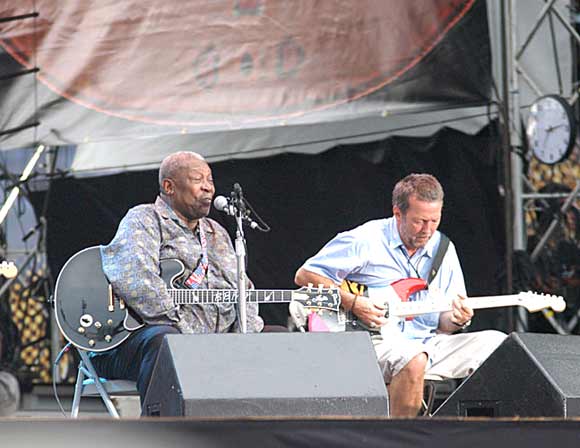
During the middle of the afternoon, Eric Clapton and B.B. King appeared on stage, sat in a couple of folding metal chairs, and wowed the crowd with an extended set which featured their artistry and mastery on blues guitar.  Eventually, Buddy Guy emerged to join them on stage, and, a little later, a fourth chair was set up for John Mayer.  While John Mayer is an accomplished musician, he appeared to be somewhat tentative as the four guitarists traded licks.  After taking the lead for the second or third time, Mayer shook his head slightly, stood up, unstrapped his guitar, laid it on down in front of Clapton, King, and Guy, and walked off the stage.  Applause erupted from the crowd in recognition and appreciation of Mayer’s humility and deference toward these significantly older and more seasoned performers.  Mayer’s actions were quite unexpected and refreshing, particularly in an industry that is sometimes noted for overblown egos and a desire to dominate the spotlight.

“For through the grace given to me I say to everyone among you not to think more highly of himself than he ought to think…” (Romans 12:3)

“Do nothing from selfishness or empty conceit, but with humility of mind regard one another as more important than yourselves; do not merely look out for your own personal interests, but also for the interests of others.” (Philippians 2:3-4)

“Be devoted to one another in brotherly love; give preference to one another in honor.” (Romans 12:10)

“Whoever exalts himself shall be humbled; and whoever humbles himself shall be exalted.” (Matthew 23:12) 

Admittedly, it was a rather strange place to be reminded of the teaching of Jesus and Paul on the subject of humility.  But, then again, it was a Sunday!


A gift from Phillip that proudly hangs in my office.

I Samuel 17 records a story that many of us have known since childhood.  Israel’s army was encamped on a high hill overlooking the valley of Elah.  The army of the Philistines was assembled across the valley on the opposing hill.  For forty days, a 9 ft. 9 in. Philistine warrior named Goliath stood in the valley and shouted a challenge to the Israelites to send someone down to meet him in battle.  Goliath was a veritable human tank: bronze helmet and shin guards, 125 lbs. of scale-armor, a javelin, a spear, a sword, and a shield.  He was the ultimate Philistine fighting machine.  He defied Israel’s army and their God.  He dared them.  He cursed them.  He shouted to them every morning and evening.  Eighty challenges; all of them unanswered and unmet.  Not even King Saul’s incentives of wealth, marriage to his daughter, and freedom from taxation were enough to instill courage in any of his warriors.

I Samuel 17:4 refers to Goliath as a “champion” of the Philistine army.  The Hebrew word is ish-habbenayim.  It literally means “a man between the two”; a middleman, an intermediary, a representative.  What Goliath was proposing was “representative warfare.”  Why incur massive human casualties and expend enormous amounts of military goods when it could be settled right here, right now, man-to-man, winner-take-all?

Embarrassed by the cowardice and lack of faith among the army of God, David accepted Goliath’s challenge, took upon himself the role of Israel’s ish-habbenayim, and ran to the battle line to meet the Philistine, armed only with his shepherd’s stick, his sling, and five smooth stones from the brook of Elah.  David trusted in God’s presence and deliverance.  He entrusted the battle and its outcome to the Lord.  It only took one stone to fell the giant.  When the Philistines saw their champion fallen and decapitated with his own sword, they fled and were routed by the emboldened army of Israel.

There was a time when our Adversary regularly took his stand against the souls of men.  This was the Accuser, the ish-habbenayim of Death and the forces of Darkness.  He called to us, challenged us, tempted us, taunted us, cursed us, and dared us to try to wage warfare against him.  We were helpless, hopeless, and sentenced to live in fear.  But everything changed when God sent an ish-habbenayim, His own Son, to represent us and fight for us.  Jesus repeatedly stared Temptation in the face and never flinched.  Temptation blinked.  He took the battle to Satan in his own domain and won.  He went into the depths of the Grave, wrestled Death, and was granted victory by the power and glory of the Father.  Jesus “rendered powerless him who had the power of death, that is, the devil, and freed those who through fear of death were subject to slavery all their lives” (Hebrews 2:14-15). 

We have been granted salvation from sin, freedom from fear, and deliverance from death through Jesus Christ, our Ish-habbenayim, our Champion!       

I saw as many feature films in December and January (four, to be exact) as I had seen in the previous year.  The successive events of heading to Oklahoma last March in advance of my family, getting them moved to Tulsa in June, Hannah starting college and Coleman a new high school in August, and Kim and I continuing to get settled into our new ministry with the Broken Arrow church pretty much spoke for any free time that we had in 2009.  But, the cinematic wait was well worth it.  I don’t know when I have enjoyed four movies in a row like I did The Blind Side, Sherlock Holmes, Invictus, and Avatar.

I found the visual effects in Avatar to be astounding; and I only saw the film in 2-D.  By the second half of the movie, I think my brain had been thoroughly (if only temporarily) convinced that the lush, exotic environment on Pandora was real, along with the seamless interaction between the Na’vi, humans, and avatars.  I don’t have the time, space, or interest to dissect the movie or address its many environmental, sociological, geo-political, and spiritual themes.  For that, I would refer you to the multitude of online articles and blog posts that tackle those thematic elements from all sides.  I just wanted to comment on two brief lines that stood out to me as I watched the film.

As Neytiri explained the initiation rites of the Na’vi to Jake Sully’s avatar, she said, “Every person is born twice.  The second time is when you earn your place among the people forever.”

As many of you undoubtedly did, I immediately thought of Jesus’ words to Nicodemus in John 3:3-8, “I tell you the truth, no one can see the kingdom of God unless he is born again…  I tell you the truth, no one can enter the kingdom of God unless he is born of water and the Spirit… You must be born again.”  Titus 3:4-5 states that we have not received salvation in Jesus Christ through righteous deeds that we have done, but God has mercifully saved us “through the washing of rebirth and renewal by the Holy Spirit.”  Water, Spirit, washing, and rebirth.  There is nothing else in Scripture other than baptism that approximates the union of all of these concepts (I Cor. 12:13; Acts 22:16; I Pet. 3:21; Acts 2:38).

Although I acknowledge and respect the sincerity of their belief, I have always had a difficult time understanding the viewpoint of those who hold that baptism somehow constitutes a meritorious work of righteousness and, therefore, cannot have any role or place in our reception of God’s grace through faith in Christ.  As I see baptism in Scripture, it has grace and faith written all over it.  Far from a demonstration of human effort or righteousness, baptism is entirely passive, beautifully submissive, and trustingly receptive.  Just as Titus 3:4-5 explicitly excludes the “washing of rebirth” from man’s righteous deeds, so Colossians 2:12 defines our burial with Christ in baptism as “faith in the power of God.”  God is the One who is working in baptism, not man.

Through the second birth on Pandora, the Na’vi “earned” their place among the people.  By contrast, when we are born again through baptism into Christ (Romans 6:1-7), we humbly accept God’s grace in total dependence and trust in Jesus’ sacrifice, and we receive a “new life” that is wholly undeserved.   

A terminal disease.  The death of a child.  A freak accident that takes the life of a loved one or friend.  The painful loss of a job.  A broken marriage.  A fractured friendship.  A miscarriage.  Bankruptcy.  Mental illness.  Birth defects.  A church split.  A stock market crash.  A lawsuit.   

As people struggle through such difficulties and hardships and seek solace in the midst of life’s storms, they will sometimes say (or someone will say to them), “I believe that everything happens for a reason.  God is in control.  I just have to accept His will in this.”  As Biblical support for their outlook, they will reference passages like Romans 8:28, “And we know that God causes all things to work together for good to those who love God, to those who are called according to His purpose.”  I fully believe in the truth and power of that verse, but I believe that there are some things that it affirms and some things that it does not.

Scripture does not teach fatalism, determinism, or a micro-managed predestination in which God manipulates outcomes and purposefully moves lives and events around like pieces on a chessboard.  Romans 8:28 does not state that “God causes all things.”  While life and history may be said to unfold within the boundaries of God’s “permissive will,” that does not mean that every success or failure, victory or defeat is the result of His “explicit will.”  He permits every man, woman, and child created in His image to make their own choices.  He has placed us in a world governed and ordered by natural, physical laws that most often bless us, but have the potential to harm or kill us. 

So, Romans 8:28 doesn’t teach that everything happens for a reason, or that sense can somehow be made out of senseless events.  But what it does affirm is that our sovereign God is so powerful that He can take any single tragedy in our lives or any imaginable combination and succession of tragedies and use them for the purposes of good and blessing, both for ourselves and for others.  That is an amazing God!  A lesser god would wield his will like a club, enforce conformity, and only then could he accomplish his purposes.  The God of Heaven says, “Give me any set of negative circumstances, whether brought about by yourself, or created by forces and influences beyond your control, and I will find a way for it to result in blessing and the accomplishment of My will for your life.” 

Joseph is a classic example of such workings of God’s providential will.  God did not make Joseph’s brothers despise him with a jealous hatred.  That was wrong.  He did not make them sell their own flesh and blood like a common slave.  That was unimaginably inhumane.  He did not make Potiphar’s wife lust for him, repeatedly try to seduce him, and then falsely accuse him of attempted rape.  That was entirely sinful.  He did not cause Pharaoh’s cupbearer to forget about him and leave him in prison for another two years.  That was a tragic oversight.  God allowed all of those individuals to make their choices and enact their own will, and still He used those events for the blessing of Joseph, the preservation of Jacob’s entire family, and the sustaining of life in the entire region of Egypt during seven years of famine.  In that sense, Joseph could say to his brothers that, even though they sold him, it was God who had sent him to Egypt (Gen. 45:5).  They had “meant it for evil against him, but God meant it for good in order to bring about this present result, to preserve many people alive” (Gen. 50:20).

Our son Coleman wasn’t born with Dubowitz Syndrome and autism for some “reason” or just so that some “greater good” could be served.  Yet, God has graciously brought about incalculable good and innumerable blessings for him, us, and a whole multitude of people throughout his life.  God hasn’t done this so that we would now understand the reason “why.”  There is no such reason.  Our loving Father simply took something that was broken and made it beautiful.  He took a circumstance that was senseless and gave it meaning and significance.  Such is the power and grace of our God!

The hype surrounding the Super Bowl every year seems to have as much to do with the anticipation of new, funny, cutting edge, multi-million dollar television commercials as it does with determining the NFL championship on the field of play.  Conversations among viewers of the Big Game in living rooms across America are intermittently silenced by the shout of, “Quiet!  The commercials are coming on!”  Tens of millions of adherents sit transfixed to their flat screens as the prophets and priests of Consumerism exuberantly (and quite cleverly) proclaim the latest revelations about beer, computers, cars, cell phones, food, and more.

This year, it is an understatement to say that the impact and value of the Super Bowl commercials is being raised exponentially by a 30-second ad that has been produced by Focus on the Family.  It features Tim Tebow, winner of the Heisman Trophy in 2007 and quarterback for the Florida Gators, with whom he won two BCS Championships.  While the text of the commercial has not been released, it is expected that it will recount the story of the decision that Tebow’s mother, Pam, faced as she experienced extreme complications with her pregnancy while serving as a missionary in the Philippines in 1987.  Doctors recommended that she abort the child for the sake of her own health and life.  She didn’t.  On August 14 of that year, she gave birth to her fifth child, Timothy Richard Tebow. 

Thank you, Pam and Tim Tebow, for the openness of your faith, the power of your testimony, and your willingness to share your story.  Thank you, Focus on the Family, for producing this pro-life commercial and for spending the millions of dollars necessary to air it.  Thank you, CBS, for rethinking your policy regarding “advocacy” commercials and for not bowing to the demands of influential political and social groups that the commercial be pulled from the broadcast.  While I know that this will open the door for advocacy ads for causes that I do not support, that is the way it should be in a free society that values free speech and the open exchange of ideas.

It is reported that the word abortion is not explicitly used in the Tebow ad.  It doesn’t need to be.  I deeply appreciate what I anticipate will be the power of the commercial’s approach, message, and tone.  No one is screaming.  No one is pointing fingers.  No one is condemning anyone to hell or calling for ungodly and indefensible violence against clinics and physicians.  Someone (a very well-known and influential someone) is just telling a story: a story of life. 

The battle over abortion will not be won in the halls of Congress, the chambers of the Supreme Court, or in voting booths.  It will be won one heart at a time, one story at a time, one choice at a time.

Last week in Poteau, Oklahoma, a monument bearing the Ten Commandments was unveiled on the lawn of a local bank.  The monument, approved by Le Flore County commissioners last year, was originally intended to stand on the grounds of the county courthouse.  However, those plans were put on hold pending the outcome of a court battle over a similar monument at the Haskell County courthouse.  Supporters of the monument in Poteau are hopeful that its current location on private property is only temporary.

Across the nation, there are numerous ongoing lawsuits, countersuits, and appeals related to the display of religious imagery (Ten Commandments monuments, crosses, nativity scenes) on public property.  Court decisions have lacked consistency and have been all over the map.  On the very same day, June 27, 2005, the U.S. Supreme Court ruled in Van Orden v. Perry that the monument on the Texas State Capitol grounds in Austin (pictured above) was constitutional, but, in McCreary County v. ACLU of Kentucky, the same justices ruled against two similar monuments at courthouses in Kentucky.

A lot of time, emotion, and energy (not to mention enormous sums of cash) are expended by both sides in these legal battles.  I have to admit that, from a Christian perspective, I cannot “catch the vision” or “embrace the crusade” for such displays on government property.  I cannot grasp the “victory” that will be gained for faith in Christ, even if the Supreme Court ruled in favor of all such efforts.  As I have expressed in earlier posts about “In God We Trust” on our currency and statements of faith on license plates, I fear that such physical expressions can become the modern-day equivalent of the broad phylacteries and lengthened tassels against which Jesus spoke (Matthew 23:5), mere symbols, signs, and talismans that give us a false sense of confidence in our personal piety, or worse, our national righteousness. 

Perhaps the bank lawn is exactly where the monument in Poteau needs to stay.  Are we lacking sufficient private property upon which to erect monuments and proclaim our faith?  I have never seen a church with such a monument on its grounds or in its facilities.  I have never been to the home of a fellow Christian who had such a monument in their front yard.  Why is there such passion to take these battles to the Supreme Court when most of us would be reluctant to even bring the issue before our homeowners’ association? 

Then there is the question over the Ten Commandments themselves.  There is more than a little irony involved when the King James Version text appears on the monuments with its verbiage concerning the making of “graven images.”   Do Christians really want to keep the Sabbath (Saturday) as a holy day and have the government enforce its restrictions?  One wonders why Christians would not be more desirous of displaying the teachings of Jesus Christ as opposed to a law delivered through Moses.  Though Kurt Vonnegut was a thoroughgoing humanist, atheist, and skeptic who denied the divinity of Jesus, he nonetheless admired many of Jesus’ teachings, particularly the Beatitudes.  Vonnegut once questioned why Christians were not more interested in displaying “Blessed are the merciful” at the Supreme Court and “Blessed are the peacemakers” at the Pentagon.  Good questions!

I love my God, and I love my country, but I cringe when the lines are blurred between the sacred and the secular, and between Christianity and nationalism.  On the back of the Ten Commandments monument in Poteau, there also appears the preamble to the Oklahoma state Constitution, the Pledge of Allegiance, and a dedication message.  The dedication indicates that the commandments are “suggestions to live by” for people of all religions and beliefs.  Suggestions?  Both God and Moses would take issue with that.  When the monument was unveiled in Poteau, a retired minister appeared dressed as Moses carrying two stone tablets.  High school students sang The Star Spangled Banner.  God doesn’t require national endorsement.  The cross stands independently from the flag.  Christ is not dependent upon Caesar to proclaim His gospel or expand His kingdom.

I don’t believe that God is concerned about granite monuments, but He is extremely desirous to write His law upon our hearts (Jeremiah 31:31-34).  Of Christians, the apostle Paul wrote, “You are our letter, written in our hearts, known and read by all men; being manifested that you are a letter of Christ, cared for by us, written not with ink but with the Spirit of the living God, not on tablets of stone but on the tablets of human hearts” (II Corinthians 3:2-3).  Being a “living monument” to Jesus is far more demanding and meaningful than the one-time effort and artistry involved in engraving an inanimate stone.  

Enter your email address to subscribe to this blog and receive notifications of new posts by email.

Join 175 other subscribers

Archives

February 2026
S M T W T F S
1234567
891011121314
15161718192021
22232425262728