I still haven’t seen Iron Man 2.  It is currently showing at the “cheap movie” theater not far from our house, but at this point I will probably just hold out until the film is released on dvd next month.  Since it has been nearly four months since the premier of Iron Man 2, the subject of this post is likely “old news” to many people, and it may have been exhaustively batted around the blogosphere back in May.  If so, I apologize for the redundancy.  It is not unusual for me to be running a few months/years behind the cultural curve.

In Iron Man 2, the character Ivan “Whiplash” Vanko played by Mickey Rourke says, “If you could make God bleed, people will cease to believe in him.”  I can only conjecture since I haven’t seen the movie, but I assume that the point of Vanko’s statement was that if he could expose some sort of weakness or vulnerability in Tony Stark/Iron Man, then the adulation from the masses would radically diminish.  If he could “make him bleed” and show his humanity, then the people’s confidence in him as a superhero would evaporate.  

If I totally missed Vanko’s point, you can let me know, or I’ll figure it out if and when I see the movie.  But, the statement is just so stark (no pun intended) that it is hard to miss the theological, Christological, and soteriological connections; translation: the God stuff, the Jesus stuff, and the salvation stuff.

“If you could make God bleed…”

“God is spirit…” (John 4:24)

“In the beginning was the Word, and the Word was with God, and the Word was God…and the Word became flesh, and dwelt among us…” (John 1:1, 14)

“Although He existed in the form of God, He did not regard equality with God a thing to be grasped, but emptied Himself, taking the form of a bond-servant, and being made in the likeness of men.”  (Philippians 2:6-7)

“Therefore, since the children share in flesh and blood, He Himself likewise also partook of the same… He had to be made like His brethren in all things…” (Hebrews 2:14, 17)

“Behold, we are going up to Jerusalem; and the Son of Man will be delivered to the chief priests and scribes, and they will condemn Him to death, and will hand Him over to the Gentiles to mock, and scourge and crucify Him, and on the third day He will be raised up.” (Matthew 20:18-19)

“They spat on Him, and took the reed and began to beat Him on the head.  After they had mocked Him, they took the scarlet robe off Him and put His own garments back on Him, and led Him away to crucify Him.”  (Matthew 27:30-31)

“But coming to Jesus, when they saw that He was already dead, they did not break His legs.  But one of the soldiers pierced His side with a spear, and immediately blood and water came out.” (John 19:33-34)

“…people will cease to believe in him”

Indeed, The Enemy and the human enemies of Jesus succeeded in making God bleed.  But, to the end and result of disbelief?  Far from it!

“Now the centurion, and those who were with him keeping guard over Jesus, when they saw the earthquake and the things that were happening, became very frightened and said, “Truly this was the Son of God.” (Matthew 27:54)

“Then He said to Thomas, ‘Reach here with your finger, and see My hands, and reach here your hand and put it into My side; and do not be unbelieving, but believing.’  Thomas answered and said to Him, ‘My Lord and my God.'” (John 20:27-28)

 “But we preach Christ crucified, to Jews a stumbling block and to Gentiles foolishness, but to those who are the called, both Jews and Greeks, Christ the power of God and the wisdom of God.”  (I Corinthians 1:23-24)

“Knowing that you were not redeemed with perishable things like silver and gold from your futile way of life inherited from your forefathers, but with precious blood, as of a lamb unblemished and spotless, the blood of Christ.” (I Peter 1:18-19)

God bled!  We believe! 

"Leaning House" Near Rescue, Virginia

I wish that the photo above had some sort of virtual tour feature like auto manufacturers provide on their websites for 360 degree interior and exterior views of their new cars.  It would give you a sense of what surrounds this old house that sits on Smith’s Neck Road between the towns of Carrollton and Rescue in Tidewater Virginia.  We passed it several times a couple of weeks ago while visiting friends and vacationing in the area. 

The house, which appears not to have been occupied for quite some time, has developed a significant lean to the north.  It is not unusual to see old houses and barns begin to lose their structural stability and start displaying a preference for one direction or another.  But this house is quite different in that it only has so far to go before it finds some additional substantial support.  Over the years, seedlings have sprung up all around the house and have now grown into tall, mature trees.  On the north side in particular (the direction of the lean) there is a uniform row of four or five trees that appear to be only a few inches from the side of the house.  If the house progresses much farther in its compass-like point to the north, it will soon find a firm place to rest on the sturdy trunks of the trees. 

The sight of this house reminded me of the blessing that it is to have people in our lives upon whom we can lean in times of weakness, discouragement, doubt, confusion, and sorrow.   This emotional support sometimes comes from friends, family members, or from our spiritual family in the body of Christ.  Of course, these are all two-way streets; mutual relationships in which we have the opportunity to be there for others in their time of need.  

“Bear one another’s burdens, and thereby fulfill the law of Christ.” (Galatians 6:2) 

“Therefore, strengthen the hands that are weak and the knees that are feeble, and make straight paths for your feet, so that the limb which is lame may not be put out of joint, but rather be healed.”  (Hebrews 12:12-13) 

“You just call on me, brother, when you need a hand.  We all need somebody to lean on.” (Bill Withers) 

One of the first two 45 rpm singles that I purchased when my parents bought a record player for my sister and me in 1972 was “Lean on Me” by Bill Withers.  Nearly forty years later, it remains one of my favorite tunes.  Hope you enjoy Withers’ performance of the song!

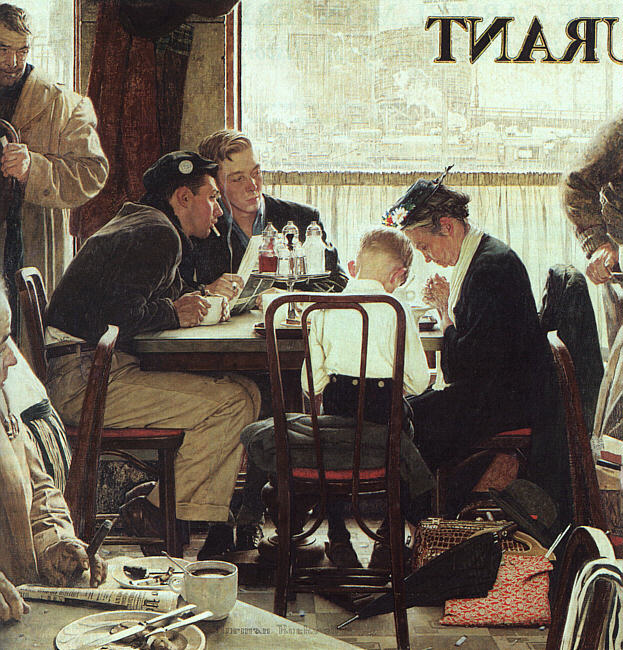
As a brief follow-up to my last post about the Prayer Menu at Captain Chuck-A-Muck’s, I wanted to share with you a practice that some of my friends regularly engage in when they are eating out at a full-service restaurant.  After the drinks have been ordered or brought to the table, they will say to the server, “My friends and I are going to be praying in just a minute and giving thanks for our food.  Is there anything that you would like for us to pray about for you?”  The question is brief, simple, and non-threatening.  Here’s the cool thing.  Every time the question has been asked, the server has responded with extreme gratitude and has shared one or more prayer requests with us.  No one has ever acted offended or insulted.  A brief conversation normally follows, and before we leave we assure them that we honored their request in prayer to the Father.   

Most recently this happened when my friend, fellow minister, and uber-evangelist Mike Crosby was visiting from Garland, Texas, to speak in our Wednesday Summer Series at the Broken Arrow church.  Since Mike was staying overnight, we had the opportunity to share two meals together while he was here.  At each meal, Mike asked the server if there was anything that they wanted us to pray about.  A young man asked us to pray for his mother who was under hospice care for cancer.  A young lady asked us to pray about a strained relationship in her life.  On both occasions I was able to give them a business card and let them know a little bit about the church.   

A small gesture to be sure, but one that can demonstrate genuine concern and compassion for others and provide an opportunity to speak a good word for Jesus.

Captain Chuck-A-Muck’s!  Now, that’s a great little seafood place!  It is located in the small town of Rescue, Virginia, and sits right on Jones Creek which flows into the James River.  You can drive to Chuck-A-Muck’s or travel by boat and tie up at the dock.   The menu is cleverly written; a sail covers the outdoor dining area; the restroom doors don’t have locks, but can be “tied off” with a rope to secure them.  Last Saturday night, my family and I ate there with our dear friends Bob and Allene Stoddert whom we have known for 22 years.  Bob and Allene live in nearby Smithfield, and we were blessed to spend last week in their home, enjoying sweet fellowship, visiting historical sites in the area, and spending some time at the beach.

The seafood at Captain Chuck-A-Muck’s was great, and the company was even better; but there was something else that added an unexpected blessing to our dining experience.  On each table was a Prayer Menu, the front of which bore an ichthus symbol.  The inside front cover of the Prayer Menu read as follows:

“At Chuck-A-Muck’s, we love all saints and sinners.  We are Baptist Christians and therefore like to bless our food before we eat.  Sometimes we forget to say our blessings when we go out to eat, or maybe sometimes people feel uncomfortable about it.  This little menu is just a reminder to give thanks, with a couple of different suggestions from our pastor.  If you are not a Christian, please do not take offense to this…we just feel that we have a lot to be thankful for in this great country, which is founded on these principles.”

On the opposite page there is a “menu” of seven prayer suggestions that patrons can use in giving thanks before their meal, including two specifically for children.  One of the general prayers reads:

“Lord, we pause for just a moment to thank you for all you do for us.  This meal is just a small indication of your love, and for it and much more we are grateful.  Mostly we thank you for sending Jesus to be our Savior.  May we always serve you faithfully.  In Jesus’ name, Amen.” 

In recent months, I have read interesting discussions on at least two blogs (thanks, Tim Archer and Bobby Ross!) about varying comfort levels and personal habits among Christians in offering thanks to God for meals when dining out. I really appreciated their insights and enjoyed reading the comments of others.  However, last Saturday at Captain Chuck-A-Muck’s was my first experience at an eating establishment that encouraged, facilitated, and intentionally created an “atmosphere of expectation” for the giving of thanks for our daily bread.  How amazingly refreshing!

Kudos to owners Chuck and Cris Lawrence for the openness of their faith and to their preacher, Jimmy Acree, for assisting them with the Prayer Menu.  We were going to pray anyway (and did), but our thanksgiving was made more memorable and special by the encouragement of the Prayer Menu.      

Bill Gates & Warren Buffett - Photo by Nati Harnik/AP

It was announced today that Bill Gates and Warren Buffett have enlisted an initial group of 40 billionaires who have pledged to give away at least half of their fortunes to charitable organizations and other philanthropic efforts.  According to the website for their new cause, The Giving Pledge is “an effort to invite the wealthiest individuals and families in America to commit to giving the majority of their wealth to philanthropy.”  In addition to Gates and Buffett, the inaugural group of 40 includes such high-profile individuals as Ted Turner, George Lucas, and Michael R. Bloomberg.  The website also includes personal “pledge letters” from the participants which provide interesting insights into their backgrounds, their motivation, and their commitment to use their wealth for the welfare of others. 

I have to say that I found the news of the The Giving Pledge to be very encouraging and inspiring.  With our national economy deeply hurting as a result of corporate greed, mismanagement, and executive officers with an insatiable desire for “more” (whether gained legally or illegally, ethically or not), it is refreshing to find those who are willing to lead the way in saying, “Others need my wealth and its benefits more than I do.”  Granted, none of these men and women and their families are going to be doing without.  There will be billions of dollars left to cover all of their needs and any imaginable desires.  Still, this was a choice that they made.  It isn’t being taxed out of them or coerced from them.  As stated by the organization, the pledges constitute a moral commitment, not a legal contract.  

This could have been called The Zaccheus Pledge.  After fulfilling his desire to see Jesus and encountering the power and presence of the Lord face to face, this chief tax collector pledged, “Behold, Lord, half of my possessions I will give to the poor, and if I have defrauded anyone of anything, I will give back four times as much,”  (Luke 19:1-10).  Though he made a substantial and sacrificial commitment, Zaccheus would have considered it a reasonable, fitting, and joyful response to the salvation that had come to him that day. 

Christ calls us to a life of generosity and freedom from enslavement to wealth and possessions.  The Jerusalem church beautifully demonstrated this spirit in their use of personal wealth for the common good, to the extent that needs were met and lives were blessed (Acts 2:44-45; 4:32-37).  

“And do not neglect doing good and sharing, for with such sacrifices God is pleased.” (Hebrews 13:16) 

“Instruct those who are rich in this present world not to be conceited or to fix their hope on the uncertainty of riches, but on God, who richly supplies us with all things to enjoy.  Instruct them to do good, to be rich in good works, to be generous and ready to share, storing up for themselves the treasure of a good foundation for the future, so that they may take hold of that which is life indeed.”  (I Timothy 6:17-19)  

An online poll on MSN.com this afternoon was asking the question, “If you were a billionaire, would you donate half your fortune to charity?”  83% of respondents had answered “Yes.”  It’s a pretty safe answer, given that there are only about 400 billionaires in our national population 310,000,000.  The real question is “What will I do with what I have?” 

It’s true that “from everyone who has been given much, much will be demanded.” (Luke 12:48) 

But, it’s also true that “the gift is acceptable according to what one has, not according to what he does not have.” (II Corinthians 8:12)

Thanks, Bill & Warren, for your inspiration!

Last Thursday, I took Coleman to get an overdue haircut before he and Kim hit the road to go to Mississippi for a few days.  There was no time to try to schedule an appointment, so I just took a chance and went to the mall.  We walked the entire length of the lower level without seeing a salon.  I checked the directory and map at the far end and noticed that a Regis salon was located directly overhead on the second level.   The name of the place immediately gave me comfort and confidence.  Let me explain.

Kim cut Coleman’s hair at home for years.  We had tried to take him to barbershops and salons a few times when he was younger, but the experience always frightened and unsettled him.  We don’t know if the smocks, scissors, and sterile looking environment reminded him of doctors’ offices and hospitals (which he had to visit with extreme regularity) or if the experience was just too far outside the box for his autism to handle.  Regardless of the reason for the discomfort, it wasn’t worth the anxiety for him or us, so Kim started cutting his hair.  Despite having no cosmotology training whatsoever, she did an admirable job with Coleman’s hair, although she regularly sliced her fingers to pieces with the sharp scissors.

About four years ago, I thought that it might be worth a shot to try a salon again, given that Coleman was now several years older than he was on our last attempt.  I had recently had my hair cut at Regis in Lewisville, Texas, near our home in Carrollton, and there was just something about the guy who had cut my hair that made me think he might do okay with Coleman.  I called Doug and explained Coleman’s autism, developmental delays, the fact that he was completely non-verbal, and his “history” of haircuts.  Doug didn’t hesitate in telling me to bring him on in.  It turned out to be wonderful.  Coleman was calm and comfortable, as was Doug.  Since Coleman tended to drop his head, I had to stand beside him with my hand under his chin for the entire cut, but that wasn’t a problem.  Doug and I just had to change positions about a dozen times during the cut.  It was like a well-choreographed “haircut dance”; but, it worked for three years, and Doug became our good friend.

So, that’s the back-story; now back to last Thursday.  Coleman and I walked into Regis here in Tulsa and I told the young lady at the counter that I needed someone to cut his hair.  She smiled, grabbed a pencil, looked down at the appointment book, and asked for his name.  “Coleman,” I said.  She repeated his name, began writing it down, then stopped and looked up.  She looked at Coleman, then looked at me and asked, “Are you Tim?”  It turns out that the young lady was Katie Spera, a member of the Broken Arrow church where I preach.  She hadn’t recognized me at first, probably because I was “out of context” and “out of uniform” (I had on jeans and flip-flops), but she knew who Coleman was!  And she knew who Coleman’s father was!  Katie got us hooked up with Sarah.  I quickly taught her the “Coleman Dance” and we had another great haircut experience.

In 1998, when Coleman was just 5 years old, a friend of ours at the Walnut Hill church in Dallas was riding in a car with her young grandson.  Much of the radio news was about Bill Clinton and Monica Lewinsky, and our friend became concerned about what “little ears” might be picking up from the discussion of the sex scandal.  She asked her grandson, “Do you know who the President is?”  “Uh, yeah,” he said in a rather exasperated voice.  “Coleman’s daddy,” he continued, as if everyone knew that.  He didn’t know my name, but he definitely knew Coleman’s. 

Coleman has touched and influenced a multitude of lives in his 17 years on this earth.  I’m just proud to be known as his Dad. 

If you live in the South, you may remember the heat wave of 1980.  The Dallas/Fort Worth area endured 69 days that summer when the temperature exceeded 100 degrees, including one stretch of 42 straight days.  I was living in Montgomery, Alabama, at the time (roughly the same latitude as Dallas) and was preparing to enter my senior year of high school.  I had begun the summer working as a groundskeeper at Greenwood Cemetery, running a weed eater for 40 hours a week.  After a few weeks, I was approached by Billy Hilyer, now President of Faulkner University in Montgomery, who asked if I would be interested in working for him for the remainder of the summer constructing a new home for his family out in the country.  I gladly accepted the offer, eager to be freed from the monotony and solitary confinement of my weed eating work.

I wasn’t hired as a skilled laborer since I had no prior residential construction experience.  I was appointed Chief Go-fer and Grunt with significant Toting and Fetching responsibilities.  Pick up this, carry that, move this, now move it back, pick up a load of lumber at the building supply store, and haul off the scraps and trash to the county dump.  I really did enjoy the work.  I learned a lot and enjoyed the conversations with Billy and the pair of carpenters that he had hired to frame the house. 

The only real impediment to our work that summer was the heat.  Since it was regularly hitting and exceeding 100 degrees, we started driving out to the work site in the dark, began working at first light, then knocked off around 3:00 or 4:00 p.m. when the heat had drained the last ounce of our energy.  After a few days of this routine, the two framers started bringing a large cooler every day that contained a couple of watermelons that were encased in crushed ice.  Each afternoon, after we stacked the materials, cleaned up the work area, and put away all the tools, we would sit down in the shade, break open the cooler, and feast on the ice-cold melons.  

It is hard to describe just how sweet and refreshing those watermelons were.  I am not sure if it was a physical reality or just my imagination, but on the first few swallows, I could feel the coolness sliding down my esophagus and into my stomach.  When you are that hot (and sweaty and grimy) and the melons are that cold, I guess it is possible.  It was a perfect way to end a hard day’s work in the sun.

“Like cold water to a weary soul, so is good news from a distant land.” (Proverbs 25:25)

Just as cold watermelon can be to an overheated and fatigued body, so good news and an encouraging message can be to the spirit.  How many times has someone “made your day” by taking the time to give you a phone call, send you an email or Facebook message, or snail mail you an encouragement card?  The impact is further heightened when the contact comes from someone you haven’t seen or talked to in a long time and/or who lives very far away.  Just to know that this person still thinks about you, loves you, cares about you, and took the time to reach out to you is so meaningful and refreshing to our heart.  It can erase (or at least significantly minimize) the pain and frustration of a day in which multiple things may have gone wrong for you. 

So, take a moment and think about it.  Whose spirit can you refresh today? 

Perhaps you have seen the television commercials which feature Sally Field as a spokesperson for Boniva, a drug that is used to treat and prevent osteoporosis in post-menopausal women.  Field is a widely recognized actress known for roles ranging from Gidget and a flying nun to Academy Award-winning performances in major motion pictures.  Apparently, she has been greatly benefited by taking Boniva and comes across as very genuine and sincere instead of just another celebrity-for-hire pitching for a pharmaceutical company.   Though the FDA approved the drug in 2003, I only became aware of Boniva’s existence recently through the tv ads.  I guess advertising really does work! 

Near the end of the television spot, Sally Field states, “I’ve got this one body and this one life.”  I fully understand the intent of her statement.  In the context of touting a medication that can increase bone density and curb premature bone loss, it is a call for people to avail themselves of a means of improving their health and quality of life.  I am extremely grateful to God for advances in medical science that have made possible the treatment and even cure of a multitude of diseases and conditions.  

There is no doubt that Coleman’s regimen of every-other-day injections of Neupogen (filgrastim) for the first seven years of his life kept him alive.  Even now, he is receiving periodic injections because of dramatic fluctuations in his neutrophil count that are leaving him with a suppressed immune system.  So, I definitely get the whole idea of “let’s take care of our bodies and live as healthily as possible.”

But, as a Christian, I am grateful that I’ve got more than “this one body and this one life.”  Boniva may prolong bone health for a significant number of years, but those bones will still eventually return to the dust from which they were made (Gen. 3:19; Eccl. 3:20).  This earthly life, even at its longest, is still just a mist that appears for a little while and then vanishes (James 4:14).  Is that all there is?  Just one body and one life?  Not even close!

When my earthly body is spent and dies, my soul (my true “life”) continues its existence uninterrupted.  My spirit will return to the God who gave it (Eccl. 12:7).  My soul will depart to be with Christ (Acts 7:59; Phil. 1:23).  There I will be in His presence in Paradise, in the bosom of Abraham, until I and all of God’s departed saints return with Christ on the last great Day to be joined with a new body that is perfect, imperishable, and fitted for God’s eternal kingdom (I Cor. 15:42-58; I Thess. 4:13-18).

Coleman’s next body will be free from congenital blood disorders and genetic abnormalities.  His mind and his body will be unimpaired, fully functional, and perfect.  He will speak.  His voice will join in the song of Moses and the song of the Lamb in praise to the Almighty and His Son.

That’s a whole lot better than Boniva!  Eternally better!

“Father, I ask that You be with us today as we …” 

“Lord, please be with …” 

I don’t know why I used to pray like this.  Perhaps it is because I heard others use similar language in their prayers.  But, regardless how I got started, I routinely asked God to “be with” me, my family, my shepherds, my fellow ministers, our missionaries, the sick, and the sorrowing without really considering the implications of my request.  Did I think God was absent and needed to show up?  Was I afraid that He might check out and abandon those about whom I had care and concern?

In recent months, I have ceased asking for God’s presence and just started thanking Him for it. 

We serve a God who has promised, “I will never desert you, nor will I ever forsake you” (Hebrews 13:5).  Among our Savior’s parting words to His disciples was an affirmation that “I am with you always”  (Matthew 28:20).  Jesus said that another Helper, the Spirit of Truth, would be sent by the Father and “He will be with you forever” (John 14:15-16).  Our bodies have become sanctuaries of the Holy Spirit who lives within us (I Corinthians 6:19).  Where we go, He goes!

“Where can I go from Your Spirit?  Or where can I flee from Your presence?  If I ascend to heaven, You are there.  If I make my bed in Sheol, behold, You are there.  If I take the wings of the dawn, if I dwell in the remotest part of the sea, even there Your hand will lead me, and Your right hand will lay hold of me.” (Psalm 139:7-10)

I think I sometimes used “be with” as a kind of generic prayer language shorthand.  I would say “be with” when I really meant strengthen, comfort, heal, grant wisdom, or some other needed Divine blessing.  So, I have tried to become more specific about what I am asking of the Lord, without needlessly questioning His presence.

I love the final verse of the hymn Father and Friend! Thy Light, Thy Love written by John Bowring in 1825:

Thy children shall not faint nor fear,
Sustained by this delightful thought;
Since Thou, their God, art everywhere,
They cannot be where Thou art not.

I have pushed the pause button on Thinking Out Loud for the next three weeks.  In the meantime, feel free to browse the archives from previous months.  Thanks for journeying with me as I think out loud.  See you in July!

Enter your email address to subscribe to this blog and receive notifications of new posts by email.

Join 175 other subscribers

Archives

February 2026
S M T W T F S
1234567
891011121314
15161718192021
22232425262728