I am currently reading Mark Buchanan’s book The Rest of God: Restoring Your Soul by Restoring Sabbath (Thomas Nelson, 2006).  I will probably share a blog post or two after completing the book, but I am already finding its contents to be extremely challenging and enlightening.  Buchanan calls us to greater attentiveness to God and the things of Spirit in the midst of a culture, sometimes even a religious one, in which “busyness is a fetish,” stillness is considered laziness, and rest is viewed as sloth.

One of the serendipitous jewels that I encountered early in the book was Buchanan’s hypothetical consideration of how a modern publisher might have responded to Solomon after receiving a draft submission of the book of Proverbs.  After commending Solomon for his “gems of insight” and his ability to cover diverse topics with great brevity, the publisher writes:

“But I need to be frank with you, Sol: this is an editorial nightmare.  It is all over the place.  One minute you’re talking about nattering wives, the next about kings’ hearts, and then suddenly you’re on about table manners, lazy people, poor men, whatever.  You repeat yourself in many places, contradict yourself in others.  I’m intrigued but confused.  I wish you would take one theme per chapter and develop it fully.”

The imaginary publisher also suggests that Solomon consider a title change from The Proverbs to something catchier like Zingers: One-Liners to Delight Your Friends and Humiliate Your Enemies.

Buchanan has Solomon respond to the publisher’s request for a “thesis statement” for his manuscript with a quote lifted from the book itself (14:8): “The wisdom of the prudent is to give thought to their ways, but the folly of fools is deception.”

Buchanan’s immediate point is that we need to wisely “give thought to our ways” rather than travel life’s pathway in foolish disregard of where we are heading.  But, in making this point so cleverly and creatively, Buchanan also succeeded in reminding me of just how abundantly evident it is that Scripture is the result of the mind of God and the working of the Holy Spirit rather than the will and the words of man.

Man would have never put Scripture together like God did; and I am eternally grateful for that. 

I wanted to share a couple of anecdotes today as a brief follow-up to last week’s post about the use of acronyms, abbreviations, initialisms, and other sacred “shorthand” in our congregational communications.  While such insider, Christian code language makes perfect sense to us and can be quite a beneficial time-saver in our writing and speaking, it often serves to leave non-members in the dark and feeling like they are indeed on the outside looking in. 

The following illustrates just how easily this can happen.  It also illustrates just how dense and off-base I can be at times.

In the summer of 1988, Kim and I spent a lot of time in the evenings watching television coverage of the Olympic Games from Seoul, South Korea.  We only had a tiny, black-and-white TV, but the Games were thrilling nonetheless.  As is generally the case, marketers and merchandisers were taking full advantage of promotional gimmicks that were connected to the U.S. Olympic effort.  There was lots of red, white, and blue in advertisements and frequent references to the IOC (International Olympic Committee) and USOC (United States Olympic Committee).

However, there was a marquee sign in front of fast food restaurant that puzzled me.  I drove past it several times over the course of a couple of weeks before I finally mentioned to Kim one evening that I couldn’t figure out what this “IOPC Dinner” was.  I was working off of the IOC and USOC models and just couldn’t make sense of it.  A few days later, Kim and I were in the car together and I said, “Look!  There it is!  I don’t understand what that is.”  Kim said, “You mean 10 Piece Dinner?”  Suddenly, everything was crystal clear.  It was a “1” rather than an “I” and the number “o” instead of a capital  “o.”  And, upon closer examination, there was a slight space between those numbers and the letters “PC.”  By the way, it was a KFC (formerly Kentucky Fried Chicken)!  I should have known, right?”

I heard a radio report awhile back about a hospice care worker who was in the habit of continuing to send periodic “thinking of you” cards to families in the months following the loss of a loved one.  This thoughtful lady was quite new to the unique brand of shorthand that had arisen in the use of email, texting, Facebook, and Twitter.  She had frequently seen “LOL” but never bothered to ask anyone what it stood for.  She just assumed (nicely, but wrongly) that it meant “lots of love.”  At the end of extremely kind and compassionate hand-written notes to people still coping with the death of a family member, she would write “LOL” and sign her name.  You can imagine her shock and embarrassment when a somewhat offended (but very understanding) individual gently pointed out to her that it meant “laugh out loud.”

The one that drives me crazy is BOGO, short for Buy One, Get One.  But, that’s not even what the promotion is.  What they mean is Buy One, Get One Free.  It should be BOGOF if they’re going to abbreviate it.  BOGO makes absolutely no sense as an incentive.  If I buy one, I generally get one.  That’s the usual deal.  But, they’re wanting to tell me that if I pay for one, I’ll get another one at no additional charge.  If they’re going to drop the “Free” from the abbreviation, it should be BOGT: Buy One, Get Two!  Now, that’s an incentive! 

Okay, I’m done! 

Early one morning recently I was getting ready to give our son Coleman a bath before he ate his breakfast and caught the bus for his summer school program.  Many of you who read this blog know that Coleman has developmental disabilities related to a genetic disorder called Dubowitz Syndrome.  He is also autistic.  Coleman is 18 years old now and can do numerous things for himself.  However, bathing is not among them, as I have previously written.  As I peeled Coleman’s t-shirt over his head before helping him into the tub, I instinctively said, “Skin a rabbit!”  I didn’t think about it; I just said it.

“Skin a rabbit” is a phrase that may or not be familiar to you.  I honestly don’t know how widespread its usage is.  I assume that it is primarily Southern and rural, but I could be wrong.  I just know that it is an expression that was ingrained in my consciousness from childhood by hearing it used as frequent commentary while a shirt was being taken off by pulling it inside out over someone’s head.  It was an especially common phrase on my mother’s side of the family in south Georgia.  I can still hear Mama Lila’s and Mom’s distinct inflection as they would say it.  The expression makes perfect sense if you have ever had the experience of dressing small game after a hunt.  For those of you who have missed out, I will refrain from going into detail here.   

Pondering the potential unfamiliarity of the expression “skin a rabbit” caused me to consider (again) how extremely confusing some of our expressions and abbreviations can be to the “uninitiated” in our worship assemblies.  It’s not just a concern about unchurched people; even Christians from other churches can be left very much in the dark as they listen to our conversations about congregational activities.

“New Heights will be using the O.C. where B.O.B. meets, but it won’t affect B.A.B.I. or VBS.”  That kind of esoteric speech makes perfect sense to members of the Broken Arrow church where I preach, but guests in our assemblies would likely be caused to feel even more like outsiders who do not speak our particular dialect of Christian code language.  While some further explanations would likely still be needed, their understanding would be greatly enhanced if I spoke to them about the Outreach Center, the Band of Brothers Bible Study, and the Broken Arrow Bible Institute.   

Several years ago, I caught some flack for always saying Vacation Bible School instead of just VBS when I would mention it from the pulpit.  The critical individual couldn’t believe that anyone on planet Earth wouldn’t know what VBS was.  In reality, there are millions of unchurched people who have never sung the “Booster” song and who think that VBS should probably be included in their children’s inoculations.

In most of our churches, acronyms, abbreviations, and other sacred shorthand have proven to be extremely handy and beneficial in our “in-house” congregational communications, and they should certainly continue to be used for those purposes.  However, we need to keep a vigilant sensitivity to the needs and understanding of guests and new members who may only hear us speaking in riddles.   

By the way, I recently spoke with someone (an adult) who had just discovered that IHOP stood for International House of Pancakes.  It was quite a revelation to them!

P.S.  When I ran the spell check tool on this post, it caught VBS and suggested that perhaps I meant VHS!      


I’ve been working on my rewrite, that’s right
I’m gonna change the ending
Gonna throw away my title
And toss it in the trash

So begins the song “Rewrite” on Paul Simon’s latest album, So Beautiful or So What.  Simon cleverly utilizes the metaphor of an aspiring author rewriting a story as a reminder that we have the ability to make decisions and exercise choices that can alter outcomes in our lives.  We don’t have to be imprisoned by a predetermined storyline or typecast as a victim of circumstance; we can elect to change the ending; then, change it again if necessary.

Life throws unanticipated curve balls at us that can knock holes in our plans, hopes, dreams, and timetables.  We can either view these experiences as debilitating defeats or accept them as challenges to adapt, roll with the punches, and adjust to a new course.  Scripture teaches us not to have a locked-in vision of the future as though we could pre-cast it in bronze.  We cannot arrogantly boast about tomorrow as if it were already in our possession, much less count on what that tomorrow will look like if and when it gets here.

“Do not boast about tomorrow, for you do not know what a day may bring forth.” (Proverbs 27:1)

“Yet you do not know what your life will be like tomorrow.  You are just a vapor that appears for a little while and then vanishes away.  Instead, you ought to say, ‘If the Lord wills, we will live and also do this or that.’  But as it is, you boast in your arrogance; all such boasting is evil.” (James 4:14-16)

When the apostle Paul first wanted to preach the Gospel in the Roman province of Asia, he was forbidden to do so by the Holy Spirit.  Plan B was to head to Bithynia, but the Spirit of Jesus nixed that option as well.  Rather than pouting or throwing up his hands in frustration and discouragement, Paul remained open to Plan C and responded positively to an “invitation by vision” to head to Macedonia.  Plan C resulted in Paul powerfully and effectively proclaiming the story of Jesus in Philippi, Thessalonica, Berea, Athens, and Corinth.  And the province of Asia?  God’s answer wasn’t “never,” just “not now.”  A subsequent mission tour allowed him to spend three years there, ministering in the city of Ephesus. 

I have burned through Plans A, B, and C in my life and am steadily working my way down the alphabet.  I am 20-plus years behind on achieving the educational goals that I had laid out as a young man.  Various circumstances in my life did not work in favor of reaching those goals by this point.  So, am I undone by this?  No.  In fact, I may be back in the classroom part-time this fall.  The possibility of being twice the age of my teacher doesn’t deter me.  Who knows?  There may be a fellow student in need of counsel from a “father figure,” and I’ve got just enough gray to qualify!   

12 years ago, I had a 30-year ministry plan for the future.  I “knew” exactly what I was going to be doing and where I was going to be doing it.  The table was set, or so I arrogantly assumed.  But, things didn’t continue according to “my” plan.  When that happens, one only has a couple of options: assume a fetal position and wallow in self-loathing defeat, or adapt, adjust, and optimistically press on.  

I have chosen the latter.  I’m working on my rewrite.      

I’ll eliminate the pages
Where the father has a breakdown
And he has to leave the family
But he really meant no harm

Gonna substitute a car chase
And a race across the rooftops
When the father saves the children
And he holds them in his arms

While studying at my desk a few days ago, my attention was drawn to several scars on my left hand.  I have carried most of them with me for years.  The end of my left thumb is mangled and scarred from nearly severing it in a car door when I was 5 years old.  Though re-attached with stitches and wires, it is different in appearance and a bit shorter than my other thumb.  I was nearly grown before I stopped glancing at my thumbs to distinguish “left” from “right”!  The base of my middle finger bears scars made by the teeth of my dog, Snoopy, who often got carried away when we wrestled and played.  Near the end of the same finger is a long, thin scar from a knife wound that I inflicted on myself during my first attempt to get a coconut out of its shell.  My legs look like a historical, injury road map of my life: bicycle wrecks, falls on outdoor basketball courts, a Weed Eater mishap, etc.  Not so precious memories!

Scars are reminders of past pain.  The wounds which caused them no longer hurt, and the discomfort no longer distracts me or makes me wince.  Still, the scars serve as evidence of past experiences from which I learned some valuable lessons.  Looking at them can immediately take me back to South Carolina, Kentucky, Tennessee, Liberia, and Australia.  I can recall the faces and the names of those who were present at the time of the injuries and who may have even contributed to them! 

Not all scars are physical.  Some are emotional.  Some are relational.  Some are spiritual.  Some are self-inflicted.  Some exist as a result of the hurtful words and actions of others.  As time passes, the pain decreases and eventually disappears.  But, the scars remain to remind us and teach us; not to make us bitter, but to make us better.

The apostle Paul stated that he bore on his body the brand-marks of Jesus (Galatians 6:17).  These marks were physical scars and reminders of being lashed with whips, beaten with rods, pummeled with stones, etc.  He also carried emotional scars inflicted by those who doubted his sincerity, questioned and rejected his apostolic authority, and misrepresented his teaching.  I have no doubt that Paul forgave those who caused his visible and invisible wounds, but the scars remained.

I own my scars.  I don’t view them as blemishes of which I need to be ashamed.  They are evidence that I have lived.  They are evidence that I have learned.  They are evidence that I have survived.

Let me explain my family’s love affair with the Dallas Mavericks.

When Kim and I married in 1988, one of our shared interests was NBA basketball.  She was a fervent Celtics and Larry Bird fan, but we also loved watching the game’s other superstars like Magic, Kareem, Olajuwon, Barkley, Isaiah, Dominique, Jordan, Stockton, and Malone.  The playoffs always provided more than sufficient entertainment for us.

We didn’t live in a market that had a team, but we took opportunities to see exhibition games when we could.  We saw the Hawks and Rockets play in Nashville one year.  Then, during the time that we lived in Hawaii, we got to see the Lakers a few times.  They held their training camp on Maui and would play a couple of preseason games at Blaisdell Arena in Honolulu each year before heading back to L.A.

Then, in March of 1997, we moved to the Dallas suburb of Carrollton.  We immediately adopted the Mavericks as “our team.” For those who don’t remember or never knew, let me remind you where the Mavs were as a team in the late ‘90s.  They had just completed a decade in which they were the worst team in professional sports, i.e., they had the worst winning percentage of any team in the NBA, NFL, NHL, and Major League Baseball.

Just before our arrival in Dallas, the Three J’s (Jason Kidd, Jamal Mashburn, & Jim Jackson) had been sent packing in trades with Phoenix, Miami, and New Jersey.  Don Nelson had just become the general manager of the team and would soon take over the coaching responsibilities.  The line-up included Derek Harper, Michael Finley, A.C. Green, Shawn Bradley, Samaki Walker, Kurt Thomas, Sasha Danilovic, Martin Muursepp, Robert Pack, and a few others.

On April 10, 1997, Kim and I attended our first Mavericks game at Reunion Arena.  I can’t tell you how excited we were.  Never mind that the Mavs lost to a Seattle Sonics team loaded with players like Shawn Kemp, Gary Payton, Detlef Schrempf (former Mav), Sam Perkins (former Mav), Terry Cummings, and Nate McMillan.  The Mavs finished the season 24-58.  We didn’t care.  They were our team!

On November 20 of that year, Hannah (age 7) and I went to Reunion and watched A.C. Green break the NBA’s Iron Man record, playing in his 907th consecutive game (his streak finally stopped at 1,192).  Kim was with Coleman at NIH in Bethesda, Maryland, at the time.  In the concourse before the game, Hannah started talking with a woman who turned out to be Kurt Thomas’ step-mother.  That encounter blossomed into a special friendship that the two of them kept up for several years.

Nelson swung a deal on Draft Day in 1998 that landed a lanky, 19 year-old German kid named Dirk Nowitzki.  Big Nellie also nabbed a feisty, young point guard named Steve Nash in a trade with Phoenix that day.  Both players got off to slow starts as Mavericks.  Both ultimately became league MVPs. 

Change was in the air.  Mark Cuban bought the team in January of 2000.  There was the Big Three of Nowitzki, Nash, and Finley.  There was the move from the cozy confines of Reunion Arena to the new, palatial American Airlines Center.  Not all of the moves were brilliant ones.  Remember the short-lived Dennis Rodman experiment?

Many players came and went over the next several years, far too many to list here.  We loved the grit and hustle of guys like Erick Strickland, Greg Buckner, and Eduardo Najera.  They had the same fearless, “leave it all on the floor” quality possessed by J.J. Barea.  We hated it when Nash got away.  Dirk just kept getting better and better.  Jason Terry joined the team.  Kidd ultimately returned.  Nellie was gone; Avery took us to the Finals in ’06; then it was Carlisle’s turn.

We attended games when we could and watched the rest on television.  Sometimes we would get nosebleed “Family Night” seats and all four of us would go.  One night we were literally on the top row, backs against the arena wall.  Coleman laughed every time a whistle blew.  Sometimes Kim and I would have the blessing of being the guest of friends who had corporate seats in the lower bowl.  Sweet!

One year I paid for Kim and Hannah to participate in a Mavericks program called NBA 101 for Women, in which they got to interact with players, coaches, training staff, and got to tour the AAC, locker room included.  They thanked me a lot for that one.

This post has gone on way longer than I intended; just too many great memories to share.

But, I wanted you to know why Kim, Hannah, and I are still a little hoarse from yelling and screaming on Sunday night as the Mavericks won their first NBA Championship.  I think Coleman’s fingers are even a little sore from signing “basketball” and “whistle” hundreds of times throughout the playoffs.  The Mavericks are truly a “family passion” for us.

Congratulations, Dirk and Mavs!  You have made us proud.  It was well worth the 14-year wait!


Shammua.  Shaphat.  Igal.  Palti.  Gaddiel.  Gaddi.  Amiel.  Sethur.  Nahbi.  Geuel.

Do these names mean anything to you?  Even if you recognized the spelling as being consistent with the transliteration of other familiar Hebrew names, the chances are not very great that you connected them with any particular story from the Old Testament.

What about Joshua and Caleb?  Well, sure!  Those two names mean something to us!  Just by mentioning Joshua and Caleb, you have likely figured out that the names above are those of the other ten tribal representatives who were sent by Moses on a 40-day reconnaissance mission into the land of Canaan (Numbers 13).  The names of the other ten spies have fallen into obscurity because of their negative report to their fellow Israelites and their disbelief in God’s ability to give them the land of promise.  Their words were so thoroughly and convincingly negative that the congregation of Israel wept, started developing a plan to return to Egypt, and even considered stoning Moses, Aaron, Joshua, and Caleb.  God’s punishment upon the people for their lack of faith in His power and promise was that they would have to wait 40 years to possess the land, one year for every day of the spies’ mission.  Rather than gradually perishing in the wilderness over the next 4 decades with the rest of their generation, the ten faithless spies were immediately struck down before the Lord by a plague.

It is interesting that the ten spies were exposed to the very same realities on their mission as were seen and experienced by Joshua and Caleb.  They all saw the grapes, pomegranates, and figs from the valley of Eshcol.  The ten did not deny that the land was amazingly fruitful and truly “flowing with milk and honey,” but they chose to focus on the obstacles and challenges: the large, fortified cities and the “big and tall” people of the land, before whom they considered themselves as mere grasshoppers.  They failed to consider that the sons of Anak were like grasshoppers before the Almighty God of Israel.

We remember Joshua for powerful statements of faith and devotion like, “As for me and my house, we will serve the Lord!” (Joshua 24:15).

Caleb, even at the age of 85, had enough confidence in the strength of the Lord to say, “Give me this mountain!” (Joshua 14:12).

As for Shammua, Shaphat, Igal and the rest of the Terrified Ten, their names have been relegated to the fringes of Bible trivia.   

Our mind-set and perspective do not alter the realities around us, but our attitude is vitally involved in determining whether we will be victims of circumstance or victors over circumstances in our lives through faith and reliance on God.

It has now been well over a week since Harold Camping’s failed prediction of the rapture of 200 million believers on May 21 and the onset of five months of tribulation for those “left behind” on Earth.  As expected, Camping attributed this eschatological non-event to yet another miscalculation on his part (failed to carry a 1 to the next column or something, I’m sure).  He cleverly “called an audible” and claimed that a “spiritual” judgment (i.e., unseen and completely unverifiable) did take place on May 21, and then pitched a new date of October 21 for the end of the world as we know it.

I know that this subject is already old news and seems like ancient history in our attention-challenged culture, which has since gone through several complete revolutions of the news cycle.  Numerous bloggers that I regularly follow offered astute and timely observations in the days immediately before and after May 21.  Still, I wanted to share a few observations before the story completely leaves our collective consciousness; that is, at least until mid-October when it will likely light up the internet and the blogosphere again. 

I share the same regrets about Camping’s prophetic hoax that have been expressed by others.  Once again, reasonable and rationale followers of Christ have been held up to ridicule because of the antics of those who dwell on the theological and hermeneutical fringes of the Christian faith.  Camping’s billboards proclaimed, “The Bible guarantees it!”  As a result, some will mistakenly impugn Scripture rather than Camping.  It provides another verse to be sung by the choir of skeptics who mockingly ask, “Where is this ‘coming’ he promised?  Ever since our fathers died, everything goes on as it has since the beginning of creation” (II Peter 3:3-4).  I hurt for those who were sincerely searching for truth and found Camping instead; I pray that they can spiritually and emotionally recover from the deception that they suffered. 

Still, there are several things for which to be grateful as a result of Harold Camping’s prediction.  Innumerable people were caused to reflect on the possibility of Christ’s return on May 21 and were prompted to consider their spiritual “preparedness” for that event.  Through personal study, conversations, blogs, articles, and even sermons, the truth of Biblical revelation concerning the Lord’s return was searched out and reaffirmed.  Those looking for Biblical information about the popular notion of the “rapture of the saints” discovered that there is no Scriptural basis for the concept of a “beaming up” of believers at some remote point of time prior to the final judgment and the consummation of all things.  

Camping has solidified his status as a false prophet (see Deuteronomy 18:20-22), scoring a dishonorable trifecta with failed predictions in 1988, 1994, and now 2011.  I am tempted to admire his tenacity, but pity is more appropriate.

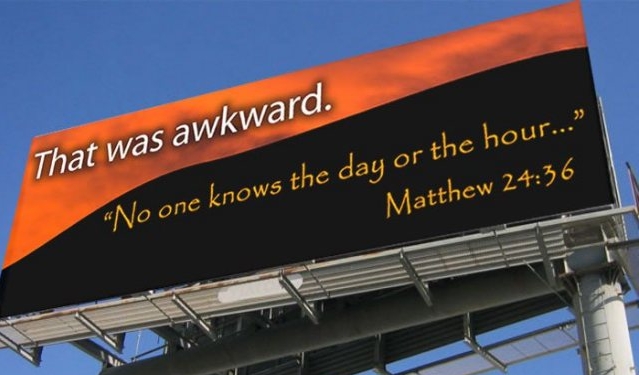
I would like to offer a mild correction to a statement that I heard several well-intentioned believers make in the days leading up to May 21.  It went something like, “Well, we can know for sure that Jesus isn’t coming back on May 21, because He said that no man knows the day or the hour!”  The day of the Lord’s return has been fixed and determined in the mind and in the plan of God (Acts 17:31).  It will happen on that day, regardless of whether or not some spiritual nutcase has made a prediction for that date.  Otherwise, we could forever forestall the return of Christ by having people make predictions for every calendar day in the future.  I don’t believe that is going to change God’s plan! 

Jesus said that no man “knows” the day or the hour of His return (Matthew 24:36, 42).  Guys like Camping don’t “know.”  They guess; they are shooting in the dark.  Jesus went on to say in the same context, “So you also must be ready, because the Son of Man will come at an hour when you do not expect him” (Matthew 24:44).  Most of us weren’t “expecting” Jesus on May 21!  It would have been a perfect day for His return!

Be ready; today and every day.

Oh, the nickname “Happy”?  Just a silly name that popped into my head every time I heard or read about Camping recently.  Very juvenile, I know.  Sorry, I just can’t seem to help it.

Finally, a cartoon for you to enjoy!    

I first read about Roland Ortmayer nearly 22 years ago in a Sports Illustrated feature article by Douglas S. Looney entitled “A Most Unusual Man.”  The article chronicled Ortmayer’s life and coaching career at the University of La Verne.  Incidentally, La Verne competes in the same Division III conference as the California Institute of Technology which I wrote about in the recent post “Bigger Than Basketball.”

Roland Ortmayer (known to all around him as Ort) was the most unconventional football coach I have ever read about.  He coached for 43 years at La Verne, but never won a conference championship outright and never produced a successful pro player.  When Looney interviewed him for the SI article, Ortmayer described himself as “a teacher, a kayaker and a rafter, a fly-fisherman and a mountain climber, not to mention being a husband, father and grandfather.”  Regarding the omission of coaching from his resume, Looney wrote that doing so seemed fitting since calling Ortmayer a football coach would be like “praising Picasso for knowing the primary colors.”  Ort was so much more than a coach.

Ort’s unorthodox approach to coaching included no recruiting, no mandatory practices, no weight training, and no playbook.  Ort washed the team’s towels, socks, and jocks and scrubbed the grass stains out of the practice and game uniforms.  Ort never cussed.  “Oh, crum” was as profane as he ever got.  Ort’s teams won about half the time and lost about half the time, which seemed like a reasonable balance to him.  

Among the quotation gems in Looney’s article are:

“Football to me is like climbing a mountain.  The climbing is where it’s at.  When you finally reach the top of the mountain, all it is, is cold and windy.”

“Okay, we scheduled the game, so let’s play it.” (His pre-game motivational speech)

“I think there is something wrong with a player if he practices every day.  Some days your car won’t run or your girlfriend requires more attention than football.  Maybe it’s just a nice day to go to the beach.  Heck, I’ve missed practices, like when I wanted to visit my daughter.  They practice better without me, anyway.”

“Some people say we don’t take winning seriously enough, so a lot of high school coaches don’t want their players to come here.  But I noticed that fathers want their sons to come.”

Those who played football for Ort praised him for the difference that he made in their lives and the “larger than football” lessons that he imparted to them. 

Roland Ortmayer passed away on October 9, 2008 at the age of 91.     

You can read Looney’s archived article at SI Vault.  Reading it can still bring a smile to my face and a tear to my eye. 

Angel food! 

That’s how Psalm 78 describes the manna that the Israelites ate in the wilderness.

“He rained down manna upon them to eat, and gave them food from heaven.  Man did eat the bread of angels…” (Psalm 78:24-25).  The text is not intended to suggest that angels (spirit beings) are dependent upon physical food for their survival, but merely serves as an additional reminder that Israel’s daily sustenance was graciously granted by the God of Heaven.

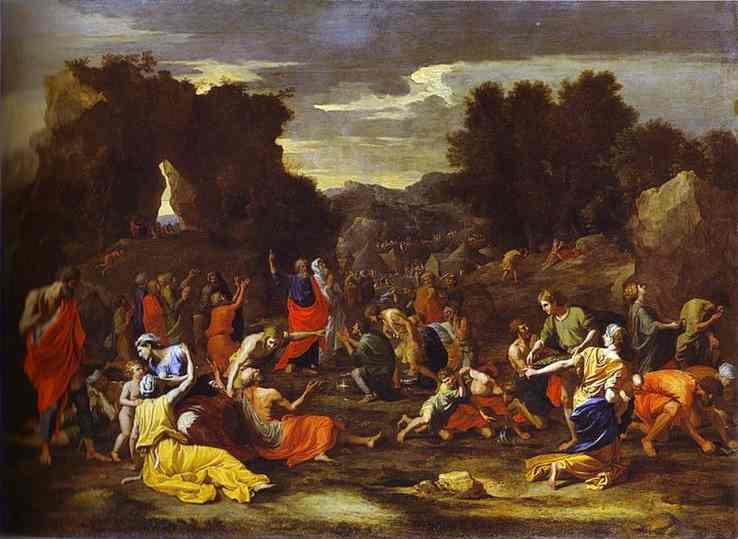
For reasons that I can’t remember now, I found myself reading the Biblical texts about manna last week (primarily Exodus 16 & Numbers 11), and I was re-impressed with several concepts and truths.  When Jesus spoke of “daily bread” while teaching His disciples how to pray, he used a phrase that was rich with meaning and one that would have immediately reminded His Jewish audience of the manna which the Lord provided for 40 years in the wilderness.  40 years!  From 1971 to 2011.  From the time I was 8 years old to my current age of 48.  That’s a lot of bread from heaven!

Fine and flake-like, the manna fell with the dew six mornings a week, Sunday through Friday.  “Gather a day’s portion every day.”  The precise amount gathered per person was to be an omer, a measurement equivalent to about two quarts.  The temptation to hoard the bread in excessive supplies or gather a week’s worth at a time was thwarted by the fact that it would spoil overnight, becoming foul and full of worms; “maggoty and malodorous” to use K.A. Kitchen’s vivid vocabulary.  The manna was a lesson in daily dependence upon God.  The way the Lord provided it also encouraged personal responsibility and industriousness.  If you slept in, you were out of luck.  The manna on the ground melted as the sun grew hot each day.    

The only exception to the “morning by morning” provision was on the Sabbath.  On Friday morning, the “harvest” was to be two omers per person to provide enough for that day and the next.  No manna would fall on the Sabbath.  Even God didn’t make bread on the Sabbath!  The manna gathered on Friday would stay “fresh” through Saturday.       

You could pound it or grind it into meal, bake it, or boil it.  Manna tasted like wafers with honey or cakes baked with oil.  God provided it for 40 years, until the day after the Israelites first ate some of the produce of the land of Canaan (Exodus 16:35; Joshua 5:11-12); a reminder that God will not do for us what we can easily do for ourselves.  The Lord allowed a jar a manna to be preserved and unspoiled as a perpetual reminder of His faithful love and care for His people (Exodus 16:32-34; Hebrews 9:4).   

As good as the manna was, it only fed the body and not the soul, and those who ate the manna eventually died. 

Jesus, however, came down from heaven as the Living Bread to give spiritual life to the world (John 6:32-58).  

“I am the bread of life.  Your fathers ate the manna in the wilderness, and they died.  This is the bread which comes down out of heaven, so that one may eat of it and not die.  I am the living bread that came down out of heaven; if anyone eats of this bread, he will live forever; and the bread also which I will give for the life of the world is my flesh” (John 6:48-51).

Enter your email address to subscribe to this blog and receive notifications of new posts by email.

Join 175 other subscribers

Archives

February 2026
S M T W T F S
1234567
891011121314
15161718192021
22232425262728