In a village on the borderland between Galilee and Samaria, Jesus encountered ten leprous men while on His journey to Jerusalem to face betrayal, trial, torture, and death (Luke 17:11-19).  The men raised their voices to Jesus from a distance, observing the social isolation and separation that their leprosy demanded, crying out, “Jesus, Master, have mercy on us.”  Despite the nearness of His own suffering, which could have easily (and understandably) consumed all of His focus and concern, Jesus was moved with compassion and directed the men to go and show themselves to the priests.  According to the ritual requirements of the Law, a leper could be declared clean and free from the disease only after examination by a priest and the offering of sacrifices (Leviticus 14:1-32).

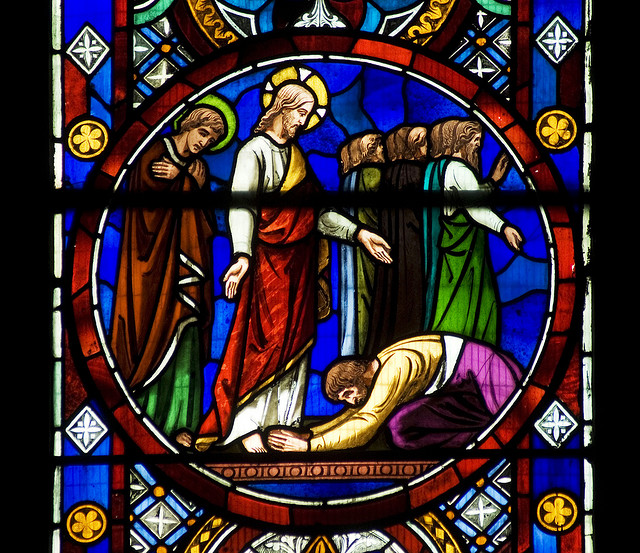
All ten of the lepers demonstrated great faith by following Jesus’ instructions, especially since their leprosy was still upon them as they began their journey.  Somewhere along the way, their disease was taken away by the power, grace, and mercy of the Lord.  One of the ten, only one, a Samaritan, turned back to find Jesus.  He glorified God with a loud voice, fell at Jesus’ feet, and gave thanks to Him for the gift of restored health.

We often use this story (and rightfully so) to illustrate our need to offer thanksgiving and praise to God and to caution against having a heart of ingratitude.  However, it is interesting to note that the other nine men still enjoyed the blessing of healing, despite their failure to return and thank the Lord.  The attitude of Jesus wasn’t, “I’ll heal you only if you promise to be grateful.”  He healed them because of who He was; loving, compassionate, and merciful.

Jesus instructs us to be merciful in the same way that our heavenly Father is merciful, loving our enemies and doing good, expecting nothing in return (even gratitude); “for He Himself is kind to ungrateful and evil men” (Luke 6:35-36).  “God causes His sun to rise on the evil and the good, and sends rain on the righteous and the unrighteous” (Matthew 5:45).  There are multitudes who enjoy the warmth of the sun and the sweetness of the rain who never acknowledge the divine Giver of those blessings; some of the them even overtly deny His existence.  Still, He blesses.

Acts of kindness to others are self-authenticating.  They need no justification.  They do not require anyone’s permission.  They are not dependent on the gratitude, or lack thereof, possessed by the recipients of the kindness. 

We do good for the sake of doing good and for the sake of the Savior in whose steps we follow.


(I shared the following thoughts before Communion in our worship assembly this morning.)

September 11, 2001, is a date that cannot be forgotten.  It was a tragically defining moment for our nation, and, in many ways, for the entire world.  Things have never been the same since.  Today, 10 years later, if you are traveling by air, the gauntlet of security that you have to pass through is directly related to that day.  Today, if you have a loved one serving in the military in Afghanistan or Iraq, they are on that foreign soil as a direct result of the events of that day.  The visual images and the emotional impact of what happened on 9/11 have been permanently etched into our consciousness.

It was a day of violence and bloodshed; an outbreak of evil resulting in untold suffering by the innocent; a day that caused people to ask questions like, “How could this be permitted by an all-powerful, all-loving God?” and “What good can ever come out of such a tragedy?”  But, it was also a day that unified our nation and galvanized our resolve.  Regardless of our various personal backgrounds, ethnicities, accents, and political ideologies, we were Americans, and we stood together that day. 

It is hard to imagine the impact of 9/11 diminishing with time, but it inevitably will; not to ever be entirely forgotten, but, in future decades, it will become increasingly more historical and cerebral in nature, and less personal and emotional, just as has been the case with December 7, 1941 (70 years ago; a defining event for my grandparents’ generation) and November 22, 1963 (a turning point for my parents’ generation).  To some of you, those dates are extremely meaningful and deeply personal, because you lived through those events.  To those of us who are younger, they are certainly identifiable and notable dates, but framed within the context of a distant, historical past. 

Not ten years ago, but about 1,980 years ago, there was another day of violence and bloodshed; an outbreak of evil that resulted in untold suffering by the truly Innocent One; a day that caused people, especially the closest followers of Jesus, to question, “How could this be permitted by an all-powerful and all-loving God?”  “What good can ever come out of this tragedy?”

But, the passing of nearly 2,000 years has not diminished the memory of that day in the least.  On the contrary, the number of those who memorialize the death that took place at Golgotha has never decreased, but has multiplied exponentially with every passing year.  The passage of two millennia has not caused the death of Jesus Christ for the sins of the world to pass into obscurity, but has only resulted in increased reflection, meditation, understanding, and clarity through the centuries; an event that is relived, reenacted, and celebrated every single Lord’s Day in the breaking of the bread and the drinking of the wine.

This is a memorial meal that unifies us, regardless of our personal backgrounds, ethnicities, accents, and political ideologies.  We are Christians.  The blood that flowed from Jesus that day, the sacrifice that cleanses us from all sin, has made us one.

This we do today, because we remember.  This we do today, because the world has never been the same.

Today I will enter a classroom as a student for the first time in 11 years.  It was the fall of 2000 when I completed the coursework for an M.A. in Biblical Studies at Lipscomb University.  That was the year in which current college freshmen were entering the second grade!  Yes, it’s been a while!  It has been even longer, 26 years to be exact, since I completed my bachelor’s degree.  No one can accuse me of rushing my higher education.

Whether or not my new studies in the Graduate School of Theology at Oklahoma Christian University will ultimately result in an additional degree is immaterial to me at this point.  I just feel a strong need to be back in the classroom.  There is so much that I need to learn and so much that I want to learn.  I want to keep my study skills freshly honed.  I want to keep my critical thinking abilities challenged and refined.  I am confident that the faculty and the curriculum in the Masters of Divinity program at OC will provide just that. 

If the Lord doesn’t return first, and if I continue to be blessed with health and strength, I feel like I can continue serving in ministry for another 30 years.  But, I don’t believe that I can do this effectively without additional study and training.  I don’t want to coast.  I don’t want to rust.  I want to finish strong.  Going back to school is a means by which I can “retool” for the second half of my life in ministry. 

I will only be taking 6 credit hours per semester.  That is about the maximum load that I can manage with all of my local ministry responsibilities and the time that I need to devote to my family.  I am very grateful to Kim for her encouragement in this endeavor.  I also greatly appreciate the support of my shepherds at the Broken Arrow church in encouraging me to continue my education.

Leon Burton, a dear brother in Christ and an elder at the Honolulu church where we served in the late 1980s, challenged me to complete a Ph.D. by the time I was 33 years old.  I’m sorry, Leon, but I appear to running a little behind schedule.  But, who knows?  It may still happen.  However, at my current rate of completion, the degree may have to be conferred in a special ceremony at my assisted living facility. 

Jack Wilhelm, a preacher I knew back in Alabama, completed a Ph.D. at Auburn University when he was well into the second half of his life in ministry.  When questioned by some skeptics as to why he would put so much time and effort into earning such a degree at his age, Jack replied, “I just thought it would look good on my obituary.”  I’m with you, Jack!  It certainly adds new meaning to the phrase “terminal degree.” 

The first day of school.  It’s still pretty exciting, even when you are 48!                

One night last week, I went to bed in the wee hours of the morning, long after Kim, Hannah, and Coleman had retired for the evening.  Since the three of them were sound asleep in the master bedroom (not an unusual arrangement in our family) I claimed the next available space upstairs and crashed in Hannah’s room.

Just as I was about to be transported to the land of Nod, a short, distinct burst of sound caused me to bolt upright in the bed, eyes wide open.  A raccoon!  Even though it sounded like it was right there in the room, I reasoned that it had to be in the attic just above my head.  I sat still, waiting to hear it again, but there was only silence.  After a few moments, I got up and went to the computer and Googled “raccoon sounds” just to confirm my diagnosis.  It was spot on!

It is not unusual for us to see raccoons around our house and elsewhere in our neighborhood at night.  They had nearly chewed through the “twist-lock” lids on our plastic garbage cans which we purchased after they consistently dumped and scattered the contents of the old ones.  They ripped into bags of bird seed on the patio.  As a result, I purchased a plastic container for the seed.  The raccoons quickly mastered dragging it around the yard until the top popped open.

But, raccoons in the attic took the issue to another level.  They had encroached upon the sanctity of my domicile.  This was personal!

Armed with a flashlight, I slowly opened the attic storage space door in Hannah’s room and cautiously walked inside.  I had witnessed a raccoon viciously fight with coon dogs on a hunt with my grandfather, and I had no desire to tangle with one in close quarters.  But, I saw nothing.  I heard nothing.  I moved boxes and bags, looked in crevices between joists, and… nothing!  No chewed up cardboard, no shredded insulation, no droppings, no raccoon.

I convinced myself that somehow I must have imagined the sound as I was drifting off to sleep.  What kind of weird, semi-conscious delusion was that?  Anyway, I turned off the light, crawled back into bed, pulled up the cover, closed my eyes, and THERE IT WAS AGAIN!  This was nuts!  It seriously sounded like it was in the room with me.  Hannah had been going through things in the attic earlier that day getting ready to leave for college, and I remembered her commenting at one point that she thought she had shut the attic door but later found it open.  Great!  I looked under the bed, looked in boxes in her room, and looked in her closet.  Nothing!

Maybe the sound wasn’t coming from inside the house.  I took the flashlight into the front yard and looked in the tree outside Hannah’s room.  I walked all the way around the house.  I spotlighted as much of the roof as I could from the ground.  It was 3:00 a.m.  I expected a neighbor to call the police.  I rechecked the attic (with no success) before deciding to crash on the couch downstairs in the living room.  I had to get some sleep.

The next night, I got Kim and Hannah to sit with me in the dark on Hannah’s bed so that they could hear the critter for themselves.  We waited a good 15 minutes and heard nothing.  They got bored and left.  Only moments after they walked out of the room, I heard it again.  I now knew that I was going to have to call a professional, either an exterminator or a psychiatrist. 

The following day was extremely hectic, and I didn’t have a chance to place a call to The Skunk Whisperer.  (Seriously!  Follow the link to his website.)  I was very tired that evening from lost sleep.  Kim and Hannah were diligently working in Hannah’s room getting college stuff ready, so I went to bed early in Coleman’s room.  At least it was at the other end of the hall from my taunting, haunting menace.  I couldn’t believe it.  I heard the disturbing sound three times during the night, but I was too exhausted to even get out of bed and went back to sleep each time, determined to call in the professionals the next day. 

Morning not only brought the light of day; it also delivered embarrassing illumination as to the identity of my raccoon.  The previous night after I had gone to bed, the girls heard the sound while working in Hannah’s room.  Though initially startled, they quickly determined the source of the noise.  It was…

An Air Wick Freshmatic!  

That’s right!  It was an automated air freshener dispenser!  No one told me that Hannah had one.  No one had ever demonstrated what they sounded like when the aerosol canister was completely empty.

So, why did I hear the sound three times in Coleman’s room that night?  Kim and Hannah were so amused by their discovery after I went to bed that they placed the Freshmatic on the floor right outside Coleman’s door, expecting me to excitedly burst out of the room with another news flash as soon as I heard it again.  Such sweet girls!  They didn’t factor in my exhaustion, so the revelation had to wait until the next morning.

So, no raccoon, no Skunk Whisperer, no attic repairs, and no psychiatric evaluation. 

Just another humbling experience, life lesson, and reminder.  I can be so confident (so very, very confident) about what I thought I heard; and I can be so very, very wrong!          

I’m sure that all of you have favorite foods, dishes that you find extremely pleasing and satisfying to your taste buds and that you try to enjoy whenever the opportunity and proper nutrition permit your indulgence.  Some of these foods may be tied to certain seasons of the year, holidays like Thanksgiving and Christmas, or even some other part of the country where you periodically visit.  Maybe you are among those people who can say, “When we are in ________, we always eat at ________.”

On our recent vacation to the Florida Panhandle, I got to indulge in some regional favorites.  We stopped at a roadside fruit and vegetable stand while driving through L.A. (that’s Lower Alabama) and bought some Chilton County peaches and some hot, boiled peanuts right out of the kettle.  Yes, the latter is definitely an acquired taste, but one that I developed a long time ago.  During our stay at Navarre Beach, I drove into Destin one day to buy a few pounds of fresh, Gulf shrimp which we boiled in the condo with some Zatarain’s spices.  Though we generally eat “on the run” on long drives, we took the time for a “sit down meal” on the trip back to Oklahoma, and I got a good country dinner of pinto beans, fried okra, mashed potatoes with gravy, turnip greens, and cornbread.

But the most important and significant meal that I had while we were away consisted of rather simple fare: unleavened bread and grape juice.  It wasn’t a meal that was intended to fill the stomach or overwhelm one’s sense of taste with an explosion of exotic flavors.  It was an ironically simple and austere meal, considering the magnitude of what it represented and memorialized. 

Jesus infused the traditional bread of the Passover with fuller, richer, and more eternal meaning.  To Christians who celebrate the Lord’s Supper, it represents the physical body of God in the flesh: beaten, bruised, spat upon, cut, crucified, and pierced for our transgressions; the Innocent One suffering on behalf of all of us guilty ones. 

The fruit of the vine is emblematic of the precious blood of Jesus, the spotless Lamb of God, our Passover sacrifice; the blood of the Savior which has the power to wash away our sins.

I shared this meal with loved ones nearby and with countless, distant brothers and sisters around the world. 

It is my favorite meal.

Another insight and challenge gained from my recent reading of Mark Buchanan’s book, The Rest of God: Restoring Your Soul by Restoring Sabbath, is our need for quietness and listening. 

A few weeks ago, just after reading Buchanan’s chapter on the subject, I made a quick trip to QuikTrip (pun intended) for an edible pick-me-up to get me through the rest of the afternoon at the office.  As I exited the crowded convenience store and walked back to my car, I decided to focus on what I could hear rather than on what I could see (mostly people, cars, gas pumps, etc.) and feel (mostly the 110 degree outside air).  I paused for a moment, closed my eyes, and was immediately overwhelmed by two dominant sounds that I had not even consciously noticed to that point. 

Diesel and cicadas.

Around the corner of the store, well beyond my field of vision, there was an idling 18-wheeler.  The distinctive “rattle and rumble” of the diesel engine seemed to be amplified by echoing off of surrounding structures.  And, despite the volume of the engine noise, I could still clearly hear the higher-pitched, raspy chorus of numerous cicadas that populated nearby trees and shrubs.

Diesel and cicadas.

On the drive back to the office, and for the next several minutes after my arrival, I reflected on memories associated with these sounds over the course of the nearly five decades of my life.  

Cicadas are the sound of summer.  While I was introduced to the sound of cicadas in the tree-filled suburbs where I grew up, it was during summertime visits to my grandparents’ farms in Tennessee and Georgia that the sound was cranked up by dozens of decibels to an ear-piercing crescendo.  Their discarded shells could be comically clipped to your ear, clamped onto the end of your nose, or used to startle your unsuspecting sister.  As my senior year at Lipscomb University was coming to a close in 1985, the city of Nashville was invaded by a horde of millions of the 13-year cicadas known as Brood XIX, or The Great Southern Brood.  The sound was incredible in the massive, old-growth trees on campus.  Cicadas were flying everywhere, easily getting entangled in the locks of young ladies who sported the “big hair” of that era.  You can imagine the sights and sounds of their reactions.  Guys from the dorm made a sport of seeing how many of the flying insects they could swat and snare with the strings of their tennis rackets.  Right on schedule, Brood XIX showed up throughout the South in 1998 and again this year; an odd, amazing, and predictable life cycle within God’s creation.          

The sound of the diesel engine at QuikTrip reminded me of my grandfathers’ tractors, which I got to drive long before I was allowed to get behind the wheel of a car.  It reminded me of the big rigs parked and idling at truck stops and rest areas on those long summer trips to visit family and friends.  It reminded me of the diesel van in Australia that a few friends and I travelled in from Queensland on a marathon trip to the Sydney area for a youth encampment in 1987.

Not a big deal?  Maybe.  But I got to relive some wonderful, joyful memories simply because I took a brief moment to listen.

Maybe it’s the kind of thing that the apostles did every time they heard the sound of a strong wind, and they remembered the events of the Feast of Pentecost following the crucifixion, resurrection, and ascension of Jesus, when the promised Holy Spirit filled and empowered them.  I can’t imagine that the sound could have ever been separated from their memories of that experience.  Perhaps the aged apostle John remembered the voice of the glorified Son of Man every time he heard the crashing of the waves on the island of Patmos.

Silence and listening allow us to learn and remember.  They provide opportunities to perceive and reflect upon God’s will in our immediate circumstances.  Listening lets us pick up on nuances of emotion, anxiety, and discouragement in the voices of our spouses, children, and brothers and sisters in Christ, permitting us to go deeper than merely hearing their words.

Take some time today to listen, really listen.     

Listen!

Man has a need for sabbath.  I’m not talking about the legalistic binding and observance of the 4th Commandment of the Decalogue found in Exodus 20 and Deuteronomy 5.  I’m talking about the concept of sabbath (ceasing, stopping, resting) that predates, underlies, and supersedes the ritual regulations regarding the seventh day which were revealed to Israel through Moses at Sinai.  We need to observe sabbath in the sense of regularly and consistently fulfilling our recurring need for physical rest, mental and emotional refreshment, and spiritual renewal. 

When do we stop?  When do we listen?  When do we observe silence?  When do we commune with the Lord?  We do we meditate (think long and deep) on the Word of God?  When are we introspective, reflecting on our walk with Christ and assessing our spiritual health?  II Corinthians 13:5 urges us to “test” ourselves to see if we are in the faith.  When do we have time for that kind of test?  When can we sit for that kind of examination?  When do we pray longer than in cryptic tweets to the Lord?   When do we fast?  When do we demonstrate that we are masters of our schedule rather than slaves of the calendar and the clock?

As justification for our non-stop, “no breaks” manner of life, we often seek solace in the fact that every available time slot has been overly filled with good things, necessary things, and useful things.  But, we, like Martha of Bethany (Luke 10:38-42), can become so busy doing things for Jesus that we have no time to spend with Jesus. 

Unless we observe sabbath with regularity, we are headed for emptiness and exhaustion (physically, mentally, and emotionally).  It took a hospitalization and some serious counseling three years ago for me to begin acknowledging and responding to this truth.  Without regular refreshment and renewal we will be left with hollow forms of ritual rather than joyful acts of service.  Our hearts will grow calloused and cold from having had no time for an intimate, personal relationship with the Savior.

One of the beauties of a sabbath that is not tied to a particular day or rigidly attached to an unalterable time is that we can seize opportunities for refreshment whenever they arise; we can find God in the interruptions of life rather than being frustrated by them.

Last Sunday, as I was preparing to make an emergency 10-hour drive to Alabama to spend a couple of days with my Dad, I was tempted to become frustrated with the unexpected alterations to my plans and schedule for the week.  Instead, because of recently being challenged by reading Mark Buchanan’s book, The Rest of God, I decided to use the drive time as an opportunity for sabbath.  I didn’t turn on the radio.  I didn’t listen to any CDs.  God provided the beautiful gift of 10 uninterrupted hours to think, reflect, pray, confess, thank, observe silence, recite Scripture, and dream about the future.  Time was no longer a factor.  I wasn’t focused on setting a new land speed record on the trip.  I was calm and relaxed.  Even though it was 11:00 p.m. when I arrived at Dad’s house, I felt amazingly fresh at the end of the journey.

“Come to Me, all who are weary and heavy-laden, and I will give you rest,” (Matthew 11:28).  Jesus extends that gracious invitation not just to those burdened and enslaved by sin, but also to a multitude of over-committed, stressed out, activity-weary church folks.

We would be wise to take the Savior up on His offer.

I experienced a reaffirming lesson in positive family dynamics last Sunday…

As church services were about to begin on Sunday morning, my wife Kim received a text message from my sister indicating that my father had fallen at his home in Cullman, Alabama, and had been transported to the hospital with a mild concussion.  Subsequent messages provided further details, and on our drive home from the worship assembly I decided that I needed to travel to Alabama that afternoon.  I knew that if I hit the road by 1:00 I could arrive in Cullman by 11:00, so Kim quickly fixed me a sandwich while I threw a few “necessaries” into a suitcase.

The only hitch was deciding which vehicle to take.  I just assumed that I would drive my car.  It happens to be without air conditioning right now, but I figured that having the windows down while going 70 mph would more than compensate for the 105 degree afternoon temperature.  That’s when our daughter Hannah said, “Dad, please take my car!”  I objected because I knew she was about to leave for Oklahoma City, and I didn’t want her baking in the stifling heat.  “I’ll drive Mom’s car,” she answered.  “But it’s got a headlight out,” I insisted.  (We had just discovered the headlight problem when we pulled into the garage on Saturday).  “No problem,” she said, “I’ll be back long before dark!”  “But you’ll have to drive my car until at least Wednesday,” I responded.  In a mostly reassuring tone, mixed with a hint of exasperation, Hannah said, “Dad, I’m all grown up; I can sweat!”

Problem solved!  I had a safe, uneventful, climate controlled drive to Alabama and was grateful for it!

I sometimes have a tendency to see problems rather than focus on solutions.  It brought me such a reassuring sense of love, support, and connectedness to have Kim and Hannah step up and find a solution that worked for everyone (save some additional perspiration for Hannah) when I simply couldn’t see it.  We pooled our resources and made some adjustments.  That’s what families do!

That’s what spiritual families do, too!

Just like the Jerusalem church (Acts 2, 4, 6) which generously utilized its collective blessings for the meeting of the needs of everyone, local church families are places where challenges can be met and problems can be solved through the mutual sharing of gifts and resources.  Need to sell a tract of land to meet some needs?  Consider it done!  Widows need to be fed?  We’re on it! 

Just two weeks ago, Mike & Karen Baskett, who work with our youth at the Broken Arrow church, insisted that I drive one of their vehicles while they were out-of-town at a camp in New Mexico.  “It’s just going to sit there while we’re gone,” they said.  “Use it!  Enjoy the cold air!”  What a blessing!

Steve Worley, a dear friend and missionary to Nigeria, has no qualms whatsoever about visiting churches when he is in the States and requesting things that are needed for the Lord’s work.  When we served together in Florence, Alabama, if Steve needed a video projector for a presentation or another van for a domestic mission trip, he would simply go to another congregation and say, “You have it and aren’t using it.  I need it.  I’ll bring it back.  If I break it, I’ll fix it.  It all belongs to the Lord anyway.  When can I pick up the keys?”  That’s how it works in families.         

By the way, Dad is much improved and is at home.  It has been a blessing to spend a couple of days with him, despite the emergency circumstances that brought me here unexpectedly.  Kim got the headlight repaired on Tuesday.  All is well! 

I’m hitting the road at dark-thirty today and am hoping to arrive in Tulsa by mid-afternoon so I can shift gears, freshen up, and make it to a speaking appointment in Stillwater tonight.  God is good!

The name of D.T. Miles is probably as unfamiliar to you as it was to me prior to last week.  Ms. Miles is credited with originating the concept of Vacation Bible School in Hopedale, Illinois, in 1894.  Miles, who was both a Sunday School teacher and a public school teacher, started a daily Bible school for children during the summer months.  Her first effort in 1894 lasted four weeks, and classes were held at a nearby school.  An “Everyday Bible School” was organized four years later at New York City’s Epiphany Baptist Church by Eliza Hawes.  The “EBS” was primarily developed for underprivileged children and was conducted at a rented beer parlor.  In 1922, Dr. Robert Boville of the Baptist Mission Society founded the World Association of Daily Vacation Bible School.  In 1923, Standard Publishing began printing VBS curricula, with enough lessons for five weeks and written on three different age levels: kindergarten, primary, and junior.

Those first efforts, dating back 117 years, have resulted in a ministry approach utilized by churches all over the world each year.  Did you notice that the earliest catalysts of the concept in the 1890s were women?  To this day, Vacation Bible Schools could not happen and would not happen if it were not for the dedication, creativity, energy, and talents of godly Christian women who love children and love teaching them about the love of God and the story of Jesus.  Yes, I know that men are frequently involved as well, and for that I am very grateful.  But I guarantee you that VBS would not exist if it were just up to us guys!  Not to mention that the kids would only eat Oreos at snack time rather than delicious home-baked goodies. 

So, thank you, ladies, for the beautiful sets you construct, the creative crafts you develop, the Bible stories you teach, the songs you sing, the patience you demonstrate, the cookies you bake, and the young hearts and lives that you touch with the love of Jesus!

Painting by Yvonne Ayoub

Kim and I continue to enjoy our efforts in micro-gardening with three raised garden beds in our backyard.  We harvested a beautiful crop of Yukon Gold potatoes last month.  We are cutting okra every day now, and the pepper plants have done fairly well.  However, not everything has gone according to our hopes and plans.  The tomatoes have been hit and miss, with some plants bearing quite well, and others being completely barren.  There were blooms aplenty, but comparatively little to show for it.  While the green okra has been very productive, that hasn’t been the case with the red variety.  Same with the cucumbers; a sea of yellow blooms, but very few cukes.  How can you manage not to grow buckets full of cucumbers?  They usually grow like grass, right?  I am continuing to learn that vegetable gardening is not a no-brainer avocation.

Despite my lack of understanding as to why some of the plants have not produced, I have resorted to drastic measures nonetheless.  Those that just won’t bear fruit have been yanked up by the roots and cast aside.  They were just taking up space, pointlessly soaking up water and nutrients from the soil.  There is still enough growing season left to give some new plants a chance.

My foray into gardening has reminded me of a consistent theme that runs through the teaching of John the Baptist, Jesus, and the apostles of the Lord.  A true heart of faith in God is always evidenced by a life of holiness, both in word and deed.  Otherwise, we have quenched and denied the power of the Spirit who lives within us. 

“Therefore, bear fruit in keeping with repentance” (Matthew 3:8). 

“Every tree that does not bear good fruit is cut down and thrown into the fire.  So then, you will know them by their fruits” (Matthew 7:19-20). 

“Either make the tree good and its fruit good, or make the tree bad and its fruit bad; for the tree is known by its fruit” (Matthew 12:33). 

“A man had a fig tree which had been planted in his vineyard; and he came looking for fruit on it and did not find any.  And he said to the vineyard-keeper, ‘Behold for three years I have come looking for fruit on this fig tree without finding any.  Cut it down!  Why does it even use up the ground?’  And he answered and said to him, ‘Let it alone, sir, for this year too, until I dig around it and put in fertilizer; and if it bears fruit next year, fine; but if not, cut it down’” (Luke 13:6-9).

“But the fruit of the Spirit is love, joy, peace, patience, kindness, goodness, faithfulness, gentleness, and self-control” (Galatians 5:22-23). 

“The fruit of the Light consists in all goodness and righteousness and truth” (Ephesians 5:9).

Enter your email address to subscribe to this blog and receive notifications of new posts by email.

Join 175 other subscribers

Archives

February 2026
S M T W T F S
1234567
891011121314
15161718192021
22232425262728